About the author
NCAA
A Primer on Skill Singularity
You’re supposed to hunt for anomalies. It’s an important objective for most predictive contexts, as the “edge” mostly comes from finding outliers before they are adequately priced in.

You’re supposed to hunt for anomalies.
It’s an important objective for most predictive contexts, as the “edge” mostly comes from finding outliers before they are adequately priced in. This concept epitomizes the strength of Draft Twitter: the general NBA industrial complex is more prone to missing on anomalous players that are shaped in unfamiliar ways.
So, this instinct to look for anomalies makes sense.
The problem is in defining and finding signal amongst anomalies. If you get woke enough, pretty much every prospect is an anomaly. This is mostly because we have dozens of publicly available features for any given prospect, and there simply haven’t been enough drafted prospects to match.
When the number of features exceeds the number of observations, you run into what’s known as the p » n problem. In this case, you can almost always find some combination of dimensions where an NBA-caliber prospect looks unique.
bart test
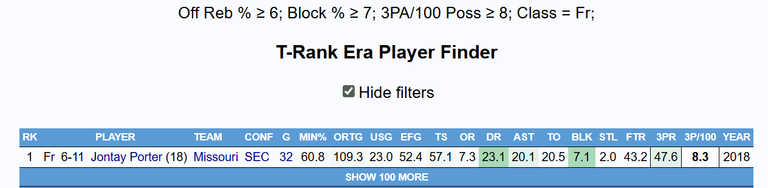
This is why “hunting for outliers” isn’t as easy as it sounds. If most prospects can be somewhat construed as unprecedented if you choose the right columns, then what distinguishes a functional anomaly from a trivial one?
Skill Singularity
This distinction can be understood through the framework of skill singularity. Rather than looking simply for an unseen intersection of traits, skill singularity promotes a single functional skill that is robust, so positionally undeniable that it should near-immediately provide strong returns.
So rather than hunting for any trivial anomaly, we are hunting for an anomaly emblematic of asymmetric dominance.
Let’s demonstrate this with three case studies.
Case Study #1: Zach Edey’s Rebounding
During the 2024 Draft Cycle, I wrote the following about Zach Edey.
And now, we come to Edey’s most projectable skill: offensive rebounding. Edey enters the league as perhaps its best offensive rebounder from Day 1. How many prospects can you say that about anything? He has two of the best offensive rebounding seasons of all time, and need I remind you that he has a 7’10 WS? I hear the term “advantage creation” a lot. I think the discourse around advantage creation is certainly an exodus from its true essence; it’s now applied most commonly to slinky wings with strong movement aesthetic. But in every sense of its literal essence, Edey’s offensive rebounding is the ultimate form of advantage creation. Hell, everything about Edey’s functional strength is a means of advantage creation. Having such a powerful offensive rebounder is also an undeniable way of extending possessions and implicitly leading to more potential advantages. Having the most physically imposing, best offensive rebounder on your team means something, and if Edey is matched against a smaller big, as is common in this era of pace-and-space: it’s over. I know I’m not emphasizing this enough, but being such a force on the boards is a lost art, and it certainly raises Edey’s expected value.
Indeed, I didn’t emphasize it enough, spending just a fraction of the article on Edey’s most overwhelming strength.
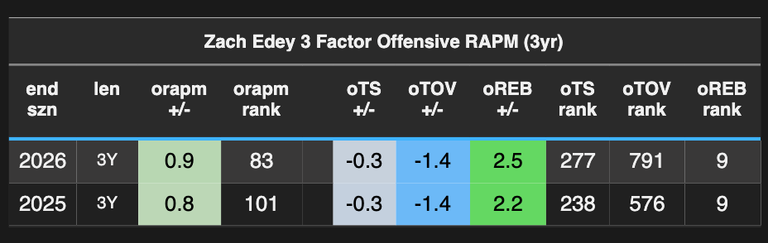
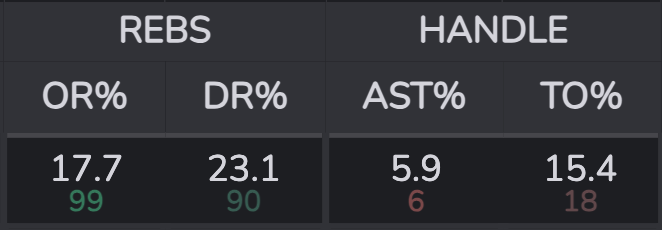
Edey’s primary value add is as a rebounder, as he’s actually been a bit underwhelming otherwise: mediocre oTS impact, and his assist + turnover numbers are much worse than in college. But these weaknesses haven’t been nearly as prohibitive as they would be with other bigs because, by virtue of his completely anomalous size and offensive rebounding rate, Edey’s impact floor is so high.
This is the purest example of an absolute skill singularity.
Case Study #2: Kon Knueppel’s Shooting
This is trickier than rebounding, because shooting projection is inherently more variable.
Free throw percentage is one of the few pre-draft indicators that reliably cuts through that noise.
Not only is FT% a strong indicator of future TS%, but it seems to be aligned with stardom. This makes precocious FT% mastery intuitively important.

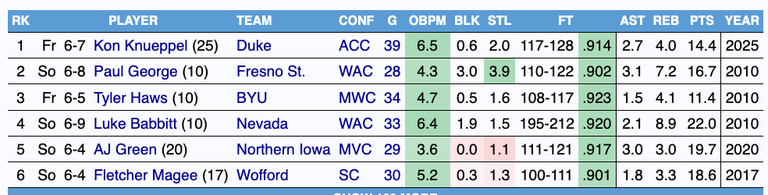
As FT% is harder to replicate in higher leverage, it is especially anomalous that Kon was the only true high major player of this small group.
Fast forward a year, and Kon is closing in the best rookie NBA shooting season ever. In fact, it’s easily one of the best rookie seasons ever. (see: literally any impact metric).
This is in spite of terrible stock production, which was also a concern pre-draft.
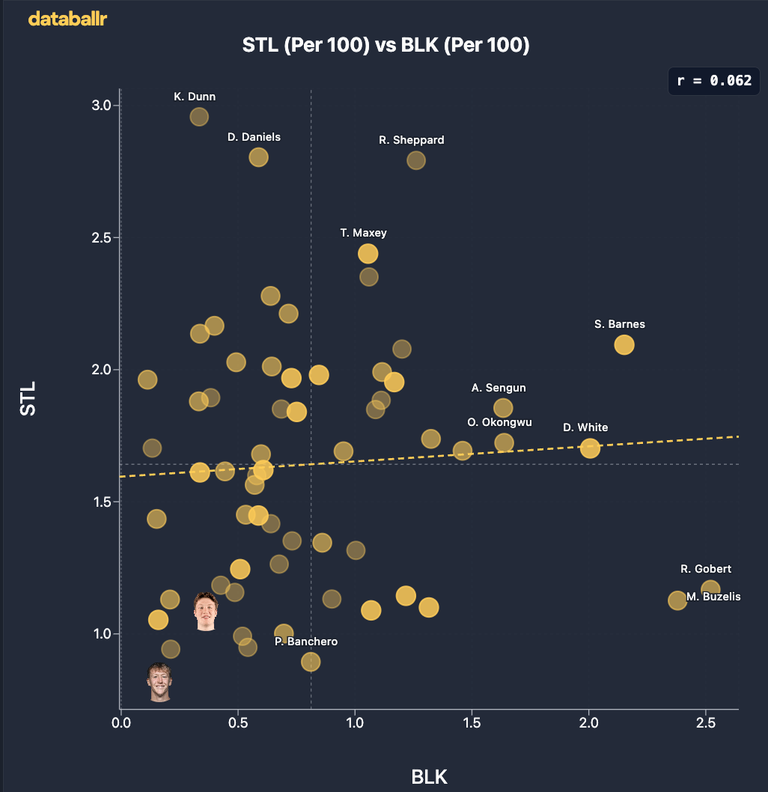
While the downstream effects of Kon’s poor athleticism will be important to monitor, the ball goes in the basket too frequently to truly penalize him for this.
Who needs defense when you’re on pace to be one of the best shooters ever?
Case Study #3: Nikola Jokic’s Cognition
Prior to the NBA, Edey and Kon each possessed an absolute statistical singularity, something outlier for position.
What happens when we try this exercise with teenage Nikola Jokic in his pre-draft year?
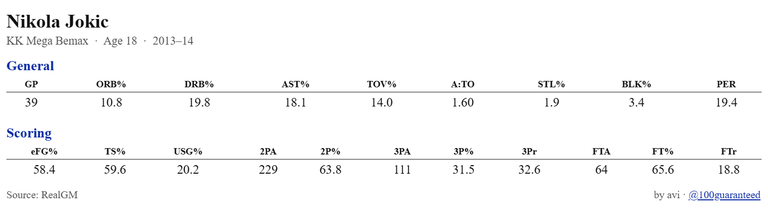
We’ve seen centers put up an 18% assist rate. We’ve seen centers take 111 3PA in a season. We’ve seen centers shoot 64% on 2s. We’ve seen bigs with mediocre stocks, and we’ve seen centers put up an 11% OREB rate and 20% DREB rate.
Jokic’s skill strengths seem great-but-not-anomalous at first glance. Where’s the skill singularity?
Well if we put on our positional goggles, the special pops immediately.
Even back then, Jokic had a high arc on his 3, though his set point looks more shallow. The miss is irrelevant because it sets up that beauty of a pass. The wherewithal to zip the pass along the backline to the recipient’s left hand... unreal anticipation and execution from a true 18 year old center that somehow looks skinny at 250 pound.
6’11, 250 pound players with a 7’3 wingspan simply do not muster a 32 3Pr or pass with a 1.6 A:TO. These are even more impressive relative to era (while his OREB% + 3Pr was rare for the time). Rebounding and elite 2P% provided a perceptible floor, but so did his cognition and skill, which were strongly outlier for position and mass.
Then there’s Jokic’s activity rate:
Especially relative to the player I’ve grown accustomed to watching, Jokic looks so light on his feet. He smothers the shot! then pushes the pace in transition. What a jump pass to freeze the defender and find the open 3.
The functionality of Jokic’s cognition is readily apparent in watching him impact games, but as we noted earlier, he appears to lack a clear stat-singularity. That’s okay, because while the stats narrate the singularity, they aren’t the sole arbitrators of singularity either.
Enter cognition-mass index, as I described in Allen Graves, Twice:
Players with high cognition tend to have low applied mass. Think point guards, with the smallest stature and lowest rebounding/blocks. And players with high applied mass tend to have low cognition. Centers crush physicality proxies like rebounding and blocks, but with the lowest passing or steal rates.This is mostly intuitive. What is more rare are the high cognition, high mass players. I believe that actively seeking out players with an outlier cognition x mass product is the highest EV pathway for effective teambuilding, and it also offers the clearest paradigm for finding undervalued options in prospect evaluation.This is especially important, as these high cognition x mass players may demonstrate unorthodox styles that lead to their being underrated. Think Nikola Jokic, one of the heaviest players in the NBA and one of its best passers ever.Searching for players with outlier combinations of cognition and mass is an easy edge, given their fit in a league where cognitive burden is consistently rising.
Jokic’s skill singularity was his anomalous cognition for size, which actualized his impact. The imprints of his cognition were all over his statistical profile.
This may seem like a stretch to be labeled as a skill singularity, but it’s really not. Try finding positional parallels for 18 year old Jokic’s cognition:


Jokic’s 1.9 A:TO and 1.6% steal rate at age 18 has few parallels. The only pre-2022 hit was Ben Simmons.
Moreover, note how none of these players match Jokic’s positionality (rebounding) or skill (3Pr). Lively and Simmons had the offensive rebounding but not the 3P rate; Khalifa and Avila played mid-major hoops and got up 3s without offensive rebounding. The closest match is Avila, who was a year older, rebounded like a small forward, and played in the MVC.
Jokic was supremely skilled and cognitively advanced for a 6’11 teenager.
Even if we drop the age filter entirely, and expand this out to encompass all of Jokic’s strengths (rebounding+scoring on top of cognition):
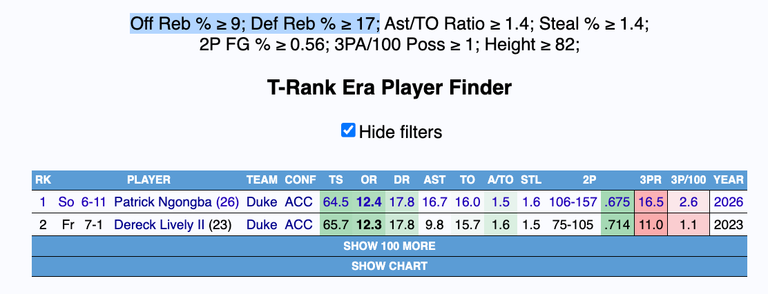
This is still such a neutered version of what 18 year old Jokic offered. And the only prospects even close are Scheyer bigs.
We would have to reduce the height to 6’9 to finally get some matches:
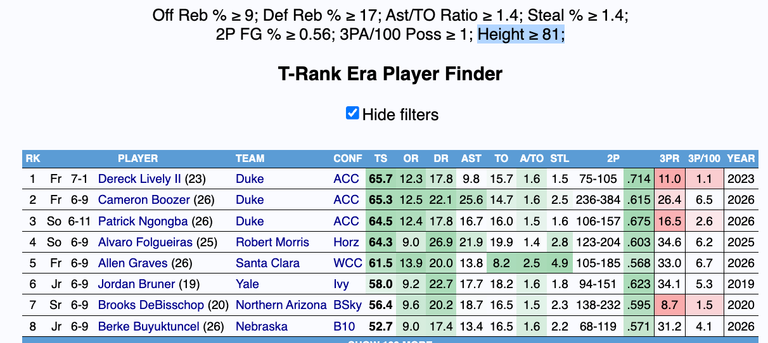
Every season can be categorized as “last 2 years”, low-major hoops, and/or Scheyer bigs. That Jokic was doing this in Liga ABA as an 18 year old in 2014 is unfathomable.
The craziest part is that we’re using Jokic’s “freshman” age stats and comparing it to all ages of NCAA. His sophomore age stats were way better: 26% DREB, 20% AST, 2.5% STL, and a monstrous 25 PER. This was the surest indication of his MVP upside.

Yes, Jokic’s skill singularity was not as glaring as Edey or Kon’s. As opposed to an absolute singularity (i.e. a single, overwhelming statistic), Jokic’s cognition at mass is more of a contextual singularity. His cognition is context-dependent, as it is actualized by his mass. It’s the intersection, rather than a single value, that establishes the anomaly quality. Still, even at Kon-size, Jokic’s cognitive edge would hardly resemble asymmetric dominance.
The obvious disclaimer is that contextual singularities can get tricky. We need to make sure we’re still distinguishing trivial anomalies from functional anomalies. Novelty is compelling, but we’re more interested in the value proposition of the skill singularity.
A value proposition as in, possibly the best big man passer ever with elite age-adjusted production.
How is skill singularity distinct from the meta?
Now that we’ve gone over the framework of skill singularity, how does it compare to the draft evaluation meta?
The meta goes something like this:
- Stars are evaluated by “template scouting”Offensive stardom (i.e. the projection of high usage) is dependent on pattern-matching with stars we’ve seen. “Comps” are especially important for players with this level of projection. Coupled with volume scoring, athleticism and strong movement aesthetic are the most popular prognostics of upside. Example: for guards with “primary equity”, traits such as burst, verticality, paint touch generation, and pull-up shooting would be prioritized.
- Role players are evaluated by “well-roundedness”Role players are defined by frictionless terms, like “seamless fit” and “swiss-army knives”. Their goodness depends on maintain lower lineup friction and fitting into common niches.Example: for guards not projected to have “primary equity”, traits such as size, defensive goodness, and playmaking would be more heavily emphasized. Well-roundedness is more critical.
The meta-process has some merits because it often works. But it mechanistically runs into problems when a player isn’t shaped like anyone familiar AND lacks true well-roundedness. Since they’re not shaped like any familiar primary, they can’t be a primary. And they don’t seem well-rounded enough to be low friction role players: concerns about limited versatility on offense and/or defense dominate discourse.
That’s what happened with each of the aforementioned players, and it’s why a framework akin to skill singularity has real utility.
This approach of hunting for asymmetric dominance is decidedly not based on the meta’s emphasis on templates or versatility. That’s not to say well-roundedness is a bad thing; in fact, negative skill singularities (ie fatal flaws) can completely tank otherwise pristine profiles. But skill singularity is categorically different than versatility because the strength is immutable rather than just useful.
In future iterations of this series, I’ll explore specific skill singularities amongst 2026 NBA Draft prospects.

Comments