About the author
Nile
The Thrill Of Competition. Basketball Team Building and Rotations. nilehoops@gmail.com. Scouting/Analytics @CapitanesCDMX
The 2005 basketball player pool has yet to find a clear-cut top prospect. Can the depth of the NBA, NCAA, and international classes make up for the lack of a Wemby-level talent?
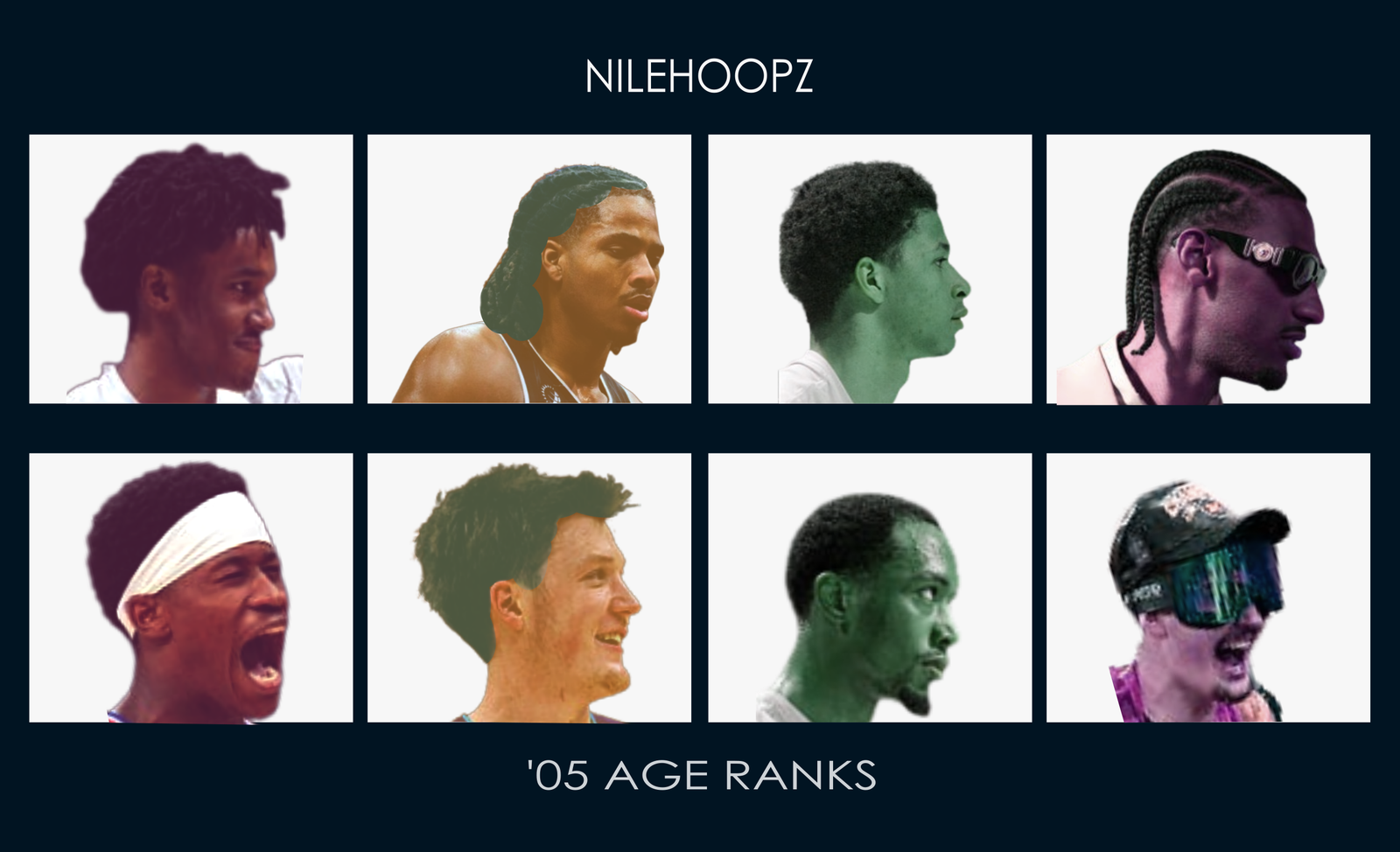
Age rankings are the new trend that are going to take over basketball evaluations, says the only person currently doing full write-ups on the matter. There's no better intro to the concept than the one I've already written for my Franz Wagner-led 2001 rankings, found here.
Every player in the 2026 draft will have their evaluations in these rankings, instead of draft notes (if I'm denouncing the draft as the way to delineate basketball talent, why would I still bend the knee and rank players amongst their draft peers? I have a backbone.)
From there, I'll be using prior tweets, released and unreleased notes from other projects, and peer articles/thoughts to highlight a handful of notable players in the 104-player rankings. Any unlisted player could be considered tier 8, and that would roughly equate to a projected sub-G League peak.
Having the three top players in a class be prospects that I wasn't particularly high on is a symptom of using tiered rankings to exaggerate the talent gaps between players, as well as a possible benefit of the draft being the default player ranking stage (as draft classes usually contain players across ~seven-year bands). Nearly all of their draft notes still apply, but their NBA contexts are worth considering in their long-term projection, both in how they're benefiting and how they may be held back.
1. Collin Murray-Boyles
Murray-Boyles stands in such an interesting position in the basketball talent ecosystem.
The advancement of all-in-one metrics has made it possible for lower-usage 'role players' to be more impactful than their higher-usage peers and to be acknowledged as such. This phenomenon has always existed, and it is one of the factors that support confidence in the CMB's long-term outlook. Next to other Tier 1 players, his pending ancillary greatness should be pronounced. Next to three of them, all of whom share TwinTheory similarities that will foster an alchemical level of group processing and apprehension?
at this point, it's an unmistakable team build strategy by the raptors. https://t.co/sWDVbIlO9h pic.twitter.com/SBP5hyzCMf
— avi (@100guaranteed) July 3, 2026
No limits.
Aside from an alarmingly assisted, low-usage scoring diet in his initial NBA campaign, which can be forgiven given his high-usage, heavy isolation/post-up portfolio at South Carolina, his offensive outlook is infallible, after putting together one of the best 2PT scoring seasons at his age in NBA history with elite OREB and above-average positional playmaking (4 potential assists/minute ranked in the 98th %ile leaguewide, higher than Jokic). Even his lackluster shooting profile will surely be remedied with time via OAS development, of which he's one of the heaviest examples on record. My biggest fear for conventional high-usage star outcomes would be the lack of live-dribble initiation from behind the arc. Zero unassisted threes across the last three seasons, and playing under a high-assist, low-isolation frequency coach like Darko Rajaković indicates there won't be a CMB 'showcase' any time soon, capping his ability to influence oTS and making his TOV issues that much more problematic on lower usage. If ever presented with higher usage sans a shot diet update (unlikely), Murray-Boyles could fall into the Sengun trap: a positionally small, fully inside-the-arc turnover machine with iffy shooting indicators can be nullified in high-leverage situations.
Cason Wallace and Murray-Boyles come to mind in this regard; as good as they may be in a vacuum, they basically have no way to be the best option to solve an isolated 6-factor problem on the court, outside of being 99th %ile playfinishers. A really good center will nearly always be a more capable rebounder, rim protector, playfinisher, and less turnover-prone in good systems; an elite on-ball guard's primary impact is to their team's scoring with both passing and scoring volume, regardless of effectiveness. Standing around is a role suited for the world's best, most prepared perimeter playfinishers. Wallace will go into the 2027 season with an inefficient shooting guard logjam cleared, with both Isaiah Joe and Aaron Wiggins (his two worst lineup pairs over the last two seasons) departed.


Playing without Sandro Mamukelashvili will likely aid CMB's lineup data next year; for two players as applauded by dataheads, they fell harshly into the Aldama+Jaren-style 'Trinary Positional Matrix Or Die' vein of failure, specifically on defense. CMB actually had an abysmal season if one projects him as a full-time 5 moving forward (for some reason), with especially weak DREB metrics relative to his rebounding talent and mediocre, low-volume rim protection #s. Being position-locked at the four, barring especially creative, tailored lineup compositions, has remained my biggest fear for him since his freshman season.

Leaning into his wing skills, a la Cam Boozer, could be viable, but his shooting baseline is substantially weaker, to the point this may not be a feasible way out.
CMB is basically the casual's explanation of Boozer, in the way his handle/jumper/positionality are constantly in question. It's validating for Boozer Nation that his caricature would still be the #1 player in most years.
Kon Knueppel
3. Ron Holland
My #17 ranking of Holland among his 2024 Draft cohort would have been significantly corrected if I had internalized the importance of two fundamental evaluative tools: age and OAS, or the ceiling-raising intersection between a prospect's offensive rebounding, assisting, and stock gathering coined by the savant 100guaranteed.
the most important precocious skill integration is oreb-assist-stocks
— avi (@100guaranteed) July 18, 2024
this is the ultimate functional athleticism x feel proxy, a synthesis of skills that exponentially raises ceiling beyond perception of raw box stats/bpm
lots and lots of instructive developmental stories here pic.twitter.com/DDygc9Bg7p
While being significantly younger for his class than the majority of successful players in the landmark query, Holland maintained 28 USG in the G League, a league comprised of the more mature evolutions of his peers' college conferences. I struggled evaluating G League Ignite's talent pool (other than being very high on Dyson Daniels and fading Scoot Henderson, currently 2/2 there) because I had not developed an understanding of the league, defaulting to cliches presented by mainstream podcasters and their cronies about an unstructured, transition-muddied playstyle maintained by the league's has-beens and never-coulds. The realities of the G become more apparent to me by the day, as I'm currently lucky enough to be a part of strategizing the Mexico City Capitanes' roster for the second season.
Watching a G League game with the stakes being your own principles and evaluations realized in a pro basketball environment is agonizing. I've spent restless nights after watching our team win trying to configure the best season-long alignments. Imagine being 18 and losing nearly every game on a poorly-constructed roster with the stakes being millions of dollars in career earnings, and then for public critiques from a 500-follower account on Twitter comparing you to Lu Dort, Josh Jackson, and Mo Harkless, while players your age will play two more years in high school, somehow (see Burries, Brayden.)
The short-form importance of OAS is, in my opinion, how the baseline for a young player to positively impact the game without shooting success is shifted significantly. If Holland was weaker in any aspect of the triad, or didn't maintain the usage he did, thus projecting less favorably to scale down next to more competent handlers, he would still be in battles with Nikola Topic and Noah Penda at the end of my tier two. Instead, I think there's an outside chance that Holland could be one of the most impactful players of his generation.
Every once in a while, I craft a query that strongly moves me in or against a player's favor. Jordan Walsh's placement in my 2004 age rankings was refuted, and I was able to identify a query with him, All-Stars, and Hall-of-Famers.
Seething response #1: But he isn't self-creating the extremely efficient makes >:(
— Nile! (@NileHoops) May 17, 2026
Get it out the net
Seething response #2: Cherrypicked >;(
You got four filters, show me the query with the one terrible player and seven All-NBA players.
Ron Holland has a way crazier version of this in his favor.

Every player listed has top-five peaks in the NBA outside of Ball and Holland, and the baseline of early career STL+FT success is intuitively a signal for star-level impact. What's way crazier is that Holland has multiple elite datapoints relative to this field of Hall-of-Famers, namely his 2PT% on higher usage than Kawhi and Paul George at the same age, as well as his era-adjusted 3PAr being comparable to George and Harden, two of the game's better high-usage shooters at their peaks. Another poorly-informed principle of my early player analysis career was the denial of transition dominance as a translatable skill. Who else would dominate in the NBA in transition (90th percentile frequency in both seasons on +7 relative TS% is Giannis-adjacent), but the player who dominated in G League transition play as an 18-year-old? The concept that transition points were less fundamental than a halfcourt creation rep in an evaluatory sense stands against my current principles of a player Winning their Way so starkly, I can only cringe, apologize, and praise gladiators for their singular strengths.
My biggest fears for him long-term no longer revolve around his jumpshot accuracy; I've been extremely excited by his continuation of one of my favorite traits a player can have, #NeverStopShooting. Regardless of 3PT shotmaking ability, of which Holland currently has very little, the highest upside outcome for an off-ball player is putting three points on the board without risking a turnover via an unconvincing dribble drive or a bad pass. The mechanics and confidence for a player whose shot has been poor across his career so far to continue shooting is that of a future star, and paired with his impressive FT% improvements from his Ignite sample (see: OAS), Holland's shooting outlook is closer to Teflon than the depressing outlook I predicted two years ago.
His limitations in frame (he's still principally a wing-sized big, even if he's gonna be elite at it), handle/halfcourt creation, and an admittedly outlier low 3PT accuracy floor likely will hamper true superstar outcomes, but his Fifth Factor™ transition influence could be the differing factor for his long-lasting impact.
4. Dailyn Swain
Swain has a case to be the premier BartTorvik-only prospect; meaning, if one's only frame of reference was the BartTorvik Player Stats screen, never learning anything else about the player's pre-NCAA/FIBA metrics, anthro profiles, film, or even highlights, it's possible that Swain would be their favorite prospect ever. The understanding that a lack of 3PT volume can be eventually alleviated by a career of success at the free-throw line, the intuitive rebounding and passing intersection requisite of all of the game's best all-around impactors, and even the less-heralded progressions in applied physicality via FTr; the totality of Swain's profile leaves every dream attainable.
Adding more data and insights for other great prospects is what eventually raises their pro ceilings to top-of-league status, though. Zach Edey would have had the best, largest build ever, whether he was actually good at basketball or not. Shai's +6 wingspan is such a massive differentiator between him and any other comparable guards. Swain doesn't really have those factors working in his favor, with his all-around mediocre measurements and testing data presenting some room for skepticism. As well, his lineup data has never been captivating, even in more subtle ways like how his high-end steal numbers at Xavier should have promoted improved team transition rates, yet didn't. His lineup help has never been substantial, and more than that, he's rarely played with a teammate tailored to alleviate some of his weaknesses. Even a player as limited as Chendall Weaver (career 16 USG, 31% from 3) was enough to help Swain, simply by being higher feel (1.9 A:TO, 9.8 TOV%,7 OREB% vs t220) than the team baseline.

While the lack of elite frame and the ability to carry non-NBA teammates stand against Swain being the best 2005-born player, the rarity of size and ability since his freshman season has direct correlation to NBA greatness.
While Tobias Harris never found the lofty heights predicted by Flocka, his NBA peak speaks to the relevance of prospects with developed (LeBron-esque?) physiques (38' max vert, 223 pounds, 3.17 sprint @ ~19 years old) and hitting admittedly mediocre physical/processing baselines https://t.co/cPaICgdg8F pic.twitter.com/bc0FRkYwaL
— Nile! (@NileHoops) June 13, 2026
We simply do not come across players this size who can sustain offensive primacy (Texas pushed a top-20 offense in 2026 with something like 0.5 non-Swain NBA players on the roster) with 2pt efficiency and FT touch. Swain is basically American Franz (#1 in 2001), and the double stimulus when they're shooting and making threes over the next few seasons after previously not doing so will be quite sweet. Two of the best shooters in the world sit with them in this query, and one happens to be his 2005-agemate Kon Knueppel.
Swain over Kon feels like a feasible case for one to make, but it won't be me today. Kon's most outlier traits tower over Swain's insanely high statistical floor, but they maybe should be sharing a tier.
5. Carter Bryant
6. V.J. Edgecombe
The difference in rookie success hasn't moved me much in conversations about Edgecombe and Bryant. In short, it would take unpredictable circumstances like VJ improving his 2pt scoring substantially, or a lighter combination of upped 3pt volume and increased playmaking responsibility (this is the factor I considered the least for his long-term profile, and he's holding down some solid playmaking metrics in Philly) to make up for the massive size, physicality, and spacing difference between him and Bryant (whose FT% does need to trend closer to his 89% EYBL run that I've ever glorified to rank him as highly as I have).
Alex Sarr
8. Aday Mara
Mara's 2026 season at Michigan is probably within the top five or six most impressive seasons played so far by the 2005 class, and he's also the largest player in the top 60. As an Zach Edey/Khaman Maluach truther, the combination of size and NCAA production should be enough to be as highly ranked as his giant counterparts.
Instead, I find myself relatively underwhelmed by Mara's glaring set of weaknesses at his age. After an instructive age-17 season with with Zaragoza in the ACB where he ranked 2nd in BLK% and top 20 in total rebound percentage in the best non-NBA domestic league in the world, he came over to UCLA and was horrible. He's mostly gotten a pass for this, and a solid amount of blame can be placed on Mick Cronin, whose utility of the teenage Spaniard was so disrespectful relative to his prestige that I believed he would simply return to the ACB instead of continuing the humiliation ritual of splitting minutes with Kenneth Nwuba.
Cronin didn't force Mara to shoot 43% on twos.
Of 163 high-major seasons by footers in the 2020s, minimum 70 2PA, this was the worst 2PT% recorded; that's the type of prior datapoint that rears its' head again when Dusty May, the best 2PT% coach in recent history, isn't your coach anymore. The most important Mara season is likely his 2025 campaign, and Cronin did no one any favors off the bat. In Mara's most predictive full-season sample, he played the eighth-most minutes on a team without any standout traits outside of being t10 in the nation in dTOV, a trait that the perpetually sub-1 STL% Mara would negatively influence if he played more. At least his raw, singular skillset would be a solid change-of-pace for an otherwise innocuous roster, and this would be exhibited in lineup data, right?
Right?

Hm. That's weird. How many 10 BPM seasons, on relatively mediocre teams, on record do we have where the on-off sample isn't flattering? And why was it like this all three seasons Mara spent in college? I'm reminded of another block-chasing, underwhelming lineup data center from the past.
The clear and obvious delineator between Mara and Whiteside is in their passing/playmaking, where one is first percentile at the position and one is arguably 99th; there's no real argument against this, and Whiteside has five top-100 DPM finishes in his career. A version of him with passing would surely be even better, right? I'm a bit skeptical. My theory on bigs and passing is that outside of genuinely skilled footer playmakers, which includes the ability to dribble, self-create, avoid turnovers, as well as all of the required passing skills (timing, touch, awareness, etc), the opportunity cost of removing playmaking touches from genuinely skilled guards nullifies most of the novelty. Every NBA team employs at least four more effective passers than Mara and he's not that potent of a scorer, especially in unassisted situations, and that's before accounting for him being a target of intentional fouling if his FT% doesn't improve. When exactly should a team look to him as a competitive initiator? Not to mention his reliance on high-low actions to inflate his metrics. See his effectiveness with and without Yaxel on the floor in 2026 (versus t220 opponents).

This, plus the evaporation of dTOV influence with him on the court AND some unsureness as to his rebounding talent (peaking out at 20 DREB @ 7'3 is pretty frightening, and does that say sub-9 OREB% vs t50 in his predraft season??), and Mara's low-end 6-factor projection has one positive (tTS) and five neutral-to-sure negative sections. If he isn't the best rim protector of his generation (him being this high in the rankings indicates I believe he could reach these heights) and anything else goes wrong, it could get weird for him. And please don't let his draft team start wasting possessions from behind the arc before we can make free throws.
7’4 Aday Mara NBA Draft workout 🔥 he has an elite skillset with a standing reach of 9’9”. Mara wasn’t missing in his workout from 3 and his jumper will be used more in the NBA 🎥 @JordanRichardSC pic.twitter.com/tstKFPgATv
— Swish Cultures (@swishcultures_) June 19, 2026
Bogoljub Markovic
Nikola Topic
Noah Penda
Jase Richardson
Thomas Sorber
Asa Newell
15. Labaron Philon, Jr.
I've maintained that two prospects over the last few seasons benefitted from their college teammate strength to the point that they would be exposed as lesser than their NCAA metrics in the league: Stephon Castle and Keaton Wagler. The Royal Pain has proceeded to validate my claims for the most part, and I imagine that Wagler will as well, when he's not surrounded with the best, most frequent pick-and-pop output that we have on record. Stylistically and talent-wise, there's usually no way for an NBA team to relatively put players in such advantageous situations as they saw in college. Without anywhere near the teammate help, I unfortunately believe Labaron Philon will suffer from this. Nate Oats is too good of a coach, relative to his peers and player talent level, for Philon to have had to suffer.
There is no NBA equivalent to the benefits of playing on the fifth-highest pace team in the nation that had the highest 3PAr. It's already been made clear that Philon needs Oatsball to survive much more than the system requires the sophomore guard, as in both seasons, the team performed just as well or better when he was off the floor, regardless of his impressive individual numbers. His backcourt mate Aden Holloway's on-off signals are slightly stronger, and he's an expected UDFA after the 2027 draft, as of today. An offense predicated on attempting very few midrange shots saw slight upticks in its 3PAr, AST%, and OREB rate when Philon was off; if anything, the system appears to have been shielding him from his natural, less effective process. The classic case is that once he 'escapes' the higher-usage, nation-low dTOV ecosystem, he can begin to play defense at a higher level, but there will never come a day where I anticipate even 25th percentile defense from a first-percentile frame/combine performer. Where this case continues to confuse me is that ranking a player higher while anticipating them on lower load makes little sense; players with the ball have the highest control of the oTS and oTOV battles, with only lights-out, 80 3PAr-style shooters being really able to motivate the factors otherwise (that's why we love Sam Hauser and Isaiah Joe so much.) Off-ball Philon just isn't a proven enough shooter, with his sub-80 career FT% and heavy OTD scoring history, to anticipate this. Projecting his 'role player outcome' comes with such risk that other players become more reliable options. I've compared Philon to Dennis Schroder since his first combine, and I appreciate the German handler with the wiry frame, but he only has four sporadic t100 DPM finishes throughout his career and has been hastily toggled on and off the ball with there usually being more potent options, whether as shooters (in volume and/or accuracy), turnover suppressors (I was out on Philon as a '25 prospects after seeing he pushed a 30 TOV% as a P&R handler, I don't have the heart to check where he was this year), or both. Philon's best-case scenarios would end with him leaning into the awesome FTr development from his FR to SO seasons, as well as attempting to maximize 3PT accuracy (like every player ever, right), based on his superb non-rim 2 accuracy.
16. Rob Dillingham

By process, one would likely not assume I am a Rob Dillingham fan. I ranked him 21st in his draft class, a massive win versus his #5 overall consensus ranking (absolutely insane). As noted in my 2024 Draft Notes (#trendsetter), the majority of Dillingham's standout freshman performances came against weak opponents; my primary case against him is seen below.

The smallest player in the league without the scoring tact (via his always-apparent negative 3PAR+FTR+2PT% intersection) to resolve the matter will never be a top-five player in any group of players, no matter the perceived class talent. While it's now impossible for him to return the top-shelf offensive returns needed to validate his consensus projection, I believe there's an inherent value in Dillingham's game that will maintain value in high-level leagues across his career. I pose that players with especially outlier ball-handling equity are visible through a statistical lens, via a combination of USG maintenance and AST volume. Having the ball and doing something with it at a young age can't be nothing. Cross-sport analogies lose their spark quickly, but a player who can dribble is the closest equivalent of an innings eater in baseball, preserving higher-leverage possession volume for their teammates.

The corny addeage/copout of 'giving small guards time' is pretty valid and effective, but not in draft conversations. Drafting any player, of any archetype, that will not contribute early in their contract will almost always be an asset misallocation, and the player's best seasons will almost surely not take place for his draft team. This doesn't matter concerning age rankings. If Dillingham had stayed at NC State, for example, and played two or three NCAA seasons, progressing at his weaknesses (his STOP% and deflection rate both saw a huge leap from his rookie to sophomore seasons, and would have likely done so to a higher degree in NCAA play) and further verifying his strengths (his regression from being a 44% NCAA 3pt shooter to a 32% NBA accuracy rate would have been much easier to stomach without his pro clock running)
His metric profile stands out as a negative outlier among this group, but this is a list of some of the most effective ball handlers and floor generals the game has seen. The likelihood that Dillingham reaches the heights of Iverson is virtually zero at this point, but Brandon Jennings has four t150 DPM finishes; this would firmly make Dillingham a top-15-or-better player of his birth year.
I'd even argue that the small sample of minutes played alongside one or both members of the Timberwolves' core duo of Anthony Edwards and Rudy Gobert proved the concept of Dillingham right.

His WOAT transition scoring package (NCAA and NBA) will be a constant hindrance to top-end outcomes (maybe I'll go through the film and attempt to troubleshoot his maladies sometime).
I remain higher on Mr. Shifts' long-term outlook than many who projected All-Star outcomes just two years ago.
17. Alvaro Folgueiras
Asserting Alvaro Folgueiras to be a Draymond Green variant last season was a lot. Simply? I overestimated the rigor of Summit League hoops
— Nile! (@NileHoops) February 22, 2026
Saying that, Folgy's only 20, pushing a 6 BPM in a down season, and has the crazy ancillary FIBA priors
So.. we're still here long-term! https://t.co/FNwXRQbpYP pic.twitter.com/ppSucWuAFv
Starting off as Summit League Jokic before transitioning to being Iowa's own Draymond Green variant with a 50 3PAr and a legendary game winner, my expectations of Folgy maintain strong going into next season with Louisville, where it wouldn't surprise me if he posted a monster playmaking season once Kelsey and staff clock that he's the best playmaker on the roster (see: Shelstad, Wooley, Knox much farther below on these rankings).
18. Isaiah Evans
Finding an interesting angle to talk about Evans from at this point was a difficult endeavor, due to his pronounced strengths and weaknesses. I've been promoting Julian Champagnie as a game-changing weapon, regardless of the holes in his NCAA profile and NBA game.
All 30 teams should be seeking their own Champagnie replica
— Nile! (@NileHoops) April 29, 2026
Traits:
High wing DREB/BLK
TOV suppression
Shooting volume/touch indicator (81 FT% on ~300 atts)
Size (6'7.5, 217 lbs, +3 WS is just enough on the wing) pic.twitter.com/Y6T97EMtzM
Where Evans misses by a long shot on rebounding talent, he projects as a significantly better shooter, and he shares another really cool high-feel indicator: perimeter players blocking shots! The ole Haliburton special.
Not missing dunks is a similarly intuitive mid-air processing action, and making free throws is the high-feel cherry on top of any query. I even further suggest that Slim's outlier three-point trigger is a spacial awareness win in itself; knowing how much space one needs to get their shot off (not much, in his case) is a functional trait that could be useful in other regards as he adds weight; Champagnie would not be capable of his rebounding goodness at 190 pounds.
His low ast% reminds me of Khaman Maluach's last season, as well. There's no logical reason to pass the ball if the highest hypothetical PPP ends in your hands, which would be a reasonable expectation for Evans moving forward as long as his elite FT% is indicative of his true shooting ability.
19. Brayden Burries
Burries is the kind of player who age rankings were made to 'expose'. It's not that his mediocre wingspan, sub-1 BLK/2.5 OREB intersection, or De'Andre Hunter-esque use of advanced age, positional weight, and stacked teams/elite coaches to pad BPM without a bankable NBA skill wouldn't be fair marks to fade him upon, but having these clear upside limitations while being the same age as players preparing to enter their third seasons in the NBA with only one NCAA season to show for it. Burries' pre-NCAA profile is impressive, but not impressive enough to devalue the NCAA development route as the ideal one.
Aside from that, Burries' positionality is that of a wing, or more specifically, not that of a primary handler. In a rotation where nearly every player had a positive assist-to-turnover rate, it's easy to speculate as to his ability to maneuver with higher offensive load, and an inability to do so would evaporate any real top-end outcomes, aside from being a nuclear shooter, which he's never exhibited. I fail to see where Burries 2026 campaign wasn't the product of being on the court with 2.5 other NBA players and with one of the best coaches in the world, even in his lineup data.

The team's shot diet didn't change substantially when he was off, and I know this process well; this is the Jaylen Brown/De'Andre Hunter/insert lineup-crutching wing here process. Midrange shot-hunting that represses turnovers and usually boosts OREB opportunities is a reliably mediocre style that requires all-time great shot making a la Kevin Durant to sustain over a full-season, and even that can become tumultuous if every other piece isn't congruent. Like, imagine if Arizona didn't keep two players with a 9 OREB%+ on the court at all times, or more importantly, imagine if his NBA team doesn't fully understand the lineups needed to maximize his abilities.

De'Andre Hunter never played a successful minute on the Hawks without one of the league's best offensive rebounders in Clint Capela. Would being a marginally better passer and hopefully better shooter, while lacking eight inches in wingspan, be enough for Burries to not punch out five straight sub-350 4-year RAPM sessions like Hunter? My ranking points to some middle ground, as opposed to a full fade.
20. Somto Cyril
His monster FTr paired with production has few modern parallels, namely Tristan Thompson and Bam Adebayo
— Nile! (@NileHoops) January 27, 2026
The trio shared impressive Draft Combine measurements, and this is as big a sell for Cyril as his on-court production; he may have the best blend of anthro/testing on record. pic.twitter.com/c7jbEbvY9s
Flory Bidunga
22. Ruben Prey
— avi (@100guaranteed) December 27, 2025
Anthony Robinson II
Yang Hansen
Tidjane Salaun
Zaccharie Risacher
Liam McNeeley
28. Bub Carrington
Carrington has been nothing short of one of the worst players in the NBA across his first two seasons, and one could argue this is one of the worst career beginnings of any high-minute player ever. Nevertheless, NBA minutes played as a projection indicator can't as easily be downplayed when the field is comprised of players sharpening their irons versus D1 athletes.
Chance Mallory
Pacome Dadiet
Mouhamed Faye
Joseph Tugler
33. Izan Almansa
Almansa's peak 2005 ranking would have likely been somewhere near the top ten, though I was always somewhat skeptical of the undersized big even in my scouting infancy. He should compete for the NPOTY next season at Gonzaga, versus 2007's Tyran Stokes and 2006's Pat Ngongba.
Ulrich Chomche
Donnie Freeman
Drake Powell
Tahaad Pettiford
J.T. Toppin
Trentyn Flowers
Justin Pippen
Cameron Christie
42. Mohamed Diawara
43. Roman Domon
One of my favorite half-written articles in my time as an analyst was a review of the 2024 France U20 roster, which included Diawara and Domon, who posted the highest PER in his country's history during the tournament and drew my interest as a future NBA player. My report on Diawara in relation to his current NBA perception was unfortunately predictive: his strong size-relative movement patterns have overwhelmingly gotten him farther than his impact or athletic tools have, to the tune of a 10 million+ contract extension, somehow. Read below, from late 2024.

Domon, on the other hand, just completed one of the most promising mid-major wing seasons in mid-major basketball at Murray State, aligning with one of the premier foul-drawers of his time in Jimmy Butler, but with a 40 3PAr.
44. Ben Defty
I wrote about Defty before the season for a second-edition my Deep League Exploration series, but cut the idea before publishing. It's my luck that he went onto have arguably the most impressive season of any of the players in the initial or prospective second group. Below is his preseason report.

My favorite datapoint on Defty currently would be one shared by the GOAT 100Guaranteed on our Transfer Portal episode with the 5th Factor, where he explains how Boston University was the best D1 team in the nation in After Timeout plays, and how this was ran almost strictly through their 7-foot German.
Bryson Tiller
Larry Johnson, Jr.
Jahki Howard
Garwey Dual
Darren Harris
Gleb Firsov
Cooper Koch
52. Kylan Boswell
Boswell marks the first 2026 NBA Draft prospect on the board, and his journey relative to his peers requires a more thoughtful approach and is a ideal exhibition of utilizing age over class in evaluations. Being the same age as a one-and-done freshman in the same draft class after completing your senior season in the NCAA exhibits a more enriched competition and development pathway, regardless of outcome, and it's not like Boswell hasn't met result thresholds throughout his career. In his freshman, age 18-season, for example, the scoring/passing efficiency, defensive playmaking, and three-point bombing intersection he provided for a top-ten team in the nation is matched exclusively by NBA players, all of whom completed the task at a more advanced age.
Boswell is another fine example of being midlocked, as the ability to truly thrive as a non-nuclear shooter (and Boswell may simply be a poor shooter at this rate, 27% on his last 250+ 3PT attempts, BUT also #NeverStoppedShooting)/weak athlete off-ball 6'2 wing is limited, but the floor is relatively sturdy. Even with a questionable NBA outlook, we can thank him for playing two seasons each under super stylized, elite NCAA head coaches in Tommy Lloyd and Brad Underwood, making the distinction between coaching-based traits (guard rebounding %s, shot diet on lower usage) and more innate representations of player talent (assist-to-turnover ratio, rim finishing, steal ability) that much more clear.
Jeremy Fears, Jr.
Cam Manyawu
Bangot Dak
Amael Letang
Jalil Bethea
Karter Knox
Dedan Thomas, Jr.
Johann Gruenloh
Massamba Diop
62. Trent Burns
...IS seven-foot-five. There is very little that any other player in this class could do to match his natural size advantage on the floor, and I don't think I would advise a prospective pro athlete to go to the lengths of limb lengthening surgery to become a footer. Saying that, Burns is not only 7'5, but he also attempted thirteen three-pointers in his freshman season, converting on a whopping one. As novel as this may seem, it's the exact variety of outlier novelty I gravitate towards.
Usually, to be excited about a six-player query, the biggest NBA success of the group can't be Bol Bol, but the principle is too strong to fade. It's also easy for me to give any player, especially a 7'5 shooter, a pass for not being utilized under Dennis Gates, a coach I am not in alignment with.
63. Keanu Dawes
The most convincing datapoint for Dawes to be even higher on a future ranking would be that BigWafe's DMX model (one of my favorites, if only for its simplicity, both in inputs and presentation, and thorough historical backing) has the positionally-ambiguous Texan as its 37th-ranked player in the 2026 class, predicting a borderline NBA player.
Fabian Flores Moreno
Magoon Gwath
Trent Perry
Acaden Lewis
68. Peter Bandelj
🥹🥹🥹 we did it pookie, enjoy the transfer up bag https://t.co/Yf82Kw4KHE
— Nile! (@NileHoops) December 5, 2025
Rob Wright III
Kanon Catchings
Dennis Evans
Marcus Adams, Jr.
Jalen Lewis
Layden Blocker
Bishop Boswell
Stefan Vaaks
Timo George
Adrian Wooley
79. Juke Harris
Had Harris kept his name in the 2026 NBA Draft class, I would have likely remained this low on his pro outlook, outside of a standout combine showing. A heuristic that goes against his favor pretty strongly is that Harris' profile has never naturally appeared in any of the plethora of queries that most dedicated BartTorvik users would run. This isn't too surprising, as the most frequently queried stats (assist-to-turnover ratio and AST%, FT%, BLK/STL%, rebounding) are all categories where Harris is mediocre or worse. Shot usage is a valuable trait, but only at an NBA level when paired with a handful of other skills, at least. Harris' scoring profile is actually especially susceptible to a drastic fall-off, as he shot nearly 48% on non-rim twos last season, while exhibiting a starkly different level of touch from both the free-throw and three-point lines that almost fully strips the predictive value.
Harris' NBA projection is one of my least-desired, most choreographed roles in the league, best described by the following query, containing him, Tim Hardaway Jr., and noted Margins Loss player Quinten Grimes. Barely athletic, one-way players whose only plus-value skill is shooting threes at volume, without the FT% indication of an elite shooter, is so wasteful, and there's nearly always a more potent weapon to put on the court.
Eli Ellis
Filip Malesevic
D.J. Wagner
Jackson McAndrew
Jacob Theodosiou
Samson Aletan
The band of players in this ranking can be roughly parsed into two groups: deep sleepers with anomalous stat/anthro profiles, or more notable players whom I've deemed 'midlocked', or the idea that regardless of solid AAU/FIBA/NCAA production up to this point, there is likely little room to improve to an ~NBA level at their peak due to multi-year stagnation or physical restrictions; therefore, locked in the middle of the talent pool. Anchoring biases are one of the biggest hurdles to go deep into projecting prospects effectively; my #97 player, Myles Colvin, has played Team USA and high-major basketball for his entire career, was a top-65 high school recruit, has an NFL father (a datapoint that likely increases potential both NBA attenability and success), et al. He even found a fan in me as he warmed the bench with Purdue!
Myles Colvin, I’m sorry you don’t get a lot of playing time but NileHoops is watching
— Nile! (@NileHoops) March 24, 2024
How could he possibly have fallen beneath an NBA projection? Outside of a moderately strong shooting outlook (81 FT%/60 3PAr with a 6'11 WS should be Teflon), he falls too harshly into the 'multi-year, do-nothing wing' archetype that I avoid at all costs due to a lack of pro impact.
Even among 2026 players that hit that query, Colvin's Box Plus-Minus ranks eighth, behind players like Kansas' Tre White and #90 2005 player Wesley Yates III.
Tyrese Martin, who appeared in the above Colvin query without my intent, was a top-150 prospect coming out of Rhode Island, and likely would have placed somewhere in that range in 1999 age rankings from ~2017. He went on to have an above-average NCAA career, punctuated by a senior season at UConn where he shot 43% from three while maintaining his above-average wing rebounding. At face value, he likely would have jumped a double-digit number of spots from his HS ranking for his production, but there's only so much that a senior, +2 WS, career 67% free throw shooter can do to aid their NBA success. Martin has gone on to play the 38th-most NBA minutes among 1999-born players, at a level far below replacement level.

The difference between Colvin and Martin in this case is that the latter saw a jump in ranking while freshman/sophomore aged, and the former fell. The biggest prospect-facing lesson from their careers so far is to prioritize getting on the floor early, with a coaching staff whose principles best accentuate traits/skills.
Daniil Sypalo
Filip Jovic
Mouhamed Sylla
Khani Rooths
Wesley Yates III
Kam Williams
Austin Rapp
GiCarri Harris
Arrinten Page
Maxim Klitschko
97. Chris Fields, Jr.
In the proto-writeup for my Deep League Exploration feature, I identified then-Norfolk State forward Chris Fields Jr. as 'the deepest athlete sleeper prospect in the country'.
Below is an excerpt of my outline for eventual NBA viability (from early 2025):
April 2005 (Same age as Sarr/Risacher) I was thinking in terms of Age Ranks before I even knew it..
7–7 record in his games played. Poor shooter (22.5 TS% on 40 jumpshot attempts). 1.43 PPP over 14 iso possessions (99th percentile). 22–37 on layups was 78th%, 4 dunks in 14 games (.043)
Improved his HC PPS from .73 (63 possessions) @ in EYBL U17s to .87 PPS (105 possessions) @ Norfolk State his FR season
AST:TO/TO%/FTR/+1% from u17 to NSU (via synergy)
u17: .46/17.5/.44/2.2%
NSU: .64/14.7/.50/5.3%
The above improvements speak to a physically imposing teenager, dually improving the utility of his physical and mental tools. Combined with his increased (still below-average) scoring effectiveness is a bonus.
Off Reb % ≥ 10; Block % ≥ 3; Steal % ≥ 3; 3P att. ≥ 20; Dunks made ≥ 5; Class = FrSo;
Appearing in an underclassmen query populated by 7 seasons by NBA prospects is promising for Fields’ outlook, especially as he completed this during his age-18 season.
3P FG % ≤ 0.2; Free Throw % ≤ 0.65; 3P att. ≥ 20; Minutes ≤ 750; Class = Fr; NBA
Outside of weak schedule strength, Fields’ scoring inefficiency and low-minute count would be reasons to reject any future pro prospects. While this often leads to fringe NBA success at best, Javonte Green, Tyler Johnson, Toumani Camara, and Derrick Jones Jr. show that there can be NBA success from such a background. Sir’Jabari Rice, Emanuel Miller, and Moses Wright present further fringe cases. Young prospects who field strong impact in ancillary skills have shown time and time again that ‘learning to shoot’ happens and can lead to massively positive outcomes.
Across his sophomore and junior seasons, the former at Norfolk State and the latter with the Campbell Camels, Fields has maintained his rarified combination of applied physicality, offensive load-bearing, and possession gaining, but the neccecary expected, requisite scoring efficiency leaps have lagged behind, likely dismissing him from true NBA talks, regardless of his anomalous profile. If Zion Williamson had F-tier bounce and touch, where would he be? Fields' senior season and pending pro career will instruct on the topic.
98. Myles Colvin (the face of midlocking, as seen above)
Juni Mobley, Jr.
Jackson Shelstad
100. Money Williams
Through a combination of freshman box score stat accumulation, highlight tapes, and being named Money, the Montana guard maintained a steady seat as a long-shot NBA prospect.
The ability to sustain career 33 usage%/27 ast% is virtually unheard of, whether it be in the Big Sky or otherwise, but without accompanying procedure, this one-man-show usually falls flat. A career 1.4 BPM after 71 games leans untenable for high-end pro outcomes, as does a 1.2 assist-to-turnover rate, and a 1 BLK%/1 career dunk on ~300 rim attempts exhibiting no verticality. All of this stands against him before anchoring the 205th-ranked offense (339th-ranked oTOV%, eww) in the nation in his JR season?
If his historic load-bearing doesn't come with effective results, and his athletic and ancillary profiles are this far behind, will scaling down and 'converting' his career 84 FT% (89% last season in conference play on 123 attempts) into improved 3PT marksmanship be enough? Possibly, but these would be easier concessions to make for a high-major player, a distinction the vast majority of players ahead of him have.
Jackson Shelstad
I'm cool on the 6'1 shooting guard with a sub-2 STL% and 1 career dunk. Flory's as awesome as a 6'9, 240-pound center can get
— Nile! (@NileHoops) April 12, 2026
Shelstad's Oregon offenses were 95th, 92nd %ile in Pick&Pop freq last 2 szns. Louisville lost a lot of edge sorting by RSCI/PPG, forgoing lineup synergy👎 https://t.co/HkgAM7KAnN pic.twitter.com/H5xhOTgYdM
Manie Joses
102. Andrej Shoshkikj (made my second-wave All-International transfer portal team)
Lowe @iam_camlowe22
— Nile! (@NileHoops) April 13, 2026
Inglemon @rrashawnn2
Ortiz @ortiz_edir
BBallard @brendanballard9
Wright Jr @liltye2021
Hardy @ohardyy
Andrej Shoshkikj
Theodosiou @JacobTheodosiou
Beckford @TristanBeck_0
Vahlberg Fasasi @Tunde61086277
St. Bernard @Ez_15_
Fanta Kabba @abdulai_fanta
Quion Williams
Emmanuel Kanga
I'll be going back and adding some features on this group over the coming days, with my thoughts on the players in the Draft being the primary focus of this note session. Thank you.
About the author
The Thrill Of Competition. Basketball Team Building and Rotations. nilehoops@gmail.com. Scouting/Analytics @CapitanesCDMX

Comments