Welcome to the 4th edition of my annual 30 teams in 30 days series, the most comprehensive and informative previews for every team in the NBA. Inside these posts, you’ll get up to speed with every team’s offseason additions and their roster hierarchies, learn whether they’ve addressed their biggest areas of need, ponder over 5 questions that will define their season and then decide whether you agree with my offseason grades and record predictions. For the first time, these articles will be exclusively posted on the Hardwood Collective AND paired with video deep-dives over on my Youtube!
Notable Additions: Darius Acuff, Ben Simmons, Alex Karaban, Precious Achiuwa (re-signed), Daeqwon Plowden (re-signed), Emanuel Sharp, Jonathan Mogbo, Adam Flagler
Notable Subtractions: Demar Derozan, Devin Carter, Russell Westbrook
Rotation — Precious Achiuwa, Maxime Raynaud, Daeqwon Plowden, Ben Simmons
Development — Alex Karaban, Emanuel Sharp, Jonathan Mogbo, Adam Flagler
Cap Sheet
Offseason Overview
In the last 16 years, only 2 teams have suffered more cumulative losses than the Sacramento Kings. That amount of despair is intended to be softened by the reparations of the NBA draft lottery, bestowing the most unfortunate teams in the league with a golden ticket out of purgatory. Sadly, that wasn't the case for the Kings, who made 14 1st round selections between 2010 and 2025, picking higher than 5th just once in that span (CHA (4) & WAS (5) have been much more favorable than BKN/SAC/DET (1 t5 pick each). Even with this lack of favor, SAC has more than contributed to their own trials and tribulations over the years.
Of the 10 1st round picks they retained (that they didn't trade on draft night), only 4 returned lottery value (Hali/Cousins/Keegan/Fox). Ben McLemore and Nik Stauskas ended up grading out as one of the least productive players in their draft class. To make things even worse, they traded away their best selection, both from a value and talent perspective, for a single playoff appearance. Kings players rehabilitating their careers once they step out of Sacramento has become somewhat of a pattern, with Davion Mitchell, Neemias Queta & Marvin Bagley following in Hassan Whiteside's footsteps (Could Devin Carter be next?). Perhaps this suggests the Kings' foremost issue is NOT talent identification, but rather building the correct infrastructure to best set up their selections for success.
For the majority of this past season, it appeared as if the Kings had their best chance selecting a transformative talent in the draft in decades, considering the strength of the 2026 class and their commitment to bettering their odds on a nightly basis. On March 8th, they were decisively the worst team in the West and slightly edged out Indiana as the worst team in the league. Then, tragically, they were stuck by a poorly-timed fit of competence, fueled by Maxime Raynaud's 18/9 run and Dylan Cardwell getting more tick. The Kings finished the season 8-10 in their last 18 games with the 5th best lottery odds, accomplishing their most competitive stretch of the entire season at the same time their competitors successfully lost 80 to 90% of their games (10 game win pace).
Receiving the 7th overall pick as a penance for suffering through the 4th worst season in the organizations' 79 years of existence is the type of comically painful outcome that only the Kings would endure. To add insult to injury, the NBA immediately instituted a lottery reform designed to negatively incentivize the exact type of tanking strategy that the Kings could've (and should've) used. The lottery results virtually guaranteed the order of the top 8 picks, positioning the Kings to select the newest heir to the throne, Darius Acuff Jr. The front office immediately cleared a runway for their young point guard, waiving and stretching Demar Derozan, drafting movement shooters, informing Russ he would be in a primarily backup return if he returned and not retaining Killian Hayes.
Pre-Draft Areas of Need:
🥇 2-Way Talent:
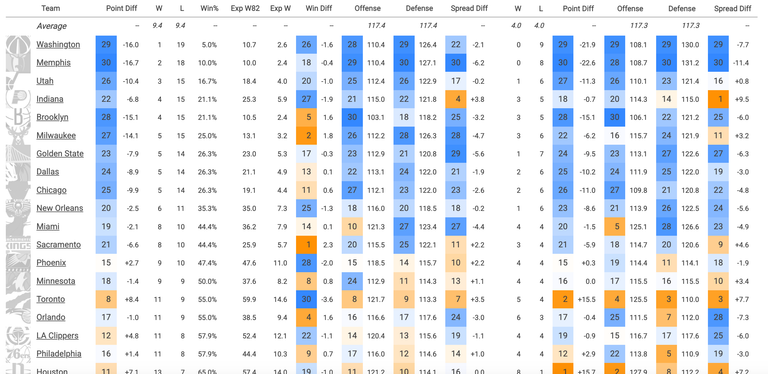
Only team in the league with just 1 player with an above avg O-EPM & D-EPM (MEM: 2, NOP: 2, UTA: 2, BRK: 2, CHI: 2, WAS had 0!!), their best player by EPM (Achuiwa) ranked 186th in EPM, the equivalent of Boston/Detroit's 10th "best" player, Utah/GSW's 5th, San Antonio/Atlanta's 8th, etc.
🥈Rim Pressure:
28th in Rim Frequency (28%, -4.2 rFreq%), 8th in Rim PTS per Shot (1.32 PPS), 32 kickout passes per 100 poss (15th, Demar & Russ accounted for 24% and 12% respectively)
🥉 Movement Shooting/Creation:
5th worst HC offense in the league (.948 PPP, -3.3 rHCPPP), 4th best in Off Screen PPP (1.07), 6th in PTS Added Off Screen, tied for league average in frequency (3.4%)
Season Outlook:
1) Can Darius Acuff be a Gen-Z version of Baron Davis?
We (as in basketball fans as a whole) are often far too generous with player comparisons. There is an almost biological imperative to approach projecting playstyles optimistically, a need to overindex on the seemingly unbridled potential of the precocious draft prospect. This tends to lead to lofty comps that set unfair expectations, demanding players live up to unrealistic standards. Allen Iverson. Damian Lillard. Kyrie Irving. Stephon Marbury. These are just a few of the point guards fans & analysts alike have referred to as comparison points for Darius Acuff's NBA translation, a clear example of our tendency to gravitate towards all-time greats to describe prospects. And yet, playstyle projections, when done correctly, are invaluable to understanding the type of roster that needs to be built around a focal point.
At first glance, drawing a comparison to Baron Davis may seem just as nonsensical as the other historical point guards. Davis was was listed at 212 pounds (nearly 30 lbs heavier than Acuff) and played with a power that far transcended his 6'3 frame. Acuff 1.7% dunk rate is actually slightly above average for his position historically, but nobody is anticipating that he'll compete in dunk contests. Baron also peaked as one of the most impactful players ever, ranking T30 in RAPM impact, in the vicinity of some of the greatest players to ever touch a Wilson.
However, Baron's offensive influence on his teams, particularly the We Believe Warriors, is eerily similar to Acuff's footprint on the Razorbacks. The 2PGs both juiced the 5th Factor (transition), boosted rim FG% and reduced turnovers by soaking up offensive usage. The fashion in which they drove this impact is similar as well. Davis was far more disruptive defensively than Acuff has shown this far, but like Acuff, his most dramatic transition impact came from his ability to create fast break opportunities off of live rebounds. They are both relatively pedestrian high-volume rim finishers (Baron hovered between 40th%ile to 60th%ile, Acuff 53rd%ile historically at his position in NCAA) which means their positive impact on their team's rim efficiency is generated by their 99th%ile and 97th%ile rim assist volume. Their ability to shoulder a massive initiation burden without turning the ball over makes their respective profiles unbelievably rare.
This overlap means there are meaningful parallels the Kings FO should mind when constructing a roster around Acuff. Davis' Warriors found their stride once their mid-season acquisitions, Stephen Jackson & Al Harrington, finally were able to play alongside a healthy Baron Davis and Jason Richardson. Nelson had surrounded one of the best transition engines in NBA history with various high-volume 3PT attempt rate athletes, including 4 of the T20 in dunk assist rate, a league-leading 3 players (Richardson, Barnes & Pietrus) to post above league-average dunk and three-point attempt rates, plus 3 more players who fell just short of one of the thresholds: Harrington, Ellis & Jackson. There's no better way to generate dunks and threes than in transition (44% of GSW's dunks came in transition), which is why Nelson's Warriors played 7.3 poss per 100 FASTER than the average 2007 NBA team and attempted 7.1 MORE threes per game. The Warriors rode this synergy to a 16-5 close to the 2007 season w/ the best transition offense in the NBA, upset the #1 seeded Mavericks then posted the most effective transition offense in modern NBA history in 2008, adding a ridiculous +6.5 points above league average on the fast break.
This is the exact blueprint the Kings should follow, modeling their roster as best as they can in Don Nelson's vision, especially considering Acuff's success with Calipari flanked by some of the best open-court athletes in college basketball. Acuff would also stand to benefit by adjusting his game to play off of 2 feet more often (a la Baron/Brunson/Pritchard), especially since his current process is more strength-based than most may realize.
My Acuff future observation point to NBA plays is simple.(Besides other pros and cons)
As small/non-stout frame player, can he make blow-by?
1. His stride is short + get low is not stable (knee is high) 2. So got stuck with defender(using offarm or stepback often) pic.twitter.com/GnczttuDy3
Fully empowering Darius to run in transition will help mitigate some of his halfcourt scoring warts, considering Acuff is entering the league as arguably one of the most context-dependent lottery picks in recent memory as a smaller guard with very little off-ball utility. The Knicks winning a chip with Brunson as a focal point validated building around a small guard for many, but that conclusion cannot be drawn without acknowledging the extreme lengths NY went to building the optimal roster around him, plus the massive offensive impact a smaller guard MUST reach to offset the limitations they impose on their roster.
As much as Acuff represents a beacon of hope for the fans, he also serves as an ultimate litmus test for the front office, to determine whether they can finally effectively surround a prospect with a context he'll thrive in.
2) Is this the final season of Sabonis in a Kings’ jersey?
2026 was, by far, Sabonis' worst season as a King. This past year was his weakest offensive season by virtually any metric you can choose since he became a starter, posting the most negative team TS impact of his career. Negatively impacting true shooting%, a measure of efficiency, is nothing out of the ordinary for Sabonis on defense (he has just 3 seasons out of 10 where he lowered opponent efficiency), but him replicating that bottleneck offensively is completely untenable as one of the more starkly "1-way" bigs in the league. His -1.5 oTS and -1.7 dTS impact over the 2025 calendar year has been equaled by just 24 players in the last 25 years, out of an 8,615 qualified players.
It's important to remember that Domas suffered a ton through many injuries, beginning the year with a hamstring strain, then a rib contusion before getting his nagging left knee soreness diagnosed as a partial meniscus tear. He would play just 8 more games after sitting out 27 straight in an attempt to rehab, before shutting it down to get his meniscus repaired. The knee injury certainly reared its' head in his own offensive inefficiences, shooting the 2nd lowest % at the rim in his career (61.6%, 38th%ile) despite the 2nd highest rim FGM assisted rate of his career. This falloff coincided with a career-low in 3P% and the 4th lowest FT% of his career. 19 games in an injury-riddled season certainly isn't representative of his talents but his sizable contract and incongruence with the younger timeline the Kings have elected to walk prompts some pondering about his future in SAC.
Sabonis' strengths make him well suited to establishing the competitive floor of a team. He's among the league's best when it comes to screening, rebounding and in handoff scenarios, which makes him a living & breathing guard development hyperbaric chamber. This makes Domas an attractive pairing with Acuff as he eases his way into the league and could also make him desired in Utah or Brooklyn, teams that heavily feature handoff & off-screen sets with younger perimeter players who would benefit from Sabonis' crushing screens. The Kings prerogative should be to try and rebuild Sabonis' value this season, while exploring how a big of his archetype fits with Acuff. As we discussed above, Sabonis doesn't necessarily have the athletic gifts or 3P volume you'd like next to Darius.
3) Does Keegan Murray have more juice left to squeeze?
The first year of the 5-year, $140 million dollar contract extension Keegan Murray signed on October 15th, 2025, begins this upcoming season. His annual average salary of $28M begins at 14.63% of the cap (or $24M) and rises to nearly 16% of the cap in 2031. 15% of the cap is a similar allotment for players such as Andrew Wiggins, Devin Vassell, R.J. Barrett & Trey Murphy, a conglomerate where Murray is increasingly becoming a polar bear in Arlington, Texas. The situation the Kings have found themselves in isn't much different than the limitations Christian Braun has imposed on Denver, though these teams are on different timelines so it's not as crippling a deal (at least not yet). These two players are a cautionary tale of the dangers of committing to long-term lucrative extensions with platyrs whose offensive viability is unilaterally tied to a healthy offensive infrastructure.
As a slightly older prospect with a limited track record as a creator, Keegan Murray's upside offensively has always been a bit below what his draft slot suggested. In his pre-draft season, Keegan attempted just 16 threes off the dribble. He ranked in the 57th% historically at his position in share of unassisted FGM (47.6%). My shot difficulty metric had him ranked in the 9th%ile among that same group, -2.8% EASIER than an average forward. The vast majority of his shots were static, which further capped his NBA offensive translation. Even with all these limitations, Keegan led his draft class in Box Plus-Minus (a production estimate) and was 2nd only to Chet in my proprietary NCAA impact estimate, which was made even more impressive by the relative lack of talent on Iowa's roster.
In the league however, his static nature began to sap his offensive effectiveness as the Kings' core slowly fell apart. A vital contributor to the Beam Team regressed to one of the worst 2P scorers in the league, his 3P% declined for the 4th straight year, the 3P volume was cut by almost 40% in the absence of a creator who could generate quality spot-up opportunities and he dunked just 3.7% of his FGA. Through 8000+ minutes of NBA play, his 92nd%ile dunk rate in college misrepresented him as an athlete, as his somewhat underwhelming verticality & burst limits him almost as much as his handle. His weakside rim protection has remained a strength through it all (70th%ile or higher all 4 years in BLKs/75) and he still doesn't turn the ball over, so the path for him to get back to being an impactful player is clear, but it won't be because of a massive offensive leap. It will be because Sacramento installs him in the complimentary role he was always meant to play.
4) Lavine/Hunter/Monk account for ~60% of the Kings’ current cap space, but don’t project as foundational pillars in this rebuild, what options should SAC explore?
We talked about Sabonis, but there are three other Kings that are also incongruent with the timeline. Zach Lavine, De'Andre Hunter and Malik Monk account for about sixty percent of the Kings' cap space, with Lavine & Hunter on expiring contracts this offseason. In terms of pure monetary value, Lavine may have the biggest gap between his impact and contract. Upon picking up his $48M player option, Zach became the 27th highest paid player next season. Accounting for 30% of the cap while grading out as a sub-top 200 player in the league is the dictionary definition of "under the water" contract. His standing around the league is likely so low that the only way Sacramento could move him off their roster before the deal expires is by waiving & stretching his contract. De'Andre Hunter has bounced around a bit since leaving Atlanta after his breakout season under Quin Snyder. Of the 3, he's the most likely to get moved at the deadline to a team that needs to duck the tax before the end of the season, cycling out a longer-term contract for Hunter's expiring deal. Denver could be a potential suitor or even a sleeper team such as New Orleans, which is treacherously close to the luxury tax they have refused to pay throughout their existence. The formula to build up Hunter's value is the same approach that would boost Keegan's offense back up, which could be possible with a healthy Sabonis.
Monk is the most interesting player, as the best of the 3 and the least expensive. He also fits best with their style, as the player who had the largest impact on their off-screen scoring. A lot of this is his willingness to just absolute chuck shots, though it also helps that he's one of the very few dribble, pass, shoot threats on the roster who's comfortable shooting off the move. This is the piece I'd most consider retaining for the short-term if I was in the Kings FO, to test out the viability of Monk (or a similar player) being the Monta to Darius' Baron, although of course the ideal backcourt pairing would be much stronger defensively.
5) Can the Kings’ diametrically opposed young frontcourt players cover up one another’s weaknesses?
In my preparation for this series, the Kings graded out as the weakest two-way talent team overall. The key word is two-way here, in terms of having players who are able to positively impact the game on both ends, not just one end. I think the best embodiment of this convoluted approach to roster construction are Sacramento's 2 young frontcourt players from the 2025 class, Maxime Raynaud and Dylan Cardwell. Maxime is overwhelmingly offensively tilted, while Cardwell is wholeheartedly a defensive specialist.
In the current NBA landscape, my general philosophy is that teams must roster guys who can function in multiple different roles, in order to have variability in both scheme and rotations. As I combed my way through historical pairings of bigs, 3 truths became very clear to me:
Modern day lineups typically demand more flexibility from their bigs on both ends
Consistent pattern across the league that pairing offensive only bigs with defensive only bigs leads to worse results than having the anchor alone
Passing in the aggregate often just isn't good enough to offset the limitations, especially if the pairing isn't overly physically dominant/large/skillful
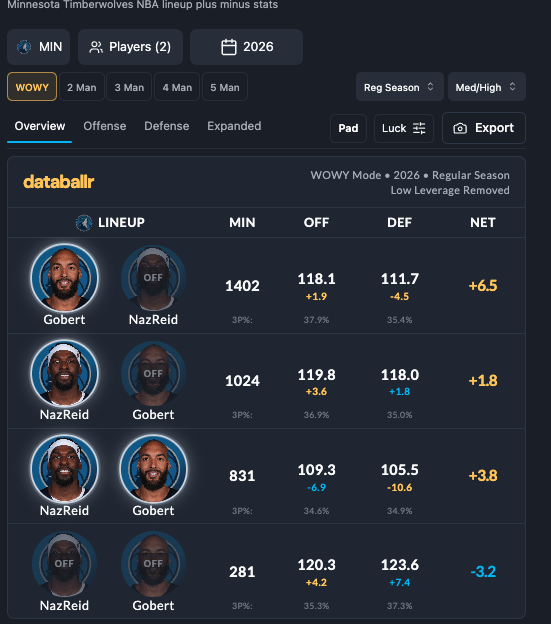
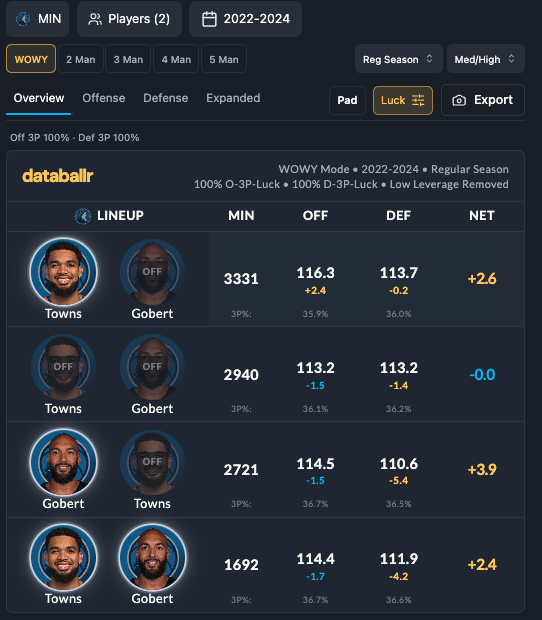
Generally speaking, it is more viable for bigs to be a defensive specialist than an offensive specialist, though specialists need to be one of the best in the position at that aspect to match the impact of more well-rounded bigs. An interesting comparison point is Karl-Anthony Towns pairing with Rudy Gobert, 2 bigs who are the premier players in their respective archetypes. (It's worth noting here that the likelihood of both of SAC's young guys reaching that level is extremely slim). KAT & Rudy played thousands of minutes together, but because they were both inflexible outside of their respective spheres, their minutes together were worse than their minutes apart and they couldn't provide enough passing to keep the offense humming. Minnesota ended up shifting the roster due to their respective deficiencies limiting the pairing as a whole.
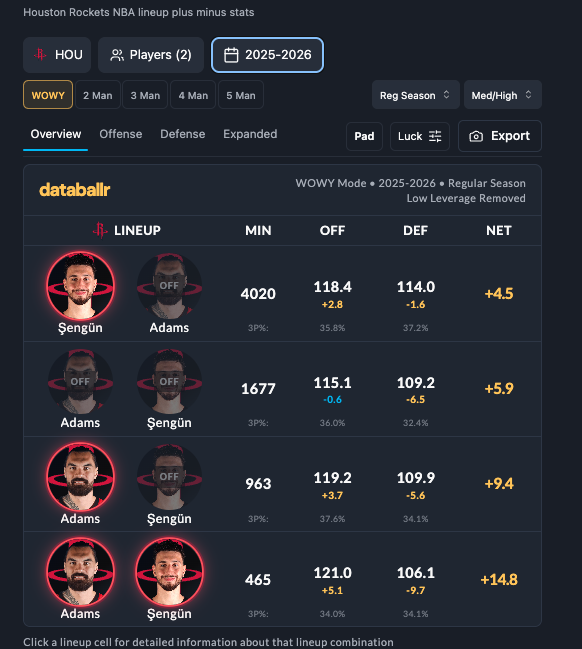
To make double big lineups work, teams either need to have an offensive GOAT to play the double bigs 80+% of their mins with (a Harden/Luka, etc.) or heavily crash the glass, which is what Houston and New York have done to great success. However, it's worth noting that their achievements were in large part made possible by rostering 2 of the greatest offensive rebounders ever. In addition to the systemic issues that come with pairing 2 centers, there are further complications that these 2 place on a team that has elected to platform Darius Acuff. There are severe anti-synergies with Raynaud on defense and while both guys are efficient at the rim (> 75th%ile), they're not the athletes Darius found success with at Arkansas, which shows up in their 49th%ile and 33%ile finishing efficiency.
However, Cardwell had extensive experience playing with bigs at Auburn, which makes him a gifted passer for an otherwise barebones offensive player. 57% of his possessions came next to Johni Broome and 86% of his minutes WITHOUT Broome came next to Chaney Johnson. In those minutes, his AST% jumped by 5%, with a meaningful jump in rim assists, which showed in his above avg assist volume and low passing turnovers. Raynaud isn't as polished as a passer, but he did drive on 15% of his possessions at Stanford, exhibiting abnormal bend and off the dribble coordination for a footer. He ranked 15th among NBA footers in drives per game as a rookie (1.5), an area of his game that would need to expand to warrant any experimentation with this pairing. Their best bet for this working is for Raynaud to develop into more of a wing, walking the Okongwu pathway as an elite touch big who gradually expands their range. I'd caution projecting any massive deviations from their collegiate profiles, considering just how much data we have on their playstyle.
Record Prediction
Combined Odds: 21.8 via multiple sportbooks
My Model Projection: 24.1 (30th out of 30th)
Floor: 19-63 (-3 wins)
Bottoming out isn't as alluring as it used to be, and the Kings sweet spot is somewhere safely out of the bottom 3 of the NBA standings. Unfortunately, someone does have to be last, and this team projects to just be too much of a sieve defensively on a night to night basis to maintain the requisite competitive floor that their counterparts have in place.
Ceiling: 29-53 (+7 wins)
I'm expecting 2 of the bottom 3 teams in the league to be Western Conference teams which means Sacramento will likely be jostling with Memphis, the Clippers & New Orleans to avoid relegation and secure an 8% chance at the #1 pick. A healthy Sabonis combined with ramping up Cardwell, plus a respectable Acuff season and maybe even some Ben Simmons resurgence would go a long way to accomplishing losing just enough games.
Overall Grade: C-
Let me know if you agree with my predictions! What are your expectations for the Kings this season?
I’m a lifelong basketball enthusiast who blends film study and advanced analytics in my independent coverage of basketball and the NBA Draft across Tiktok, Twitter, Youtube, Substack and Instagram. I’ve also covered the Hawks for ~2 years as an accredited digital journalist for Afro News, and I am a member of the Atlanta Hawks’ Creators Collective.


-400x500.jpg)





Comments