Welcome to the 4th edition of my annual 30 teams in 30 days series, the most comprehensive and informative previews for every team in the NBA. Inside these posts, you’ll get up to speed with every team’s offseason additions and their roster hierarchies, learn whether they’ve addressed their biggest areas of need, ponder over 5 questions that will define their season and then decide whether you agree with my offseason grades and record predictions. For the first time, these articles will be exclusively posted on the Hardwood Collective and are paired with video deep-dives over on my Youtube and full-length podcast episodes over on The Fifth Factor!
Notable Additions: Nic Claxton, Norman Powell, Caleb Wilson, Dailyn Swain, Zach Collins (re-signed), Tobe Awaka, Jaylin Sellers
Draft Pick Comps & Strengths + Weaknesses
Caleb Wilson to the Bulls:
Very, very similar playstyle to 2 of the most athletic prospects ever. Caleb Wilson only attempted 3 stepback 3s in his time at UNC, but I think his efficient energy transfer on his many spinning/turnaround middies translated to his OTD 3s tonight. He's an incredible athlete, the coordination & speed in which he squares up is just as impressive. .52 3PR is crazy in a vacuum for Wilson to put up after a 24 games sample where he attempted just 27 (.09 3PR) but it’s even wilder that ~8 of his 3PA were OTD step backs AND several were feet behind the line AND every single one was effortlessly fluid...or maybe it isn’t that crazy and Caleb Wilson’s dominance on the glass, touch, extremely polished passing & overwhelming feel indicators all belied him being exceptionally skilled and more likely to develop rapidly.
or maybe it isn’t that crazy and Caleb Wilson’s dominance on the glass, touch, extremely polished passing & overwhelming feel indicators all belied him being exceptionally skilled and more likely to develop rapidly https://t.co/4osk2tXzgm
Swain was the lead creator for one of the most potent offenses in the country, despite Texas ranking extremely low in Assist Rate and below average in Tempo + 3PAr. Operating in a system that so rarely generates transition opportunities necessitates highly efficient half-court offense. Dailyn has found massive success generating his own offense at the rim, off the bounce and in isolation.
So much of Swain's success as a self-creator can be attributed to his truly generational driving ability. He effortlessly toggles as the initiator and play finisher in both transition & in the half-court while maintaining unreal efficiency. The most glaring issue in Dailyn's game is certainly his turnover problem, potential offensive engines typically have a stronger global impact on reducing their teams' turnovers, even if their own TO% is high
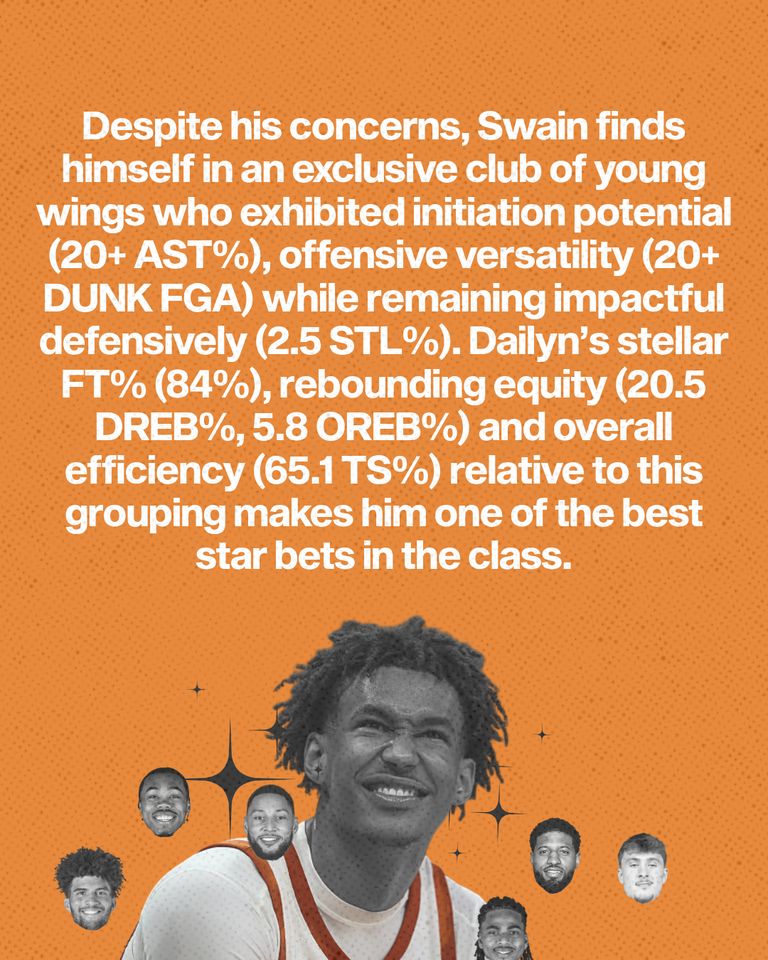
Swain's turnovers aren't related to his handle, but are moreso a product of his low 3P volume + downhill playstyle out of ball screens. He's able to mitigate his turnovers in iso/drive scenarios, but lacking a reliable pull-up 3 on volume allow defenses to collapse heavily. The 3P volume and TO% influence is undoubtedly concerning, but Swain's playmaking relative to his usage, dunk volume, efficiency and ancillary footprint on defense & the glass makes him one of the best star bets in the class.
Undrafted: Tobe Awaka
Undrafted: Jaylin Sellers
Notable Subtractions: Anfernee Simons, Collin Sexton, Guerschon Yabusele, Mouhamadou Gueye, Mac McClung, Nick Richards, Rob Dillingham
Depth Chart + Roster Hierarchy
Franchise — Caleb Wilson
Core — Josh Giddey, Matas Buzelis
Key Rotation — Nic Claxton, Norman Powell, Isaac Okoro, Jalen Smith, Tre Jones, Buddy Hield
Rotation — Patrick Williams, Leonard Miller, Zach Collins
Development — Dailyn Swain, Noa Essengue, Tobe Awaka, Jaylin Sellers
Cap Sheet
Offseason Overview:
There’s an unspoken hierarchy among NBA franchises, a inner circle that only the most decorated and respected teams can claim membership to. This pantheon greets me everytime I open Stathead to query for stats, with the Lakers, Celtics, Bulls & Knicks having the distinction of being hyperlinked below the “Team Filter” dropdown. These 4 franchises all played an instrumental role to the survival of the league, rostered some of the most iconic players in NBA history and still boast the largest and most fanatical fanbases. For a variety of reasons, the Lakers and Celtics have been far more successful than the Bulls & Knicks at remaining competitive throughout their existence. The Knicks officially graduated from this dishonor with their championship run this past season, leaving the Bulls as the lone premier franchise that has tarnished their perception with basketball that undermines their pedigree.
This team has won 3 playoff games and peaked as a 6-seed in the last decade, postseason struggles that aren’t befitting of a franchise of this caliber. Ironically enough, trying to live up to the reputation that the MJ-era Bulls set is precisely why this team has floundered in the Play-In year after year, dooming themselves to a cycle of mediocrity, never being quite good enough to make the playoffs, yet never being quite bad enough to pick highly in the draft. There’s no worse place to be in the NBA than this purgatory state, and it felt like the Bulls would never make the painful decision to pull the plug and try to rebuild the proper way.
Arturas Karnisovas finally decided to “get out of the middle” at the 2026 trade deadline, moving Coby White, Dosunmu & Vucevic in others for other teams’ salary ballast. This decision should’ve happened years ago, as they weren’t able to improve their lottery odds, and according to league sources, they didn’t acquire ANY players they viewed as long-term pieces. Chicago ended the season with the 9th best lottery odds, which seemed to doom them to another season stuck in the middle, until the basketball gods bestowed upon them the 4th overall pick. Perhaps this fortune came from ownership moving on from AK, a reward for installing a new head architect, Bryson Graham. Whatever the reason, Chicago was able to snag Caleb Wilson, a young man whose aerial gifts might be enough to restore just an inkling of the feeling his Airness himself brought to the United Center.
Pre-Draft Areas of Need:
🥇 Rim Deterrence (when Gobert is off the floor): 10 defense since Gobert has arrived, including #1 in 2024, but bottom 15 in 3 of the 4 years in rim freq. allowed including 24th last year)
Somewhat Addressed: Kuminga + Beringer should offer more switchability which will keep Minnesota out of rotation, but Joan is still extremely raw
🥈Playmaking: 30th in Cut PPP, 28th in C&S Frequency, 2nd highest TO% (23.1%) and 13th in PPP when defenses committed on their PNRs in the playoffs
Addressed: LaMelo led a Charlotte offense that was the 2nd most efficient when defenses committed and was the best player in the league in such situations (1.08 PPP), has dealt with aggressive coverages for years even if he hasn’t sniffed the playoffs yet
Note: Teams with multiple on-ball creators tend to a have a lower portion of their FGA come off of the catch, but MIN should’ve been closer to OKC in frequency (a team with 1-2 players who should be taking a large portion of OTD jumpers and everyone else off the catch)
🥉 Off-Screen Scoring: 70%ile in Off-Screen frequency or higher last 3 years in the playoffs, but they’ve regressed to 27th%ile efficiency
Partially Addressed: LaMelo 84th%ile in offscreen PPP, Kuminga also familiar with high off-ball screening environments from his team in Atlanta & Golden State
Season Outlook:
1) Billy Donovan fostered one of the friendliest developmental environments in the league in his time in Chicago, can Tiago Splitter craft his own unique system that is just as effective?
During the pre-draft process, my fellow contributors and I at The Hardwood Collective put out a joint piece detailing every aspect of Kingston Flemings’ game. We discussed his compatibility with the teams who would be picking in the lottery based on how effective of an environment it would be for his game, with Chicago ranking the highest by a decent margin. Billy Donovan’s offensive system had the shortest average time of possession in the last 2 years, regularly featuring multi-guard lineups to encourage a quick pace and transition play. His Bulls also boasted the 2nd highest rim rate and the best Rim + 3PA rate in the league, elements that also led Chicago to rank 2nd in the league in my dev environment score.
Billy’s principles successfully developed players such as Tre Jones, Ayo Dosunmu, Jalen Smith and Giddey, only to be consistently met with vitriol from a fanbase desperate to feel the rush of being in the playoffs once more. As head coach, he was a human shield for the front office that bottlenecked him the entirety of his time in Chicago, providing him jumbled, incongruent rosters, wasting 1st round picks on future salary dumps (Dalen Terry to NYK for Yabusele, Vucevic to BOS for a 2nd round pick & Anfernee after giving up the first that became Franz, extending Patrick Williams, trading for Ivey, etc.). I can understand fans being upset with the lack of results during his tenure, but the process was always solid, he just never had the pieces he needed. The one time he did have a sensible roster, Chicago was the 1st seed in the East for weeks before Lonzo’s knee injury. Their 27-13 record to open that season is STILL the best stretch of competitiveness they’ve had in 4 years.
Tiago Splitter had maybe the most abrupt start to a head coaching career ever, stepping in just days after the season opener with the former head coach, Chauncey Billups, caught up in a gambling scandal. At the beginning of the season, POR had a projected win total of 35.5. I saw the floor to be right above that threshold at 36-46 with a ceiling of 39 wins due to my belief in their defense. Tiago ended up piloting them to 42 wins, the #8 seed and a playoff appearance, which certainly exceeded expectations with all the turmoil.
Before I begin my criticism portion of Splitter, it’s important that I mention that being promoted after the season opener virtually guaranteed that Tiago didn’t get a chance to install any of his personal beliefs into this roster. He also inherited a team with some pretty glaring flaws, finishing 2nd last in TOV% the year before and 3rd worst in DREB%. Additionally, the Blazers only got 32 games from Scoot Henderson, 56 from Jrue Holiday and 30 from Thybulle, players who would’ve helped to address the TOV issues.
Now even with all these caveats, Tiago didn’t quite set this team up for success on offense. The Blazers had the 6th lowest frequency of plays out of handoffs, 2nd lowest out of off-ball screens and were dead last in post-up frequency, playtypes that could’ve helped to mitigate their ghastly turnover issues. (with Clingan/RWill as the bigs in DHOs, etc.). Instead, they ran PNR at the 7th highest rate in the league while being the 2nd least efficient and Iso’d at the 10th highest rate while being the 9th least efficient.
This is how a team that was exceptional on the offensive glass, one of just 16 teams since 2004 to have an halfcourt OREB% 5% higher than league average, was also the 2nd worst halfcourt offense in the league last year. Even considering all the injuries, this team should’ve had too many ways to create advantages to rank as poorly as the 2025 Nets, 2023 Pistons & the Process Sixers. Tiago’s lack of offensive creativity may have also manifested in Portland’s drawn up plays, as they ranked dead last in PPP after a timeout with the worst efficiency in those situations since the 2022 Thunder. Coaches can develop just like players (Mark was 1st in ATO PPP in 2024 and has been strong since) and just like we discussed with Billy, they are ultimately constrained by the players they’ve been provided. Hopefully Splitter can get some betetr returns out of a Bulls roster now that he has a full offseason, but if he had any input on how they ran their Summer League team…I wouldn’t get your hopes up too high.
2) Could we see lineups featuring Matas, Caleb Wilson & Noa Essengue?
The Bulls summer league team was a torturous experience in person. They were completely disjointed, in large part due to tasking Dailyn Swain with running point guard, a role he never truly had in college. He was at his best at both Texas and Xavier attacking out of movement or as a second side creator, not initiating from the top of the key. The Bulls didn’t have a point guard on the roster, which led to hero ball from Caleb Wilson and Jaylin Sellers alike, producing one of the 5 worst records in summer league and the 7th worst offense.
Amidst all the chaos, a variety of hints about how the Bulls could approach rotations revealed themselves. Caleb Wilson came out the gate firing up 3s at a ridiculously high rate for a guy who took just 27 in 24 games at UNC, which tells us that it was a clear emphasis for him in his offseason work. This suggests that he and Matas will shoulder the 3P burden of Giddey and Claxton in the starting lineup, which could make him a viable pairing, in time, with low-volume 3P shooters. Swain being asked to run PG also hints at the Bulls either viewing him as a guard or wanting to develop him as a guard, which would open a slot in the wing room nicely for Noa.
However, Noa Essengue was essentially benched in summer league, a decision that I can’t find any rationale for since he missed his entire rookie season and was drafted as an extremely unrefined prospect! If anyone needed a long leash in games that don’t count for anything, it was their former #8 overall pick who played just 113 combined possessions in the NBA & G-League last year. He wasn’t overly impressive, but most guys in his mold would struggle in a similar fashion if they had such a dysfunctional surrounding infrastructure. Noa was still getting to the FT line, dunking everything and causing havoc on defense regardless, which is exactly what his strengths were pre-draft. I’m hoping this was Chicago recognizing they had set him up for failure instead of just not being invested in him, though we have seen regime shifts move on from draft picks they didn’t co-sign relatively quickly. This makes me think we may not get a chance to see Chicago field Wilson/Matas/Noa lineups, though I do think it would be worth rolling out their 5 guys in this rough archetype, Swain/Wilson/Matas/Noa/Leonard Miller, just to see what does and doesn’t work.
3) What structure can Claxton and Norm add to this team on offense & defense?
As we discussed in the Areas of Need and the coaching question, the Bulls’ offensive process has been extremely solid the past couple years, but they didn’t have players who could capitalize on their league leading loc eFG%. Powell took the most jumpers per game of his career last year (8.4) and was the 15th most efficient player in the league at that volume or higher. In addition to playing faster within Miami’s offense, which helped him achieve his best iso scoring season ever, he also took the most 3s per 75 of his career. If CHI retains even a bit of Billy’s principles and allows Norm to fire up 3s off the catch and attack closeouts, he’ll be dangerous in their offense.
Nic Claxton came into the league as a 1-dimensional play finisher, but he always had some intrinsic mobility skill that up until recently, was only evident in the way he could hedge/blitz/switch on PNRs and contain guards. Thanks to the genius that is Jordi Fernandez, Clax has developed his perimeter game massively as both a passer and scorer, ranking in the 90th%ile in rim assists AND passing turnover% while boasting a 20.5% drive frequency and an excellent 1.054 P&R BH PPP on very low volume. He grew to the point where BKN would open games with a set intended to clear one side of the floor for him to attack out of PNR. They began this action by having Claxton set an initial on-ball screen, then pop to receive a pass at the top of the key. While this happened, a teammate would 45 cut through to the opposite corner, leaving one guard on the left side of the floor to set a rip screen for Claxton to attack downhill off of.
This newfound comfortability has made Clax a better offensive player, though he will always have a cap on his efficacy since he’s both a poor FT shooter and struggles on non-rim paint FGA, but the skillset will nonetheless add some new dimensions to Chicago’s offense if Tiago opts to include it in the scheme. Defensively, Chicago will likely find it touch to consistently get stops with a Giddey/Powell backcourt, especially if Splitter plays the conservative PNR coverages they did in POR. They’ve got so much size and Giddey is capable of guarding 4s though, so maybe Splitter will lean into the aggressive style full-court press aspects in the HC, switching PNRs instead.
4) Does the end of AK’s regime also mean Patrick Williams’ time with the Bulls will mercifully come to a close?
My best ideas for research are usually inspired by an interesting trend I’ve observed in a player or a team. Most times, this observation is something positive, a source of edge I want to validate historically to trace the lineage and evaluate how sustainable it is. When I formed by Patrick Williams theory earlier this summer, it was anything but positive.
Patrick Williams’ generational ability to tank every single lineup pairing he touches the floor with is what led me to begin researching the players with the worst 4-factor impact on both ends. Before I even started, my hypothesis started and ended with PWill, based on how low-impact his mold of players tend to be. I discovered that while he was indeed an overwhelming negative in the vast majority of the 4 factors, Patrick had an overwhelmingly positive impact on the defensive glass.
Unfortunately, while defensive rebounding is very important, it isn’t close to being worth $18 million dollars a year and even this one area of impact for Williams will probably dissipate this season with Vucevic’s departure. As a low-usage player who can’t finish plays, doesn’t force turnovers at an above average rate, has a low motor, shot 48% at the rim last year and turns the ball over far too often relative to his playmaking burden, the only path to NBA viability is to be efficient. Sadly, he peaked as a sophomore as a shotmaker and has only regressed since. This contract has far too much time left for a team to be generous enough to take Patrick off their hands, so I’m interested to see how a new FO navigates rostering the biggest bottleneck in the league, especially since he plays the position they’re most invested in. He’ll be #1 on my list of players that teams are LEAST likely to leave protected in the expansion draft.
5) Bryson Graham’s SLAP philosophy doesn’t quite apply cleanly to the entirety of the roster. Who are some potential targets the FO can attempt to acquire with their short-term contracts or in the draft?
Size, length, athleticism & physicality, or SLAP, is the mantra the Bulls new front office head honcho used to typify his approach to roster construction. His time in both New Orleans and his brief stint in Atlanta reflect his belief in this thought process, with both teams selecting and acquiring players who more or less fit the mold, such as Herb Jones, Nickeil Alexander-Walker, etc. Bryson emphasized a need to identify versatile two-way players, which in conjunction with SLAP, omits about half of the roster.
Players who embody SLAP: Wilson, Buzelis, Swain, Miller, Essengue, Claxton, Smith
In the middle: Collins, Okoro, Giddey
Players who do NOT: Powell, Hield, Williams, Jones
The immediate areas where I could see CHI wanting to instill more SLAP is certainly in the backcourt and at center. Any team that’s relatively young and in the market for a franchise center should have their eyes glued on this 2027 draft glass, with Motejus Krivas, Najai Hines and Patrick Ngongba all warranting some consideration. Jordan Smith Jr. also feels like a perfect fit for Bryson’s philosophy.
Cason Wallace and Anthony Black could reach restricted free agency this offseason, I would anticipate Chicago having interest if they end up not signing an extension. They could use Norm’s contract to try and acquire Jalen Suggs or Scoot Henderson depending on if either Orlando or Portland wants to pivot. A 2027 offseason that ends with one of Krivas or Hines, plus Cason or Suggs/Scoot would be a home run in my opinion.
Record Prediction
Combined Odds: 28.5 via multiple sportbooks
My Model Projection: 28.5 (27th of 30), -4.83 Net Rating, 4% playoff odds
Floor: 24-58 (-7 wins) The East is fierce this year and while the Bulls added a ton of athletic juice, their best shooters will further complicate their defense. I’m not convinced Tiago will do enough to make this team strong enough on offense to compensate. I also think it’s highly likely Norman Powell + others are moved at the deadline which will drop their competitive floor.
Ceiling: 33-49 (+2 wins)
I’ve got one last bit of Billy Donovan propaganda to share. In essentially every year he was head coach, the Bulls outperformed their expected win/loss pace by some of the largest margins in the league. A part of this is CHI was consistently one of the best in the NBA in the clutch when they had no business doing so, going at least .500 in the last 3 seasons. Can Tiago get this team to execute as consistently down the stretch? I don’t think so, which puts their ceiling quite low in my estimation.
Overall Grade: — B-
Let me know if you agree with my predictions! What are your expectations for the Bulls this season?
I’m a lifelong basketball enthusiast who blends film study and advanced analytics in my independent coverage of basketball and the NBA Draft across Tiktok, Twitter, Youtube, Substack and Instagram. I’ve also covered the Hawks for ~2 years as an accredited digital journalist for Afro News, and I am a member of the Atlanta Hawks’ Creators Collective.
-768x960.jpg)
-768x960.jpg)
-768x960.jpg)
-768x960.jpg)
-768x960.jpg)
-768x960.jpg)
-768x960.jpg)
-768x960.jpg)



Comments