30 teams, 30 days: Cleveland Cavaliers | 2027 Season Preview
The Cavs pledged their undying faith in their franchise player once more, extending an individual whose playstyle directly conflicts with Evan Mobley. Welcome to the 4th edition of my annual 30 teams in 30 days series, the most comprehensive and informative previews for every team in the NBA.
Welcome to the 4th edition of my annual 30 teams in 30 days series, the most comprehensive and informative previews for every team in the NBA. Inside these posts, you’ll get up to speed with every team’s offseason additions and their roster hierarchies, learn whether they’ve addressed their biggest areas of need, ponder over 5 questions that will define their season and then decide whether you agree with my offseason grades and record predictions. For the first time, these articles will be exclusively posted on the Hardwood Collective and are paired with video deep-dives over on my Youtube and full-length podcast episodes over on The Fifth Factor!
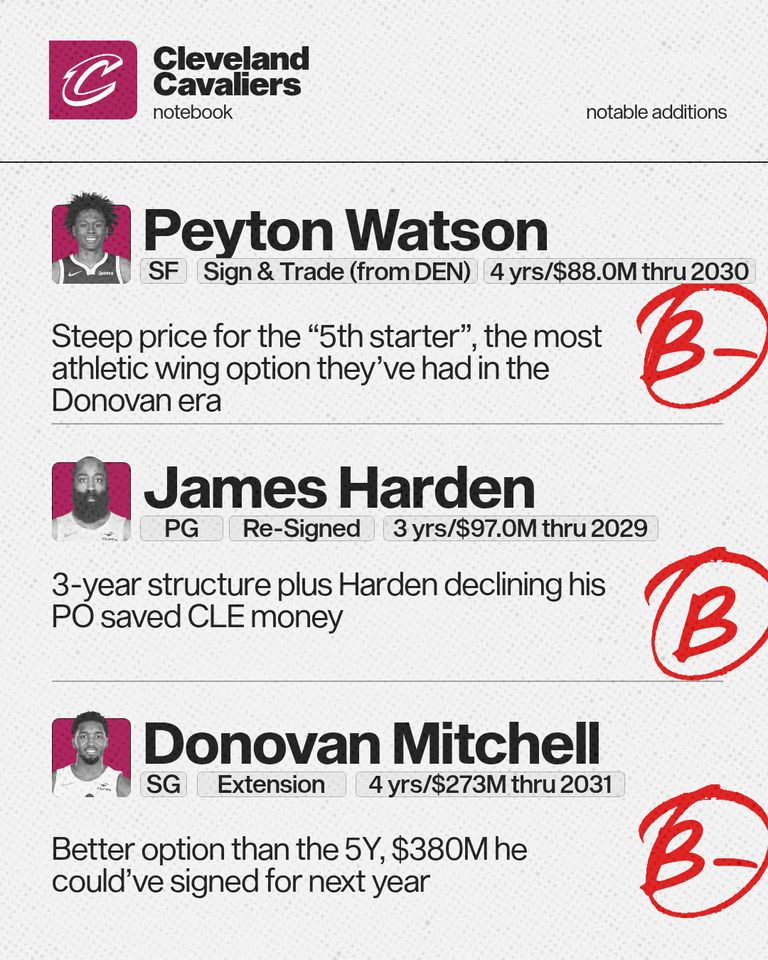
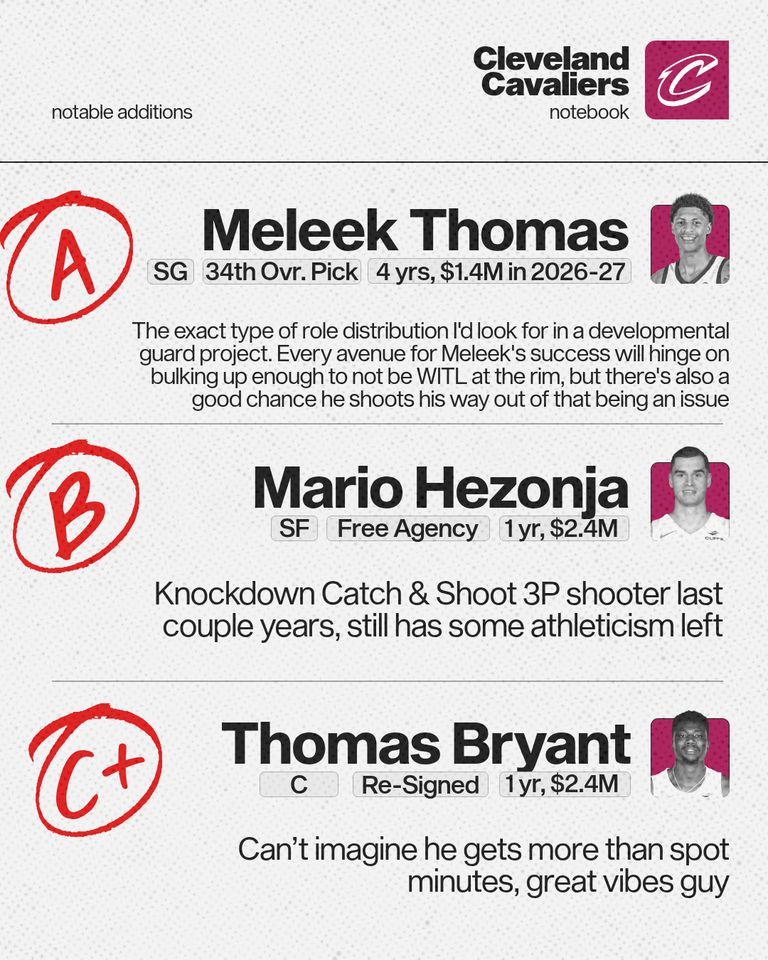
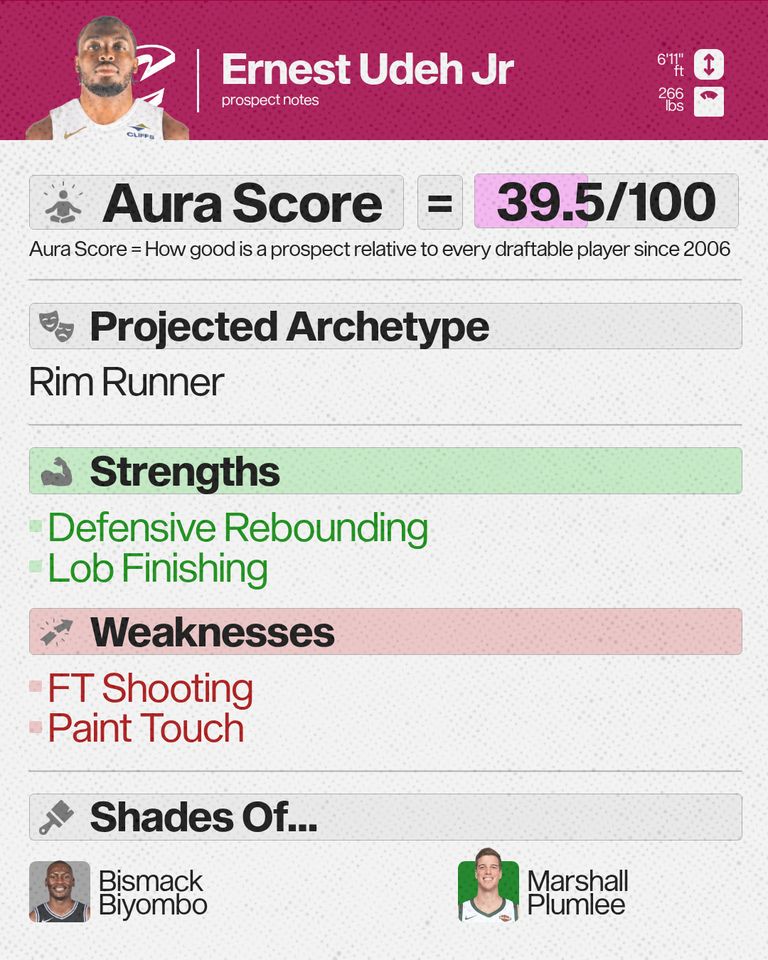
Notable Additions: Peyton Watson, James Harden (re-signed), Donovan Mitchell, Cam Whitmore, Meleek Thomas, Mario Hezonja, Thomas Bryant (re-signed), Ernest Udeh Jr., Khalifa Diop
Draft Pick Comps & Strengths + Weaknesses
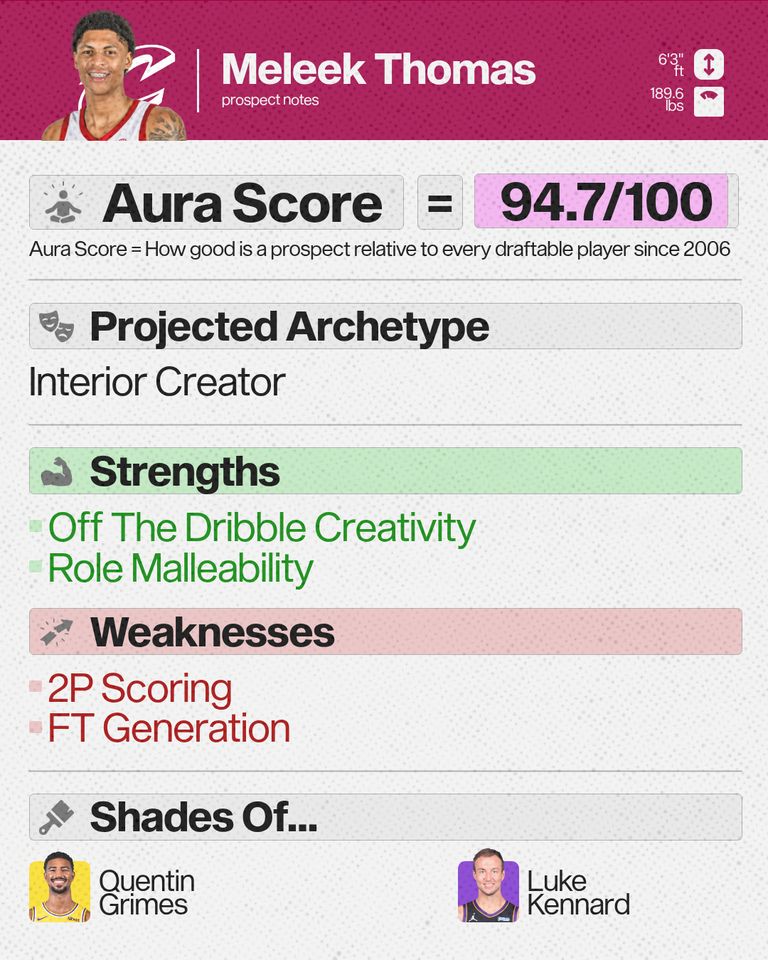
34). Meleek Thomas
Meleek Thomas is the type of combo guard I would usually fade, but he drew me in with the rebounding and playmaking ability before the cycle even began. I viewed him as a knockdown shooter & space creator with plus rebounding, playmaking and finishing relative to his archetype, with the potential to provide far more portability than you typically get from guys with his offensive skillset. There were few incoming freshmen that I was more confident would be elite shooters than Meleek.
Thomas validated nearly every prior I had, shooting 38% off the catch from 3 and 49.2% off the dribble (41.6% overall, 87th%ile), 84.3% at the line and 60.7% at the rim. He had a minuscule 8% turnover rate, a 88th%ile passer rating and 62% of his assists lead to layups pr dunks (97th%ile). He even exhibited the on and off-ball utility I envisioned him achieving next to Darius Acuff. Arkansas was able to mitigate turnovers to an even greater extent without Acuff, thanks to Meleek's decision making and shot versatility. Thomas paired the ~5% usage jump with increased efficiency (+4 eFG%), more playmaking (+4 AST%) and a higher rim rate (+3)
His biggest weakness, 14th%ile 2P scoring, was alleviated a bit in these minutes, as his slight frame made him struggle attacking defenders off the catch a bit. Operating more from the top of the key allowed Thomas to dictate when he felt most comfortable to let the ball fly, which increased his driving efficiency from 45.1 TS% to 61.3 TS% ( a PPP jump of 0.86 to 1.167). For many guys at his weight, this would be an indicator of strength/contact balance issues, but for Meleek, his inefficiency was a product of his suboptimal deployment in the minutes he shared the floor with Acuff.
When you’re driving and there’s a rotating defender, or someone is already on your hip, you don’t have the ability to get into your bag and create separation. The separation is generated for you, so you have to maintain that advantage. He can create advantages, but maintaining and leveraging them, and then finishing plays, isn’t quite his strong suit at this point.
Meleek Thomas is shooting just 45% on 2s (the 18th% at his position historically via https://t.co/joCNzM6O0H) and is one of just 6 guys I have ranked to struggle this much from 2P range
the %'s would make you think he has massive contact balance issues but he has a couple drives… pic.twitter.com/NuG5VnyWfz
These signals hinted at his eventual explosion in summer league, where Cleveland put the ball in his hands and let him rock out. The 16% increase in offensive load was the largest influx of usage for any prospect, which Thomas gladly turned into the most productive rookie Summer League stretch since Trey Murphy in 2021. This scalability is what makes Meleek such a fascinating prospect, with the realistic hope that he can effectively blend all the aspects of a movement shooter, secondary creator and POA defender into a single player.
the T20 most productive players at Summer League per DRE (Daily RAPM Estimate)
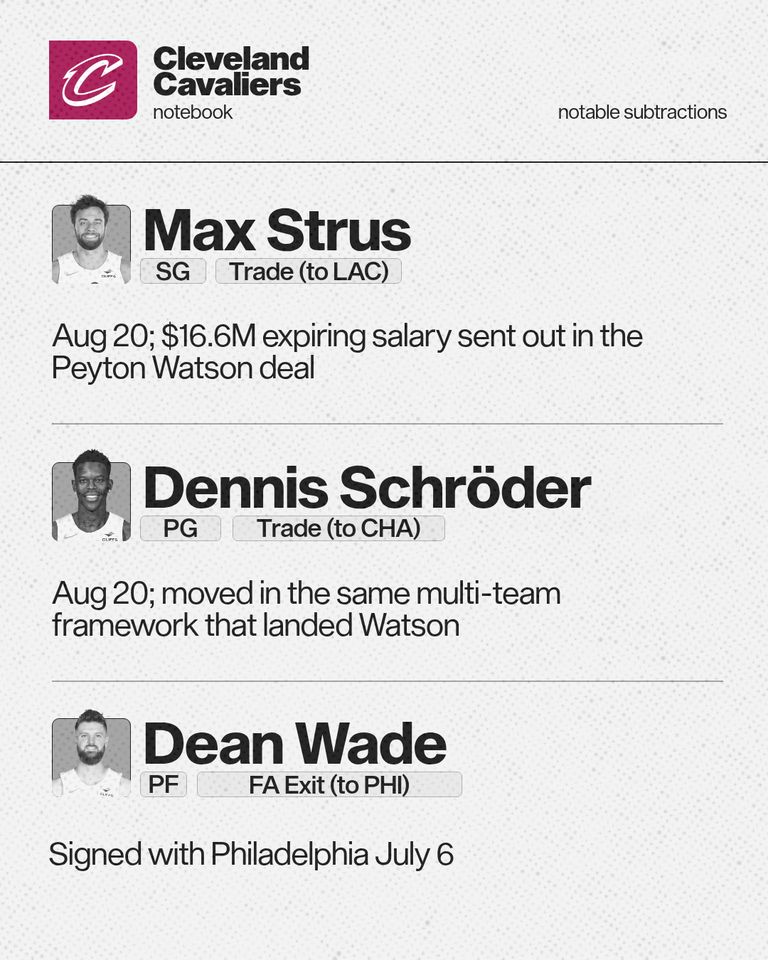
Notable Subtractions: Max Strus, Dennis Schröder, Dean Wade, Larry Nance Jr., Keon Ellis, Olivier Sarr, Alex Karaban, Cam Whitmore
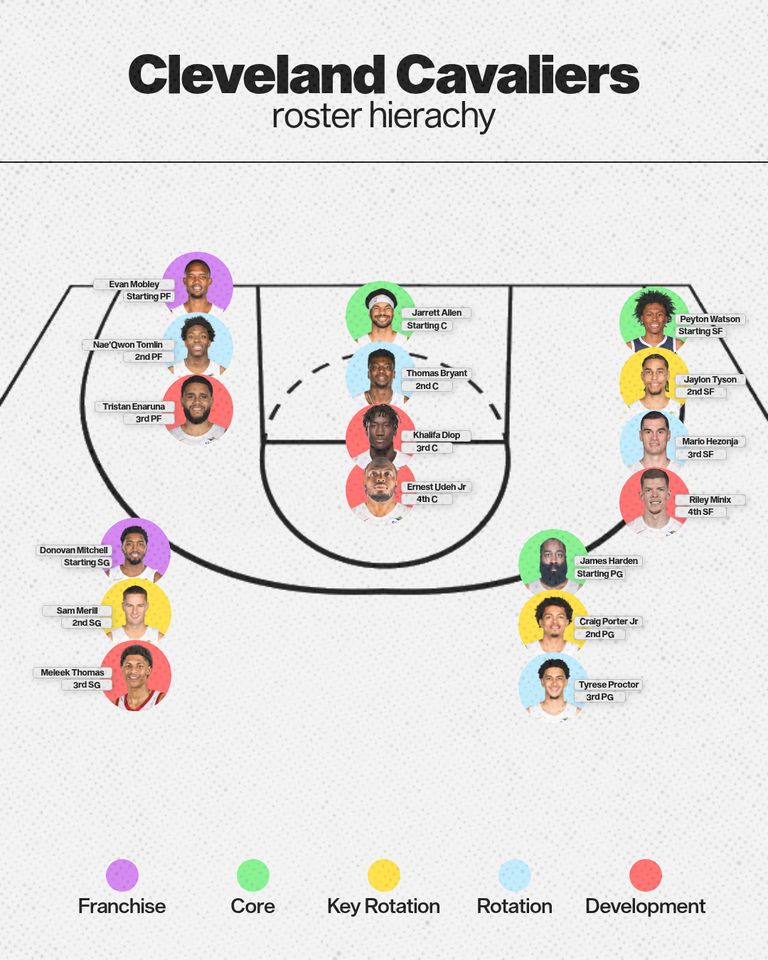
Depth Chart + Roster Hierarchy
Franchise — Donovan Mitchell, Evan Mobley
Core — James Harden, Jarrett Allen, Peyton Watson
Key Rotation — Sam Merrill, Jaylon Tyson, Craig Porter Jr.,
Rotation — Tyrese Proctor, Thomas Bryant, Mario Hezonja, Nae'Qwan Tomlin
Development — Meleek Thomas, Khalifa Diop, Ernest Udeh Jr., Tristan Enaruna, Riley Minix
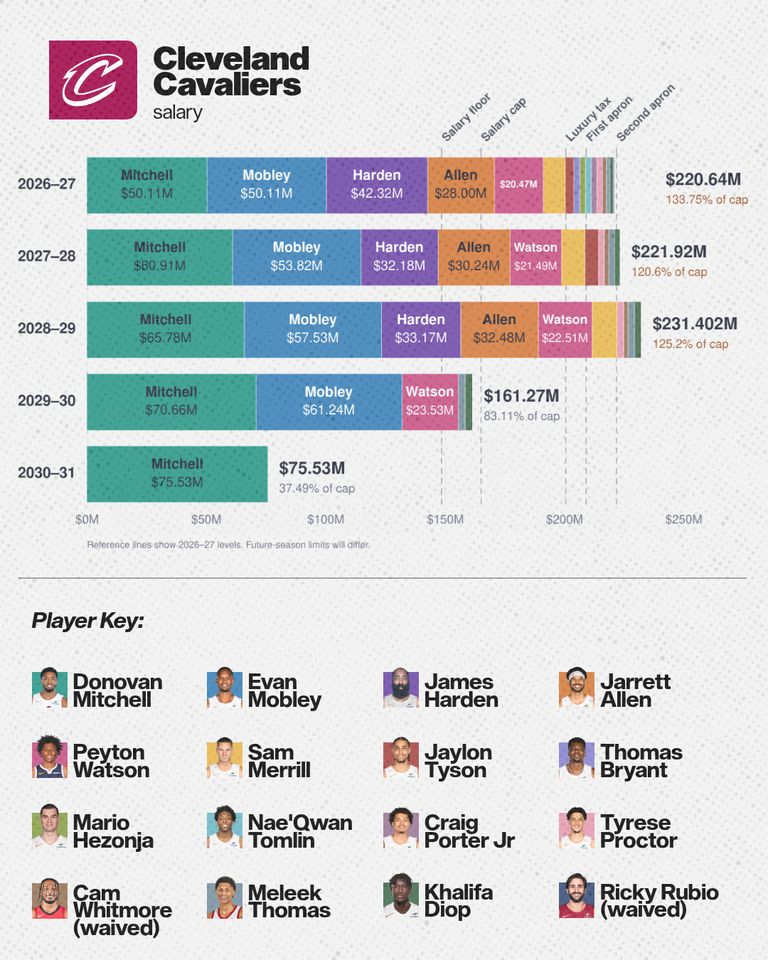
Cap Sheet
Offseason Overview
The Cavs began the 2025-2026 season as the most expensive team in the league, with a payroll of nearly $230 million and tens of millions in luxury tax penalties. Cleveland was doubling down once more on the Core 4 continuity that powered them to the #1 seed in the East, the best offense in the league and the ninth best halfcourt offense since 2004 (they were even better relative to league average than the 2024 Celtics). Evan Mobley being awarded as DPOY virtually guaranteed they would have to operate as a 2nd apron team, which cost them the ability to retain Ty JeromeBlock Fieldand prevented them from making any massively consequential changes to the roster.
There was only one team last year that was constrained by the 2nd apron, with that team finding themselves as a 9th seed 30 games into the season. The injury bug had reared its head once more, with foot surgery costing Max Strus the majority of the season, calf strains restricting Evan to start the year, all while Garland was dealing with nagging toe injuries that had seemingly sapped his burst. These absences were further exacerbated by De'Andre Hunter shockingly regressing from a 90th%ile efficiency complementary wing to a 25th%ile off-ball liability, plus the Lonzo Ball experiment failing due to Zo ranking as one of the worst halfcourt offensive player to ever play 150+ possessions. He was brought in to step into Ty Jerome's role but was the least efficient halfcourt player in the league (40 eFG%) while turning the ball over at an insanely high rate (21.2%), a level of detrimental that only the most reckless of rookie guards (Isaiah Collier/Blake Wesley/Jalen Suggs/Killian Hayes) and old-man Ish Smith have achieved in the last decade.
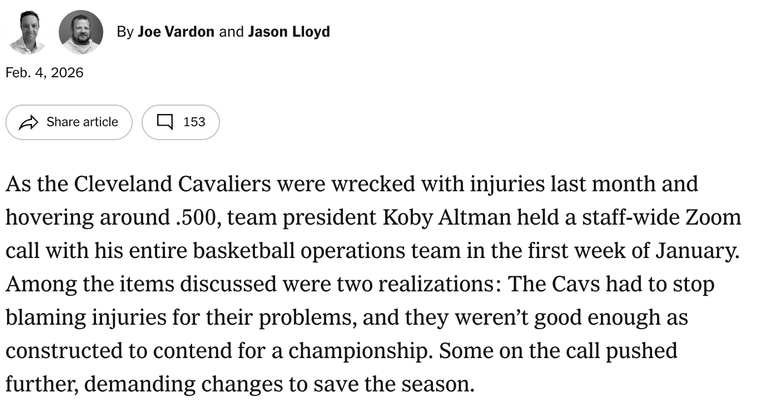
This was far from a roster worth paying even the luxury tax bills, let alone the payroll. A meeting was called with the entirety of BBall Ops to search for pivot points, with the first domino falling once De'Andre Hunter was traded a month later. His departure brought back Keon Ellis & Dennis Schroeder, but most importantly, it wiped out an additional commitment for $25M in 2026-2027 and saved them $50M in luxury tax payments. They followed up that trade with a swap of Darius Garland for James Harden, addressing both the availability concerns and the long-term financial constraints in one move, by acquiring Harden's pending player option that he could decline to give them even more flexibility.
The Cavs were able to achieve their stated goal to "get cheaper this season while at minimum maintaining its current level of production", making a decisive decision to end their developmental timeline tinkering and fully commit to trying to win a championship immediately. With Harden in the fold, they closed the season with a 21-9 record, a much better W/L than the 60% win rate they were pushing prior to the trade. The intrinsic limitations of Harden & Mitchell (and by an extension, the revamped version of the Core 4 as a whole) is what eventually sent Cleveland home, but not before they made their first conference finals appearance in the Donovan Mitchell era. The moves they made to cut their losses at the deadline ended up producing their most successful iteration yet, while they also providing the opportunity to move pieces around to acquire Peyton Watson. The cost was merely two core rotation players and their only tradable first-round pick (their 2033 1st was frozen, meaning it's not tradable, since they finished the season above the apron), yet another indication of their undying faith in their franchise player, an individual whose playstyle directly conflicts with their 2nd highest paid player and whose shortcomings have constrained them in the playoffs more than any injury (besides maybe that Garland toe issue in 2025).
Pre-Draft Areas of Need:
🥇 Continuity: most played lineup only was on the court for 186 possessions together (lowest poss for a team’s most frequently played lineup this year), 8 lineups with 100+ lineups
Addressed: while Merrill will start/finish games based on matchups & Watson’s availability, CLE has committed long term to a projected 5th starter
🥈 Weakside Rebounding: Over last 2 seasons, CLE has defensive rebounded worse with Jarrett Allen on the floor (26.8% opp OREB% with both bigs, 29.5% with just Allen) and grabbed fewer offensive rebounds with Mobley on (29.1% → 27%).
Partially Addressed: Watson will help a ton with his rim protection & Allen played more of his minutes alone with Garland, CLE should have more size overall in those minutes but don’t have another true big to pair with Allen if Mobley is off the floor
🥉 : Weakside Rim Protection: +0.9 relative opp rim frequency and -2.5% rim dFG% with Allen on without Mobley (they were 4 to 5 points better protecting the rim with Mobley on by himself/ double bigs)
Partially Addressed: Watson is in the 99th%ile in blocked shots at his position, they’ll be better in his minutes but need one of Mario/Tomlin to also be viable
Offseason Overview:
The Cavs began the 2025-2026 season as the most expensive team in the league, with a payroll of nearly $230 million and tens of millions in luxury tax penalties. Cleveland was doubling down once more on the Core 4 continuity that powered them to the #1 seed in the East, the best offense in the league and the ninth best halfcourt offense since 2004 (they were even better relative to league average than the 2024 Celtics). Evan Mobley being awarded as DPOY virtually guaranteed they would have to operate as a 2nd apron team, which cost them the ability to retain Ty Jerome[1]and prevented them from making any massively consequential changes to the roster.
There was only one team last year that was constrained by the 2nd apron, with that team finding themselves as a 9th seed 30 games into the season. The injury bug had reared its head once more, with foot surgery costing Max Strus the majority of the season, calf strains restricting Evan to start the year, all while Garland was dealing with nagging toe injuries that had seemingly sapped his burst. These absences were further exacerbated by De'Andre Hunter shockingly regressing [2]from a 90th%ile efficiency complementary wing to a 25th%ile off-ball liability, plus the Lonzo Ball experiment failing due to Zo ranking as one of the worst halfcourt offensive player to ever play 150+ possessions. He was brought in to step into Ty Jerome's role but was the least efficient halfcourt player in the league (40 eFG%) while turning the ball over at an insanely high rate (21.2%), a level of detrimental that only the most reckless of rookie guards (Isaiah Collier/Blake Wesley/Jalen Suggs/Killian Hayes) and old-man Ish Smith have achieved in the last decade.
This was far from a roster worth paying even the luxury tax bills, let alone the payroll. A meeting was called with the entirety of BBall Ops to search for pivot points, with the first domino falling once De'Andre Hunter was traded a month later. His departure brought back Keon Ellis & Dennis Schroeder, but most importantly, it wiped out an additional commitment for $25M in 2026-2027 and saved them $50M in luxury tax payments. They followed up that trade with a swap of Darius Garland for James Harden, addressing both the availability concerns and the long-term financial constraints in one move, by acquiring Harden's pending player option that he could decline to give them even more flexibility.
The Cavs were able to achieve their stated goal to "get cheaper this season while at minimum maintaining its current level of production", making a decisive decision to end their developmental timeline tinkering and fully commit to trying to win a championship immediately. With Harden in the fold, they closed the season with a 21-9 record, a much better W/L than the 60% win rate they were pushing prior to the trade. The intrinsic limitations of Harden & Mitchell (and by an extension, the revamped version of the Core 4 as a whole) is what eventually sent Cleveland home, but not before they made their first conference finals appearance in the Donovan Mitchell era. The moves they made to cut their losses at the deadline ended up producing their most successful iteration yet, while they also providing the opportunity to move pieces around to acquire Peyton Watson. The cost was merely two core rotation players and their only tradable first-round pick (their 2033 1st was frozen, meaning it's not tradable, since they finished the season above the apron), yet another indication of their undying faith in their franchise player, an individual whose playstyle directly conflicts with their 2nd highest paid player and whose shortcomings have constrained them in the playoffs more than any injury (besides maybe that Garland toe issue in 2025).
Season Outlook:
1) Is Peyton Watson the long-awaited 5th starter?
The Cavs played a total of 31,778 possessions of regular season & playoff basketball in the 4-ish years that they rostered Donovan Mitchell, Darius Garland, Jarrett Allen and Evan Mobley before the DG trade on February 5th of this year. Their "Core 4" was on the floor for just 4,938 possessions, a mere 15% of the total court time they played over 350+ game . The Cavs were dominant in these minutes, beating teams nearly 7 points per 100 possessions[3], but a combination of injuries, a lack of reliable backup frontcourt play and a constantly cycling "5th starter" capped their influence.
I'm of the belief that less guard skills is not the answer for a team that stars a player with one of the most drastic scoring usage to passing usage splits we've ever seen, though the type of guard they would need to acquire to make everything work seamlessly is about as rare as the wing they've been so desperate to acquire. To CLE's credit, they've tried a variety of different options at the wing, Dean Wade started for stretches when he was healthy, Sam Merrill had burn alongside the Core 4, they traded for De’Andre Hunter at the 2024 deadline, Jaylon Tyson was really good for them in that position early in the season and they also gave Caris Levert and Lamar Stevens chances to entrench themselves. Cleveland even bought low on Lonzo Ball as the exact type of big guard they needed (if only he was healthy). Whether due to injury, inconsistency, or most commonly, the hyper-specific needs of their core players, they weren’t quite able to find a go-to starting lineup OR a consistent closing lineup. The most common pairing with the Cavs' foursome was Max Strus, who was on the floor for 30% of the quartet's minutes. That distinguishes Cleveland from the other highly effective lineups over the years, as virtually all other examples of 4-man lineups that pushed a +7 net rating the last four years had a 5th player consistently playing at least 50-60% of the group's possessions.
Peyton Watson is the best athlete the Cavs have had on the wing in the Donovan Mitchell era, with the enticing potential to be such a physical force on both ends that he can both address the defensive shortcomings of a Spida/Harden and make them a more dynamic offense with his recent growth as an off the catch shooter and driver. Watson went from a sub 33% catch & shoot 3P shooter to 45% this year, while shooting 42.2% on contested threes. This was a massive leap for a player who was one of the rawest offensive players ever drafted, posting a sub 1 A/TO, 34.8 eFG% and 68.8% from the FT line, though he's still just a 19th%ile 3P shooter from a volume perspective. Potential has been the dominant theme of Peyton's journey, given how sparingly he played at UCLA and being an exclusively bench player in Denver that was struggling to produce efficient enough offense to carve out a larger role, up until Jokic went out with an injury at the end of the December.
His absence gave Peyton a massive jump in on-ball usage, going from 75% of his scoring possessions coming off of play-finishing situations such as Spot-Ups, Transition and off Cuts, to nearly 40% of his poss being PNR Handler, Isos and Handoffs. There were corresponding slight dips in halfcourt scoring efficiency, but the ability to remain relatively just as efficient (54.7 eFG%, 57 TS%, prior to Jokic injury, 41.5 eFG%, 55.4 TS%) while taking on so much more offensive responsibility should, in theory, make it much easier for him to be a more effective weakside creator out for swing passes for Cleveland. He got to the FT line much more often, showcasing an ability to weaponize his verticality and burst in the halfcourt just as well as he had shown in transition.
It's worth discussing that while Watson scaled as a scorer, he didn't quite evenly distribute that usage as a passer. Peyton had a worse A/TO and lower AST% in the time he played without Jokic, which could make it tougher for him to play a connective role for a Cleveland team that has more on-ball creators than Denver. This also means that if he can't sustain his shooting leap, CLE might experience the same issues they fought through with Isaac Okoro. Additionally, the sample size of this supercharged offensive version of Watson was only 17 games, and he never fully returned once Jokic was back, so there's no validation of how his time on-ball translated once he was placed back into an off-ball role.
CLE has committed long term to a projected fifth starter that in addition to the athleticism and scoring, does a lot to improve their weak-side rim protection and rebounding, as a 99th%ile rim protector at the wing position. Will he be able to play this weakside role while also guarding most teams' best perimeter player? How well can he cover the inevitable defensive miscues that come with trying to shield Mitchell? I have a sneaking suspicion that they need someone with a bit more playmaking equity and a bit more off the drive polish to keep the offense moving, especially to make sure the bigs are being leveraged effectively. I think it’s less about Peyton Watson’s limitations or whether he’s the right fit, and more about how specific that player needs to be for this particular core to reach its ceiling as a contender. Ultimately, I wonder how much Watson will be able to offset the depth limitations they lost in this trade.
2) Can they get a larger minutes share of the two bigs on the floor with one another?
As a consequence of the inconsistency of their best players' availability, both Garland and Mitchell played more minutes with one of the bigs than their double-big look, which is the frontcourt Cleveland has had the best success with. Mitchell played most of his single-big minutes with Mobley, while Garland played a slight bit more with Allen, though those frequencies probably should've been switched. Darius' passing ability was a better fit with the more dynamic Mobley, while Mitchell's shot volume is even more valuable when Jarrett Allen can crash the offensive glass. CLE wasn't able to add another proven big to their rotation, with how expensive the top four of the roster is, so they opted to bring back Thomas Bryant and add someone whose draft rights they’ve had for years — Khalifa Diop — which is how you really know a team is exhausting its resources to add a player to a position of need. This means they're going to have to split their best pairing once more this season, spreading Mobley and Allen across 48 minutes of play in the highest leverage games.
In the 2026 playoffs, Cleveland would run Harden and Allen from the 6 to 3-minute mark in the 1Q after subbing out Mitchell and Mobley, then close the 1st and open the 2nd with Mitchell and Mobley. Harden and Allen would then play the last 9 minutes of the 2nd until Mitchell and Mobley rejoined them with about 6 minutes left. This is a pretty standard staggering pattern, but I would suggest a few tweaks. Harden may be 37, but he's still better suited to switch on-ball screens onto a wing/big with his mass and is several magnitudes above Mitchell as a passer, so I would pair him and Mobley instead of Allen. In these minutes with Mitchell and Mobley off the floor, the Cavs' could play a more aggressive style of PNR defense, playing Sam Merrill, Jaylon Tyson and Peyton Watson, using Watson's roaming ability to help protect the rim with Mobley at the level of the screen.
Cleveland should attempt to play drop coverage in the Mitchell + Allen minutes, turning to Craig Porter Jr. as their primary POA defender. I wouldn't be mad at them trying Thomas Bryant in these minutes either and asking anyone not named Donovan Mitchell to crash the glass after every shot. Nae'Qwon Tomlin is a good option for this strategy given his 99th%ile OREB rate and 90th%ile defensive playmaking, though if the offense proves to be detrimental, they could turn to Mario Hezonja to step in for either Bryant or Tomlin. The defense has suffered a bit in the Allen-only minutes, which could necessitate bringing Peyton to this unit if the defensive rebounding and rim protection proves to be untenable.
3) Who is the best candidate to step into the Ty Jerome role?
This team hasn’t found a player that can play the invaluable role that Ty Jerome provided in the 2024–25 season, when he was the best off the dribble shooter in the sport. Ty was such a huge part of that 64-win team as the quintessential third guard: he could scale up when certain guys were off the floor, then scale down and play complementary basketball when he was sharing the floor with Mitchell or Garland.This is a slightly different iteration from that 2025 squad, but I do think they would benefit a ton from having a player who can step into this responsibility when Donovan/Harden is on the floor, but also shoulder some offensive responsibility when they're off. There are a handful of guys on the roster who will likely get a shot at growing into this role, with Meleek Thomas as the most interesting candidate.
Teams this expensive just usually don’t play rookies, so don't expect Kenny Atkinson to play him for a large share of minutes, but as we discussed in his profile, Meleek starred in this exact role playing off of Acuff. He has direct similarities with Ty Jerome as well, with how he weaponizes his skill and change of pace. I also think he has a better defensive skill set than someone like Tyrese Proctor despite his slight frame, which makes him the exact type of player you want next to Mitchell and Harden for the next couple years.
Proctor is the option who'll likely get the largest opportunity this year, off the strength of having a near .50 3-point rate out of PNR in his last 3 years going back to Duke, plus him shooting 44% off the dribble on nearly 300+ attempts over that same span. The shooting track record is robust enough that I can buy him as an above average shotmaker to see him mixing in a bit more pull-ups, though he doesn't create space as easily (although he does have a nasty behind the back snatchback). Against bench units, maybe CLE can ask him to take on more usage, though the transition to a 60+% of his jumpers coming off the dribble would need to be gradual. At this point in his career, I just don't see Craig Porter Jr. ever getting the 3-point rate high enough to play on-ball, which may not matter with how good he is on the glass and as a connective piece. In my estimation, this hole will go unfilled until Meleek is a part of the rotation.
4) Will Jaylon Tyson be able to reinforce a wing room that lost so much depth?
It was shocking to discover that Cleveland had the lowest total minutes played in the entire league for its most-featured lineup. Their most-played lineup had only about 180 possessions, which really put into perspective for me how much of a floor-raising job Donovan Mitchell did in the regular season. There was a complete and utter lack of night to night continuity, with many moving parts and injuries, though the sheer amount of options also gave CLE a reasonable amount of depth amid all the missed games. With the departures of Strus, Wade, Hunter, Ellis and even Dennis Schroeder (whose ballhandling allowed CLE to play Harden as a wing defensively), the Cavs have suddenly gone from having a plethora of choices to play at the wing to a select handful.
This makes Jaylon Tyson an infinitely more consequential piece of the rotation. Tyson offers the most versatility of their wing options, with his 3rd most frequent playtype being rolling to the basket as a screener while having enough passing touch to connect actions together and the finesse & strength to punish lazy closeouts as a driver. He was 9th in minutes played in the playoffs, on the fringes of being firmly in the top 8, mainly because he just couldn't make a 3 in the playoffs. The offensive rebounding and decision making as a cutter wasn't quite enough to excuse his lack of 3P gravity, so he'll need to get the volume above average and settle somewhere around 38% off the catch to really snatch that 6th man role.
Sam Merrill will always be the better offensive option with the gap as a shooter and TO aversion, so Tyson will have to really make his money on the defensive end. Just being a bigger, more stout matchup for initiators is a huge plus, in addition to Jaylon being very productive on the defensive glass. He's not that much more disruptive than Merrill, so the value will need to come from helping CLE not get into rotation by shading help his way or compensating for him getting screened off his matchup. His foot speed isn't the quickest, though he does seem to flip his hips relatively well to mirror opponents' change of direction. Cleveland can't afford to be any smaller than they already are, which is why Tyson will need to prove that he can hold his own as a primary wing stopper. The defensive rebounding is a huge part of the equation, as it could allow Cleveland the choice to close games with a single big on the floor flanked by Watson and Tyson against teams that feature multiple dynamic handlers.
5) CLE has dominated the regular season for years, what habits/tendencies/schemes do they need to refine to translate that dominance to the playoffs?
There are maybe 3 teams that I feel more confident in than Cleveland in terms of regular season success. Most of the elements that have given them a T4 seed in the East ever since Mitchell arrived are still intact, they consistently dominate with both bigs on the floor and they've got a walking T5 halfcourt offense in the greatest isolation player ever. Even with all this confidence, my skepticism about this team comes down to the core itself.
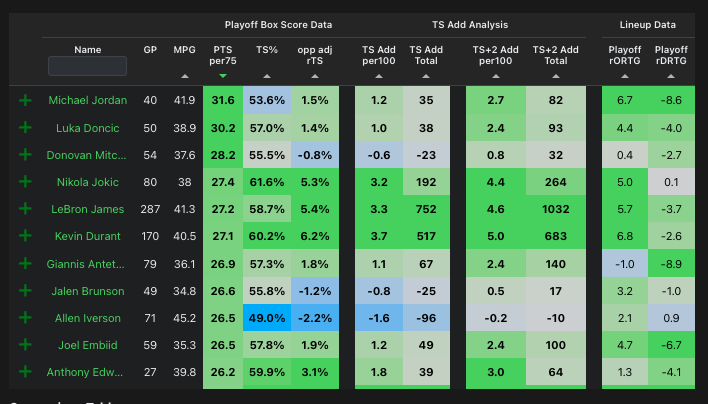
Donovan Mitchell has to either adjust his fixation on scoring the ball (highly unlikely going into year 10) or they have to bring in a player who knocks his role down a bit (highly unlikely with how much money he makes). Donovan Mitchell passed on just 53.8% of his 1,155 postseason touches, the 3rd lowest passing ratio among high-volume playoff drivers since 2014. His reputation as an elite playoff riser and unheralded shotmaker has been carried for half a decade by a 7 game series where he shot 13 points better than league average in the bubble, with his subsequent pedestrian postseason appearances leading him to post an adjusted relative true shooting 0.8% below average. He may be 3rd in per possession playoff scoring in the play by play era, but his monopolization of the rock hasn't led to successful playoff offense, with his teams just barely ranking above league average offensively in the offs, several levels beneath the other most prolific playoff scorers. Simply put, Donovan Mitchell is not efficient enough to carry this much scoring usage against playoff defenses, isn't a good enough or willing enough playmaker to consistently punish tilted defenses, doesn't get to the FT line enough to survive when his shot isn't falling (4th lowest FT rate among career 25 PTS/75 playoff scorers), all while his defensive limitations compromise his teams' defensive shells. His extreme scoring tilt relative to his touches will cap Cleveland yet again in the playoffs if he cannot accept that he needs to intentionally involve CLE's bigs in the offense.
After the Cavs got swept in the Eastern Conference Finals, I tweeted that "Every season Cleveland keeps Donovan Mitchell on the roster further depreciates the 30+% of the cap they allocated to Evan Mobley." Intuitively, investing nearly $300 million dollars into a player should mean that you do your best to optimize their game. CLE couldn't have known that he would become a DPOY and command that much money, but pairing your franchise big with an extremely reluctant passer was never going to be the way to maximize his game. Trading for Mitchell after Mobley's first year pretty much halted his development as an offensive player, as he still has not surpassed the self-creation frequency he was allowed to experiment with as a rookie. Evan attempted 5.4 shots out of Iso/PNR/Post-Ups in 2022 and didn't even break 5 such attempts per game again until this past season.
Every season Cleveland keeps Donovan Mitchell on the roster further depreciates the 30+% of the cap they allocated to Evan Mobley.
1 of the most glaring examples of incongruence between a team’s two best players in the league, CLE MUST make a decision between them this offseason https://t.co/4a7BgsoRk4pic.twitter.com/74lnPy9uoO
There's no telling what he could've been if allowed a longer runway to develop or even what he could be if CLE was to move on from Mitchell. There's also no guarantee that they would've made a run to the Eastern Conference Finals this past year, had multiple 50+ win seasons or be in the position to gear up for another deep playoff-run, but it's evident that their decisions -- from trading Darius Garland to failing to keep him involved in the offense -- haven't been what is best for Mobley, their most consequential asset and most versatile player. Perhaps there was some pessimism about his ability to be a dynamic offensive player internally, but he's morphed his game in so many ways to accommodate the rosters CLE has built, bulking up to play the 5, stretching his range beyond the 3P line, building the confidence to knockdown clutch shots and improving massively as a finisher. It's time for Donovan Mitchell to accommodate his growth in turn, to adjust his mindset to allow for Evan to take precedence in the offensive hierarchy for stretches.
Donovan's most egregious limitations—how much he monopolizes the ball and how unwilling he is as a passer, and what that means for the rest of the roster—are things they’re going to have to solve. Maybe that comes from having a stronger defensive core. Maybe it comes from connective pieces like Merrill or Jaylon Tyson and learning to trust those guys, or from having a full training camp with James Harden and getting more comfortable playing off one another. I think there are still ways this could work. Nonetheless, their margin for error is so low because of how much they've invested into the guys they’ve chosen to build around. I'm just as sure of their regular success as I am sure that, barring a shift in how Mitchell sees the game (both literally and figuratively), Cleveland will have extreme difficulties punching a ticket to the Finals.
Record Prediction
Combined Odds: 47.4 via multiple sportbooks
My Model Projection: 55.0 (2nd of 30), +6.03 Net Rating, 91% playoff odds
Floor: 49-33 (-3 wins)
The Cavs have pretty much mastered the regular season since Donovan Mitchell came to town, winning at least 48 games every year. The bigs’ steady production with Spida’s scoring is a winning formula and Harden’s arrival addressed their biggest issue (turnovers). They don’t have the depth they did in years past but they also won 52 games with some of the worst injury luck in the league last season.
Ceiling: 54-28 (+2 wins)
Losing Dean Wade and Max Strus is huge for this team, as their shooting gravity plus Wade’s versatility helped plug a ton of holes on both ends. They’ll be asking a lot from 3rd year wing Jaylon Tyson to fill aspects of both of their roles, with Proctor/Porter Jr. and/or Meleek assuming the Schroeder/Jerome role. This team is so committed to this core that if things go awry, I feel relatively confident they’ll continue to be aggressive at the deadline to try and remain competitive.
Overall Grade: C+, while CLE was able to make their most advantageous bet on a “5th starter”, continuing to play wing roulette to find their elusive 5th starter ignores the fact that:
the Core 4’s flaws are compounded when flanked by most wings
there’s exactly 1 sub-All NBA wing who could cover those up
less guard skills is not the answer!
Let me know if you agree with my predictions! What are your expectations for the Cavaliers this season?
Up Next: Washington Wizards
Footnotes
↩who was a massive part of their offense and the ideal complementary 3rd guard (on one side of the ball)
↩it was actually the farthest thing from shocking, as Quin Snyder juiced Hunter's effectiveness by having him attack purely out of motion and almost always on the weakside. CLE didn't have the luxury of utilizing him in the same way with Garland on the sideline and he was never the type of player that could remain viable if his shot wasn't falling, since he's such an unproductive rebounder and defender. It's unbelievable CLE gave up a first to acquire him!
↩Denver, Boston, Milwaukee, Minnesota, Golden State, Indiana and Oklahoma City are the only teams with 4-man groups that were better (min 1000+ possessions played)
I’m a lifelong basketball enthusiast who blends film study and advanced analytics in my independent coverage of basketball and the NBA Draft across Tiktok, Twitter, Youtube, Substack and Instagram. I’ve also covered the Hawks for ~2 years as an accredited digital journalist for Afro News, and I am a member of the Atlanta Hawks’ Creators Collective.




Comments