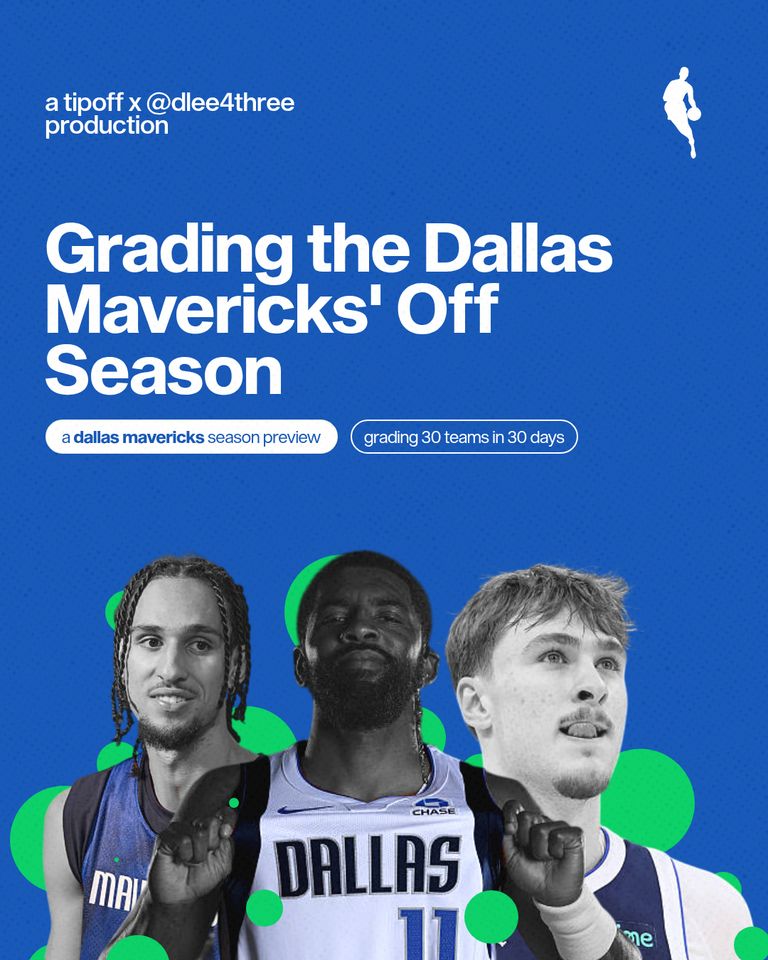
30 teams, 30 days: Dallas Mavericks | 2027 Season Preview
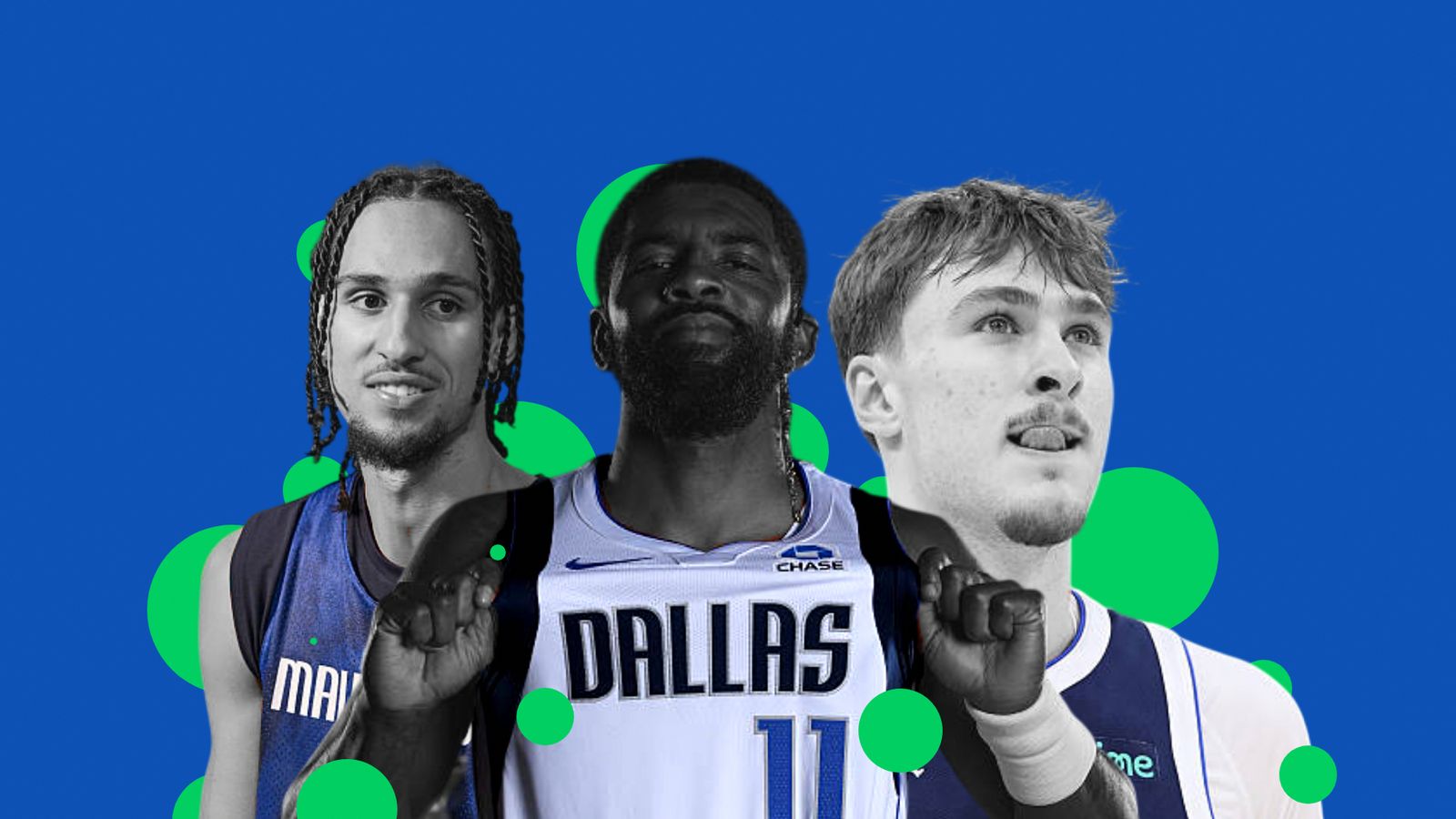
A new era of Mavs basketball begins firmly centered around Cooper Flagg, with Masai Ujiri's first task to identify the players who will flank their young cornerstone as he blossoms.
Welcome to the 4th edition of my annual 30 teams in 30 days series, the most comprehensive and informative previews for every team in the NBA. Inside these posts, you’ll get up to speed with every team’s offseason additions and their roster hierarchies, learn whether they’ve addressed their biggest areas of need, ponder over 5 questions that will define their season and then decide whether you agree with my offseason grades and record predictions. For the first time, these articles will be exclusively posted on the Hardwood Collective and are paired with video deep-dives over on my Youtube and full-length podcast episodes over on The Fifth Factor!
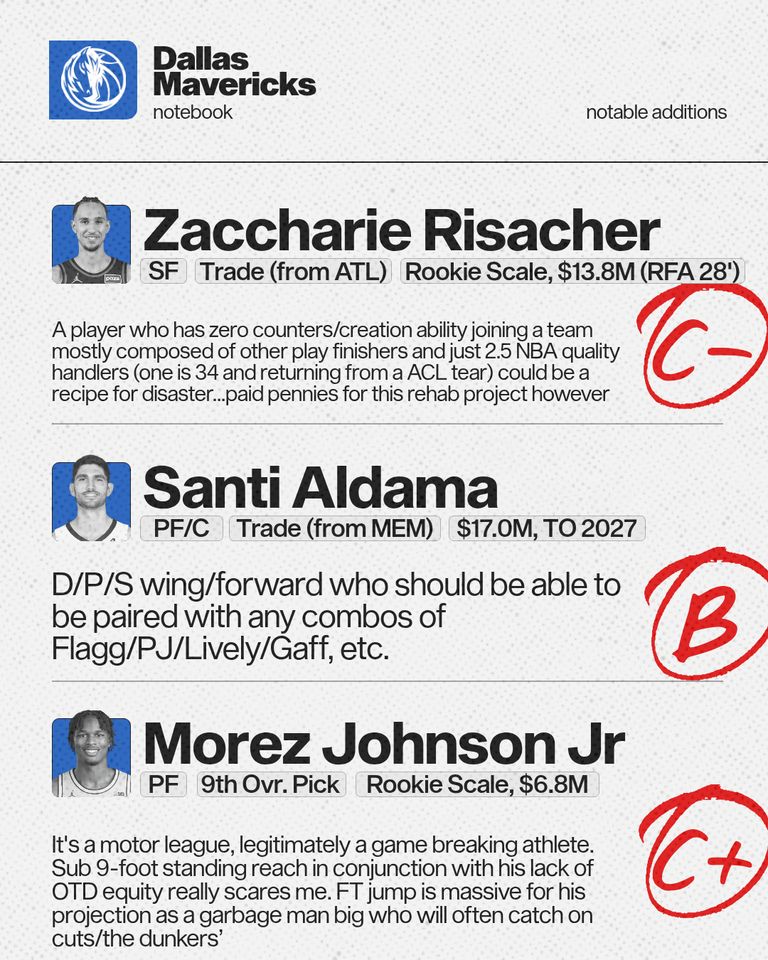
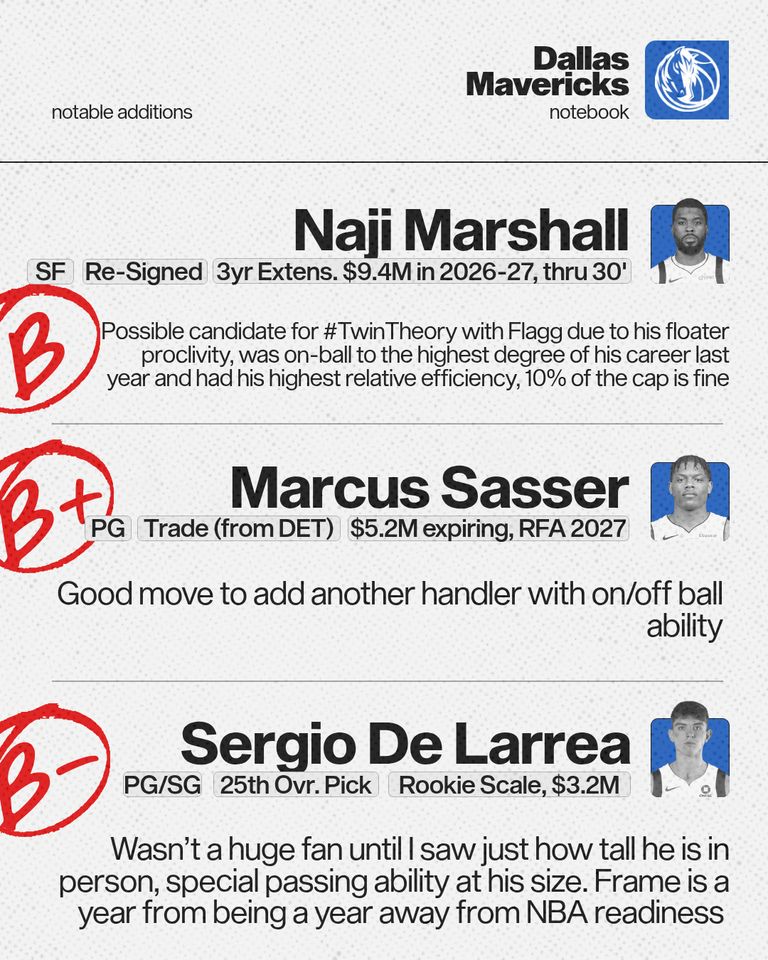
Notable Additions: Zaccharie Risacher, Santi Aldama, Morez Johnson Jr., Naji Marshall (re-signed), Marcus Sasser, Sergio De Larrea, Tarik Biberovic, Moussa Cisse (re-signed), Tobi Lawal, Jett Howard
Draft Pick Comps & Strengths + Weaknesses
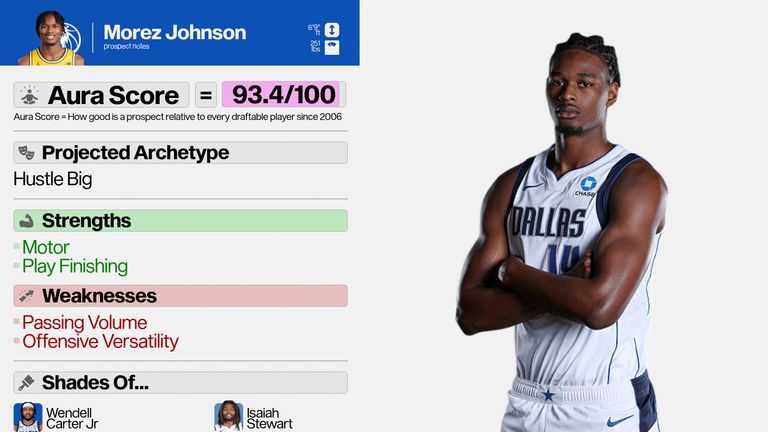
9) Morez Johnson Jr.
Morez was the prospect I found myself debating the most throughout the 2026 draft cycle. He showcased a lot of the elements I love in bigs: a seemingly perpetual motor, contact finishing (.51 FTR), vertical pop (5th in Cut PPP), strong screener, vacuum on the offensive glass (12.8 OREB%), excellent in transition plus he really improved as a FT shooter from his freshman year at Illinois (61.8% -> 78.2%). I kept getting hung up on my concerns about whether he could function next to another big in the NBA, given his lack of passing volume (32nd%ile Passer Rating, 44th%ile relative A:TO) conjoined with suspect ability to space (66th%ile 3P Rate, 15th%ile rim:non-rim ratio), especially once he measured in at a sub 9-foot standing reach. That's generally the line of demarcation that can hint at whether a prospect can play the 5 in the league, barring outlier length, athleticism and/or mobility. Johnson displayed 2 of those aspects (though his athleticism is probably a bit overstated, especially vertically as he "only" dunked 15% of his rim attempts, 66th%ile) and a 6.5 inch difference between his wingspan and height is nothing to sneeze at, though it wasn't the freakish 9.5in of an Isaiah Stewart or the 7.75in of Wendell Carter, bigs I envisioned Morez emulating in the league.
Then we began Summer League, where Morez displayed a metamorphosis to the degree we've never seen over the handful of months that passed between his last game at Michigan and his first outing at Vegas. In very limited minutes across 2 outings, Johnson Jr. displayed a comfortability in the middle of the floor that was night and day from what he looked like as a Wolverine. 75% of his FGM were unassisted and his rim rate dropped to 50%, encouraging signs of an ability to provide value even when he's several feet from the basket. His head coach having a say in how the Mavericks' approached the draft does make me wonder what May saw in him to not push to select Lendeborg or Mara, players who I think both were cleaner fits and just better overall prospects, mainly due to how they could complement Cooper Flagg. If Morez hits, it'll be because him and Flagg are pieces of one of the strongest defensive frontcourts in the league, switching as needed with enough physicality and strength to keep his height from being a limiting factor.
A look into the rookies who saw the BIGGEST change in their playstyle from NCAA to Summer League, based on the stats that are most likely to translate to the NBA:
1. Morez Johnson Jr. > the biggest playstyle change EVER 2. Emanuel Sharp 3. Darryn Peterson 4. Braden Smith
de Larrea entered the cycle as a fringe prospect, then carved out a pretty consequential role for Valencia as they stormed their way to an ACB championship. Sergio accounted for the 2nd highest PNR volume on the team (8.2 per game), generating much more efficient offense kicking out to teammates (.964 PPP) than he did as a scorer (.868 PPP). A decent part of this is due to how much lower his TO rate was when he wasn't trying to score it himself, underscoring his current standing as more of a passer than a true playmaker, not quite having the scoring chops to bend defenses consistently to truly weaponize his passing at 6'6. 23.5 AST% at that height, with a .49 3PR, 83.7% at the line and 6.7 OREB% is an interesting collection of traits that's dampened by his slender frame, 2005 birthday (beginning NBA career at 21 while already behind the curve physically) and defensive apathy.
I got eyes on Larrea at Summer League and his height was every bit as advertised, although he struggled to use it to much of an advantage due to how easily he was bumped off his path. He demonstrated a slight tendency to float around a bit too much for my liking in the games I caught, not making much of an impact on either end possession to possession. His best path to making himself into a valuable NBA player is likely something similar to how Egor Demin has bean his NBA career as more of an off-ball movement shooting wing, while still possessing the off the dribble playmaking and creativity from his time as a true lead guard.
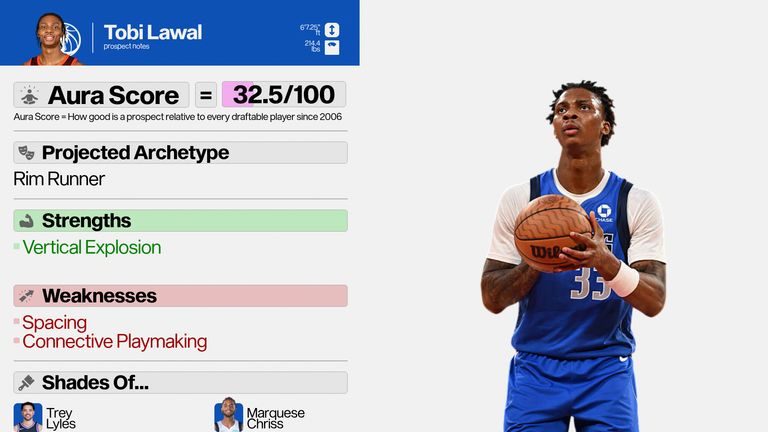
48) Tobi Lawal
Lawal's game is pretty reminiscent of mixtape legend Coen Carr, with a springiness that looks like there's a trampoline hidden beneath his feet. The quickness at which he can get his head above the rim is a bit terrifying to watch, boasting a dunk frequency that very few non-centers have reached, ranking in the 92nd%ile. He also made a sizable improvement as a FT shooter from his previous collegiate season and he also shares some of the passing and spacing concerns we discussed with Morez. Those are a good deal more substantiated with Tobi, as a career .25 3pR tweener with 5th%ile or lower height, wingspan, standing reach and weight at the 5. His current frame just isn't viable to be a non-spacer who's entering the NBA with a career 5% assist rate and 20% turnover rate. There's enough as a driver (1.1 PPP despite a pretty high TO rate) to offer some offensive intrigue, but he's either got to really bulk up or commit to shooting more 3s to have a long-term NBA career.
Notable Subtractions: Klay Thompson, Khris Middleton, Ryan Nembhard, A.J. Johnson, Tyus Jones, Marvin Bagley III, Tyler Smith, Dwight Powell, Brandon Williams, Jeremiah Robinson-Earl, Miles Kelly, John Poulakidas
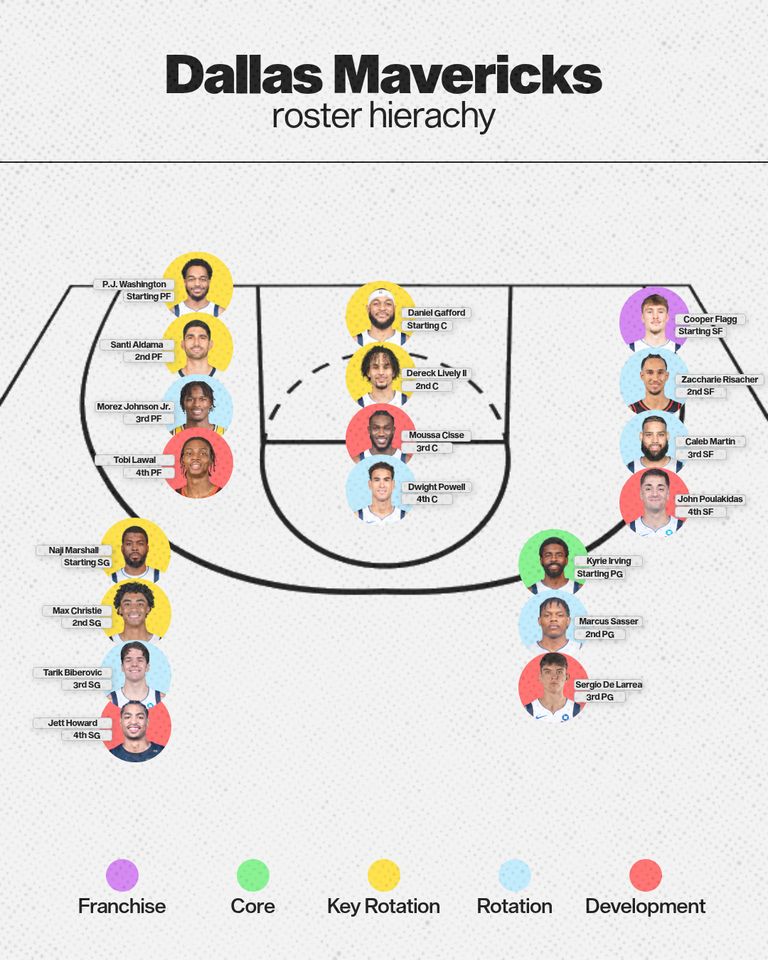
Depth Chart + Roster Hierarchy
Franchise — Cooper Flagg
Core — Kyrie Irving
Key Rotation — Daniel Gafford, Santi Aldama, Naji Marshall, Max Christie, Dereck Lively II, P.J. Washington
Rotation — Morez Johnson Jr. ,Marcus Sasser, Tarik Biberovic, Caleb Martin, Zaccharie Risacher
Development — Sergio De Larrea, Moussa Cisse, Tobi Lawal, Jett Howard
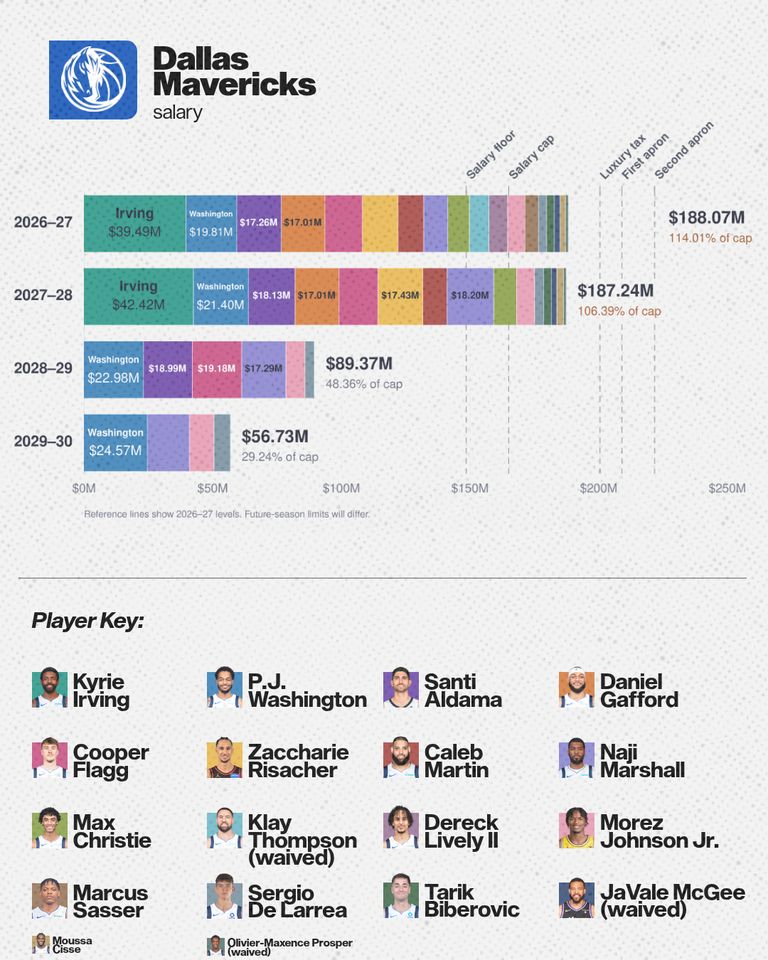
Cap Sheet
Offseason Overview:
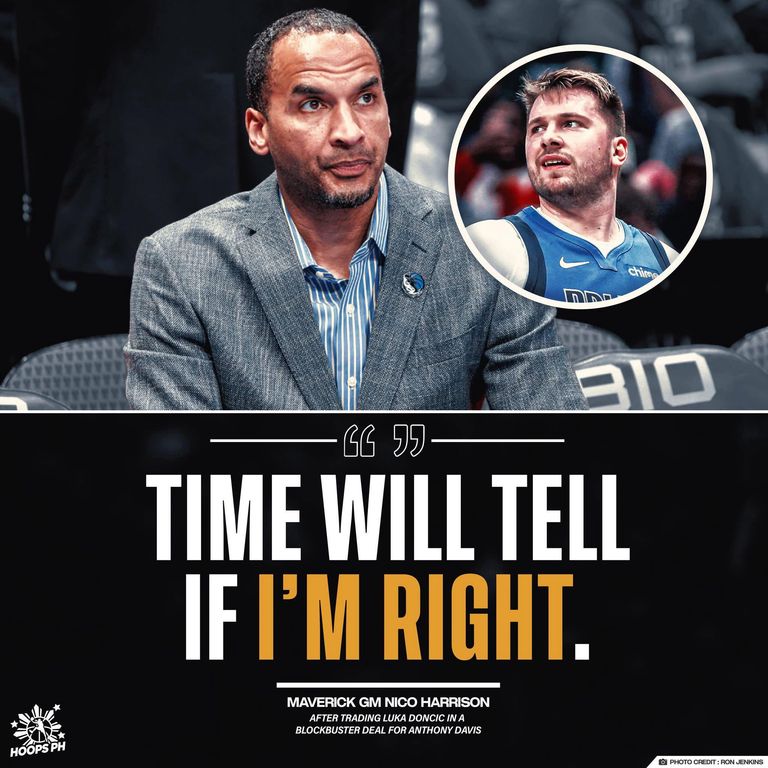
When any organization sees a drastic change, the effects of that loss, and the ensuing addition, tends to take its' sweet time seeping through the entire structure of a business, club or basketball team. For instance, even the shockwaves from the Luka Doncic trade, which was hilariously unpredictable and so bewildering that I vividly remember fact checking it twice before I fully believed Shams' word, have yet to cease rebounding throughout the foundations of the Mavericks. The ramifications of trading away their franchise player were delayed by Nico Harrison's delusional plan to pivot to a contending roster featuring Kyrie Irving and Anthony Davis, further proven by their subsequent move trading away Quentin Grimes PLUS a second round pick for Caleb Martin, an older veteran with an additional 3 years of salary (Grimes was headed to restricted free agency).
For the briefest of moments, Nico Harrison's plot looked just a bit less nonsensical, with AD erupting for 26 points, 17 rebounds and 7 assists in his Mavs debut. They felt like an impenetrable defense without Luka sandbagging their rotations, holding the Rockets to their 8th lowest opp eFG% allowed, then reality kicked in. AD missed the next 17 games and would end up playing just 29 games as a Maverick. Kyrie Irving tore his ACL on March 3rd and the Mavs dropped from the 15th overall DRTG with Luka to 21st without him, which allowed the Mavs to stumble their way into retaining their 1st round pick.
Winning the #1 pick blessed Harrison with a new cornerstone that he hoped could placate the fans clamoring for him to be fired, as he clung stubbornly to his "win-now" approach in an attempt to validate the roster he constructed. That's why the Mavs re-signed P.J., Kyrie, Gafford and Exum, insisting on trying to fit the vestiges of the infrastructure that was once collected to complement Luka around Cooper Flagg. Harrison wouldn't last more than a few weeks as GM once the 2026 season started, getting canned by the same ownership group that pivoted to scapegoating him for the plan they had approved just nine months earlier. His dismissal kicked off another wave of restructuring, likely serving as the catalyst for the Anthony Davis trade deadline move that netted Marvin Bagley, AJ Johnson and Khris Middleton, plus two 1sts and three 2nds, with 2 of those picks turning into Sergio De Larrea and Tobi Lawal in the '26 draft.
Masai Ujiri was hired as his replacement and Dusty May got poached from Michigan to lead the new era of Mavericks basketball in the wake of Jason Kidd's departure, which completed the installment of fresh blood in the front office. The roster still bears the lingering stench of Nico Harrison's decisions, with 7 of the players 77 went to battle with in 2025 still wearing a Mavericks jersey. This makes the 2027 season a vital one in identifying the players who will flank Cooper Flagg as he develops, the first one that's truly separate from Luka Doncic, with Masai's first task almost certainly being to craft a better developmental environment for their guys, especially considering their attempted rehab of Zaccharie Risacher's value.
Got some questions about where different teams ranked, so here's the entire league ranked (in reverse order) by Dev Environment Score*
🥇 PG Play/Ball Handling: Flagg -14 in his ~ 610 mins as PG, -2.01 at SG/SF, +5.7 TS% boost with Nembhard on the floor
Partially Addressed: Kyrie is back in the fold, they acquired Sasser and De Lerrea, still need to consolidate the frontcourt depth into another handler and continue to deploy Flagg at his natural position
🥈 Halfcourt Versatility: 30th in Halfcourt PPP, below average in every playtype besides Putbacks and Transition
Partially Addressed: Kyrie has had a positive impact on his team’s HC efficiency every year of his career, kept the 24 and 25 Mavs respectable in his minutes without Luka. Roster has so many play finishers however which means Dusty will need to be creative
🥉 Frontcourt Playmaking: 30th in Passes per game by Centers, 5th lowest by forwards
Partially Addressed: Santi is certainly a more capable passer than most forwards, but Risacher and Morez are a bit lower relative to positional averages. Lively’s health is the biggest factor, if he can play than they’ll be a much more dynamic P&R team
Season Outlook:
1) What does the Morez Johnson Jr. pick mean for Dereck Lively’s future in Dallas?
Dereck Lively had a relatively pedestrian rookie season from a box score perspective, putting up just 8.8 PPG, 6.9 RPS, 1.4 BLKS, 0.7 STLS and 1.1 ASTS. Once we expand our scope beyond the archaic box score however, his debut NBA season becomes far more impressive. The Mavs' overall halfcourt offense was 7.5 points per 100 possessions BETTER when Dereck played, the 13th biggest swing of the 244 players to play at least 1000+ minutes. Playing 90% of your minutes with Luka Doncic can lead to such a signal, but Lively popped enough in impact metrics to suggest he had more of an influence over DAL's offense than your traditional hyper-efficient big, posting a 84th%ile estimated plus-minus at 19 years old and excelling in RAPM estimates due to his ability to assist the Mavericks' in converting at a higher-rate on the advantages Luka (and Kyrie) created.
Dallas ranked 21st in the league in Roll Man scoring efficiency (1.1 PPP) and jumped to 1.203 PPP with Lively on the floor, the equivalent of the 9th best roll man PPP in the league. They generated 2.93 assists per 100 possessions, Luka was almost 3 points more efficient as a scorer and the Mavs' ORTG on 2nd-chance opportunities (after an offensive rebound), spiked from 127 to 135. All of these data points capture just how impactful a high-feel, playmaking big is for a team oriented around the most-blitzed player in the league, as Lively's passing helped immensely in 4 on 3 situations on the short roll, on kickouts after he grabbed an offensive rebound and in out of bounds/sideline out of bounds scenarios. You combine that ability with 72.8 TS%, 11.4 OREB% and 5.2 BLK% and it's clear why Lively played 55% of the center minutes in high-leverage moments. His production has been steady in the small sample of minutes without Luka, maintaining stellar efficiency and taking on a larger playmaking burden without a corresponding spike in turnovers.
The only problem is Lively has played just 36% of Dallas' minutes in his 3 years in the league due to a variety of injuries, appearing in 11 games since the Luka trade. An ankle sprain in January 2025 ended up being a misdiagnosed stress fracture, a mistake the Mavericks' medical staff didn't catch until Lively had already undergone a strenuous on-court workout. He needed to get surgery to remove bone spurs form that foot in the summer, was active to begin the 2026 season but then had season-ending foot surgery. The right foot surgery he underwent in December 2025 has kept him out indefinitely, with an initial prognosis to be ready for training camp that has developed into a much more nebulous, "whenever he's ready". This uncertainty had to have factored in to the Mavericks' selection of Morez Johnson Jr., although there are several other factors that likely motivated Dallas.
Dusty May was Morez's collegiate coach at Michigan, where Johnson played 46% of his minutes next to a true big in Aday Mara. Plus, Morez is the exact type of mold Masai Ujiri pursued for years when he ran the Raptors and the Mavs have established a precedent of retaining bigs no matter what the rest of the roster looks like, matching Moussa Cisse's offer sheet and nearly bringing back Dwight Powell for one more year. Dallas currently has a league-leading 6 players with the "Big" positional tag on their roster, evidence of just how much they value having multiple bigs. Perhaps this means the Morez decision would've been made even if Lively was healthy, although the front office opting not to extend Lively this offseason does indicate a desire to further validate what he looks like fully recovered. This is of course driven by the unfortunate history of bigs' struggles after suffering a lower-body injury, but Dallas also needs to experiment with how/if he and Morez can play off of one another and which better complements their franchise cornerstone.
My money would be on Lively's passing winning over Morez's motor and activity and I'm fascinated to see if the Mavs can manufacture lineups with enough strong decision-making in the backcourt to make a Morez/Dereck pairing tenable. I envision the Mavericks reaching an agreement with Dereck in RFA, especially considering their dire FRP situation.
2) Can the Mavs turn their frontcourt logjam into another player who can handle the rock?
In the first few regular season games, the Mavericks' on-ball responsibilities have mostly been handled by Coop, Kyrie Irving and Naji Marshall. Flagg is running the most pick & rolls per game (11.3) and is leading Dallas in AST% (32.2%), Naji has the largest share of his possessions as a handler (61.1%) plus the most per-minute passing volume (14.8 POT Assists, 2.8 Rim ASTS per 100) and Kyrie has been their most efficient self-creator, shooting 66 TS% on Isos/PNR/Post-Ups (95th%ile). Dallas was also able to pick up Walter Clayton Jr after he was waived by Memphis for some additional handling help and their rookie, Sergio de Larrea, has had some moments of intrigue on-ball. At a glance, this may appear like an ideal separation of duties with multiple handlers, but the underlying team results thus far suggests limitations with these usage distribution.
It's still extremely early, but this Dallas team is 27th in TO rate (18.5%), 27th in loc eFG% (shot quality estimate), 27th in rim frequency (23.1%) and 30th in FT rate (15.6, lowest in modern franchise history). These rankings aren't so drastically far from their preseason performance or the baseline they put up last year, a 2026 campaign that led me to describe Dallas the toughest developmental environment in the NBA due to the heavy midrange volume, lack of assisted bucket generation and low frequency of spot-up attempts. The Mavericks are exhibiting those same characteristics thus far, which makes them one of the more variable offenses in the NBA. Inconsistencies getting all the way to the rim is why their FT rate is so low, teams with this intersection can become too reliant on shotmaking ability to keep the offense humming.
Zaccharie Risacher is joining one of the roughest developmental environments for his play-finisher skillset in the NBA
Dallas is one of just 2 teams with a bottom 10 rank in AST% (60.6), Moreyball% (65.2), Spot-Up Frequency (21.9%) & Spot-Up PPP (1.01) in the last 2 years! https://t.co/ScQ9uhoL0Ypic.twitter.com/U1xxe4wq40
The lack of complementary passing volume alongside their 3 main players is one of the biggest culprits, with their 3 most played players, P.J., Christie and Risacher all grading out as below average volume passers at their position. Risacher and PJ are particularly static in that aspect, which I expected considering Zacch graded out as the least prolific passer in Atlanta's rotation last year per my hand tracking. The unique shot profiles of Coop/Irving/Naji are also dictating the lack of rim volume, as they are some of the more idiosyncratic on-ball operators in the league.
per my hand tracking, Zaccharie Risacher was ATL's least effective self-creator (.47 PPP) and scored just 1.56 on set play-calls (3rd worst)
It's worth mentioning here that Dallas' midrange attempts are not like most other teams (besides Memphis). They are 1 of just 3 teams attempting 10+ floaters per game thus far and are 2nd in points per possession, blitzing teams to the tune of 1.49 PPP. Kyrie is one of the most gifted touch-based finishers in league history and Naji has earned a reputation as #FloaterMan, plus Coop has been well on his way to patenting the floater as a massive strength in his game. His apparent ambidexterity/versatility in how he gets his floater off may prove to be a massive part of his game (and a helpful tool vs Wemby for years to come), a quirk that is increasingly more of a feature than a bug as he further proves his touch.
all of Cooper Flagg's Iso floater FGA from his league-leading efficiency on such shots (as the youngest player itl)
his apparent ambidexterity/versatility in how he gets his floater off may prove to be a massive part of his game (and a helpful tool vs Wemby for years to come) https://t.co/ySMZG0hFpNpic.twitter.com/XKo5REZCy0
These aspects of Dallas' offense: heavy floater volume, low FT rate, low rim rate, reliance on tough shot making, etc. hint at a lack of sustainability even if Kyrie, Flagg and Naji can continue to outperform their expected FG% per NBA.com. The greats in this league do that exact thing year after year and Dallas' on-ball players have mastered shots that are "bad" for other NBA players, though even the slightest regression threatens to crumble the foundation of their offense because of the static supporting talent. The Mavericks' offense slowly beginning to reflect the principles May prioritized at Michigan and FAU can help insulate this vulnerability, as May's teams were constantly T60 ish in rim frequency and one of the faster paced squads in the country (DAL 5th in transition frequency).
Flagg has started this season on an unbelievable tear considering this context, pushing a neutral AST:USG rate (insane at 6;9 and 30+ USG%) while leading his team in STL% and FTR while ranking 3rd in BLK%. It's possible that Flagg is just that good this early, though DAL would be shrewd at continuing to build with the best context for his game in mind, flanking him with multiple handlers like Duke did. Daniel Gafford and Caleb Martin are the clear best candidates to be moved, but they're both overpaid relative to their impact and have been dangled in trades for quite some time with not much buzz. The Mavericks could find themselves having to make a tough decision between P.J., Risacher and Santi at the deadline.[1]
3) Flagg’s worst 2-man lineups featured Christie, P.J. or Naji, are Santi & Risacher going to be able to shoot their way out of that same fate?
Flagg was generally better in his rookie season when he was playing with other handlers, with Brandon Williams and Ryan Nembhard both assisting in keeping his turnovers down. His minutes with Williams unlocked more rim FGA for both himself and the team, while Ryan's handling boosting their rim and 3P scoring efficacy. They've moved on from these players but the existing infrastructure that caused challenges in the PG Flagg minutes remain (and they added more players who could complicate this dilemma).
"This intersection of a heavily assisted shot diet with little to no playmaking value on either end places Zacch in a group of players this season that no #1 pick would ever aspire to be comped to...The average estimated wins contributed for players with at least 80% of their FGM being assisted, while assisting on less than 15% of their team’s made baskets when their on the floor AND accounting for less than 2% of their teams’ blocks and steals, is just 0.9. Zacch ranks 26th among this group, at 0.4...The most jarring conclusion however, is how inextricably linked 3P% is with impact (eWins) among players of this archetype. Because so many of these guys are limited in the value they provide outside of their shot going in, they have to convert at absurdly high-rates from 3 on well above average volume to surpass league average impact."
"As we draw closer to that 750 career 3PA threshold that indicates stabilization, it’s becoming increasingly more likely Risacher is a 35-36% 3P shooter for the rest of his career. As we established above, he simply needs to be elite (38+%) to have a realistic path to above average impact. If this becomes reality, barring outlier development, Zacch will struggle to provide replacement level value throughout his career."
Acquiring Risacher and Aldama this summer meant stacking 2 more players on top of P.J. & Christie that are some approximation of this exact archetype, threatening to flank Coop with multiple players who are just a bit too reliant on him to be viable rotation pieces. Of these 4, Aldama is the most dynamic, attempting the most threes, ranking as the most prolific and efficient driver and boasting some passing flair from his time in Memphis' offense that the other 3 don't quite have. Zacch has been the most disruptive in this small sample, making timely rotations to rack up steals and blocks. P.J. is the most physical with a big-adjacent skillset and Christie is likely the best shooter, so I'm expecting the best wing combos around Coop to be partitioned as defensively-slanted and offensively-slanted duos. Christie and Aldama should provide the most offense dynamism once Santi is healthy and if P.J. + Risacher lineups can rebound better they may prove to be a strong defensive tandem next to Flagg. Whatever combo May ends up prioritizing, these 70+ assisted % players shouldn't be stacked without at least 2 handlers on the floor to compensate.
4) Will Kyrie be able to provide enough gravity to reduce Coop’s creation load?
The NBA's new "Inside The Game" stats that debuted last year include the expected field goal % we discussed in Question 2, plus some Gravity, Leverage, Zone Defense and Handle Score statistics. The Gravity one has drawn my intrigue (although I wish they would backfill some other recent seasons), especially seeing Klay Thompson rank 6th last year. He and Duncan Robinson are the lone non-offensive engine/on-ball operators in the T20 or so, underscoring the impact of movement shooting volume. There are of course many different types of gravitational pull a player can exert on a basketball court, with this single season sample suggesting that outside of legitimate stars, players who thrive out of off-ball motion bend defenses to a great extent (THJ, Monk Kennard, etc. are also in the 30s or so).
The 2026 Mavericks didn't have a ton of other options to draw defense's attention, which likely inflated just how much teams reacted to Klay moving about the perimeter. 100th%ile possession share as an off-screen and handoff shooter forced defenses to commit to Klay even as his 2P scoring and OTD pop completely fell out the bottom, but his presence didn't exert much influence over Cooper's effectiveness in any meaningful way. Flagg saw a slight bump in his FTAr and the slightest improvement in his scoring efficiency despite a massive spike in his 3P% (almost 10 percentage points), which may seem like nothing but shot variance, BUT Klay Thompson's presence severely increased the amount of unguarded 3-point attempts Coop was able to get up. With Thompson off the floor, 50.5% of Flagg's 3PA were unguarded (shot 22.7%). Once Klay joined him, his unguarded 3PA share was almost 62%. Cooper didn't take a ton of threes regardless last year so a marginal improvement in his shot quality just by virtue of playing off of Klay is pretty valuable, even if it was an extremely indirect effect.
Kyrie projects to have a more concrete impact on opening the floor up for Flagg, mainly off the virtue of being a much bigger threat off the dribble. Running Thompson off the line last year (and in Miami) was an automatic win for the defense, Irving will be able to punish teams more effectively. Spacing, Handoff and Off-Screen plays haven't been a large part of his playtype distribution and May seldomly used Handoffs and Off-Ball screens in his last 4 years coaching in the NCAA, which leads me to believe Kyrie's gravity impact will be much more on-ball slanted.
5) How creative can Masai get building a team with virtually zero control over their draft picks?
One of my most popular videos on Tiktok to this day is my analysis of how Luka Doncic's and Lebron James' rise to superstardom inhibited their teams from putting cost-controlled talent around them because they were too good, too early, playing themselves out of prime draft positioning. If Flagg keeps stacking games like the way he's started the season, he might just be on the same trajectory, but unlike Luka's time in Dallas, there are pretty much no inbound draft picks that the Mavericks will be too good to reap the benefits from. Generational curses are inherited, Flagg could experience the same shackles Doncic was trapped under simply because Luka ascended so fast that Dallas fired off multiple picks from their cupboard. Nico Harrison's refusal to let go of contending aspirations further depleted that arsenal before they had a chance to recenter around Flagg, leaving the Mavericks with full control over just 2 of their next 5 draft picks (2028 and 2031).
Being in such a situation necessitates creativity. It demands best in the league scouting across the globe and within the league itself, canvassing for undervalued players who can produce in a more conducive context. Dusty May's track record of punching above the apparent talent of his rosters has to have been a driving factor in his hiring, amassing teams at FAU that would go on to not just make a Final Four run, but have players featured on other dominant NCAA teams (Alijah Martin at Florida, Nick Boyd at Wisconsin, Goldin at Mich, etc.). Dallas will need to approach every avenue of player acquisition opportunistically, replicating the process that landed them Walter Clayton Jr. and Zaccharie Risacher for cheap (at least relative to where they were drafted). I'm curious to see how aggressive they are in the restricted free-agency market and eager to see just how much May is allowed to experiment with fringe/hyper-specific talents.
Record Prediction
Combined Odds: 35.5 via multiple sportbooks
My Model Projection: 31.7 (23rd of 30), -3.33 Net Rating, 5% playoff odds
Floor: 30-62 (+4 wins)
The Mavs are one of the deepest teams in the league, but sadly the bulk of their depth is at positions with a ton of redundancies, which projects to really limit their lineup versatility. I wouldn’t be surprised if this team is a bottom 10 offense even with Kyrie back on the floor.
Ceiling: 40-42 (+14 wins)
We’ve only seen Kyrie as a lead creator in one stint, his 2 years in Boston, with both seasons comprising the weakest offenses he’s been a part of. His skillset is amplified as a complementary player, as his space creation ability hasn’t quite translated in a primary role. How will he function in that role once more, at age-34 after a year off from basketball that he spent rehabbing an ACL tear, especially for a team that doesn’t have much handling support? It’ll take a big leap from Coop, Naji sustaining his upward trajectory and health from Lively for this team to challenge for a Play-In spot, which honestly feels like a lot of fortune to ask for.
Overall Grade: C-
Let me know if you agree with my predictions! What are your expectations for the Mavericks this season?
Up Next: Miami Heat
Footnotes
↩not a tough decision for me though, imo Dallas should try and pump risacher/pj/santi value as much as possible and trade as many of them as possible
I’m a lifelong basketball enthusiast who blends film study and advanced analytics in my independent coverage of basketball and the NBA Draft across Tiktok, Twitter, Youtube, Substack and Instagram. I’ve also covered the Hawks for ~2 years as an accredited digital journalist for Afro News, and I am a member of the Atlanta Hawks’ Creators Collective.



Comments