Welcome to the 4th edition of my annual 30 teams in 30 days series, the most comprehensive and informative previews for every team in the NBA. Inside these posts, you’ll get up to speed with every team’s offseason additions and their roster hierarchies, learn whether they’ve addressed their biggest areas of need, ponder over 5 questions that will define their season and then decide whether you agree with my offseason grades and record predictions. For the first time, these articles will be exclusively posted on the Hardwood Collective and are paired with video deep-dives over on my Youtube and full-length podcast episodes over on The Fifth Factor!
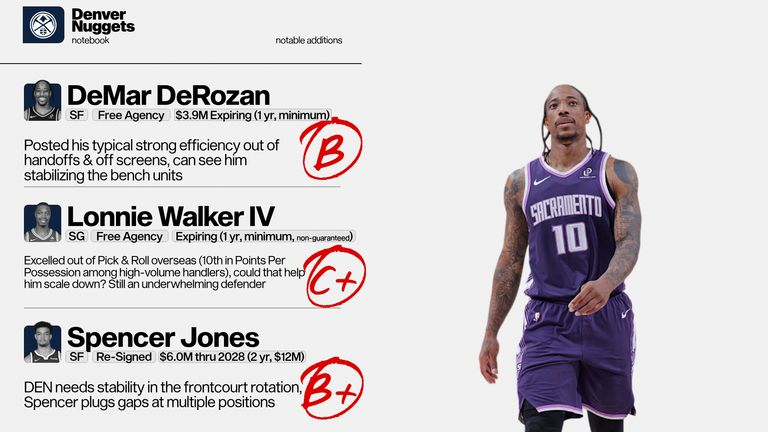
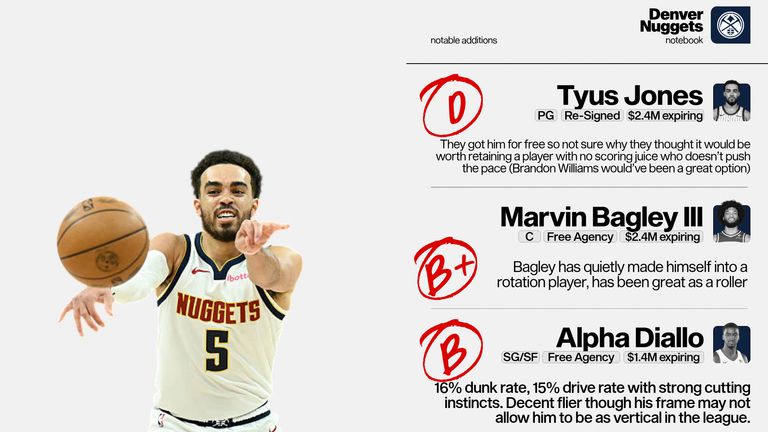
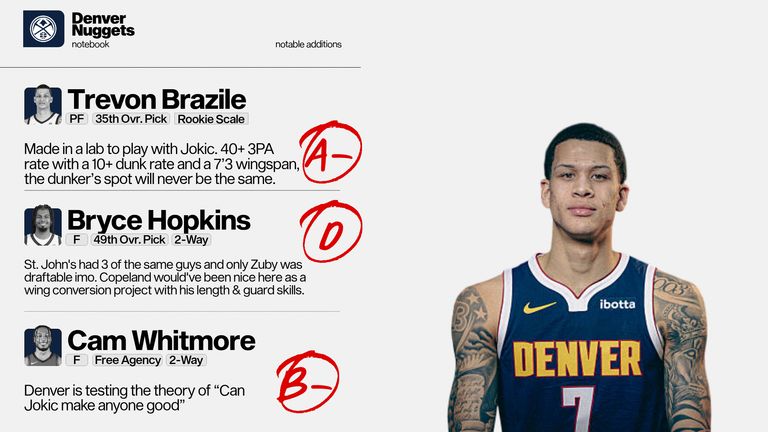
Notable Additions: DeMar DeRozan, Lonnie Walker IV, Spencer Jones (re-signed), Tyus Jones (re-signed), Marvin Bagley III, Alpha Diallo, Trevon Brazile, Bryce Hopkins, Cam Whitmore
Draft Pick Comps & Strengths + Weaknesses
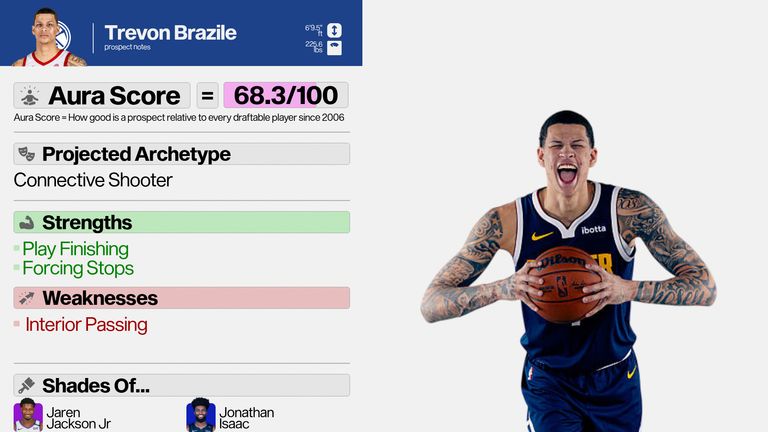
#35: Trevon Brazile to DEN:
Brazile made a massive FT% leap while also cleaning up the turnover issues that were blocking him from getting drafted. He’s had a NBA frame since he stepped on a basketball court and produced massively as Arkansas’ lead rim protector, transition lob threat and pick & pop big (popped 50% of the time he set a screen). 6’10 with a 7’4 wingspan and 99th%ile vertical testing combine score is the definition of elite measurables. I don’t think there was any player better equipped to step in for Aaron Gordon right now for stretches, but I do think Chris Cenac would’ve been a better investment long-term.
Playstyle shifts aren't inherently good or bad, but here are some guys that i think saw positive or slightly concerning shifts (min 50 mins played):
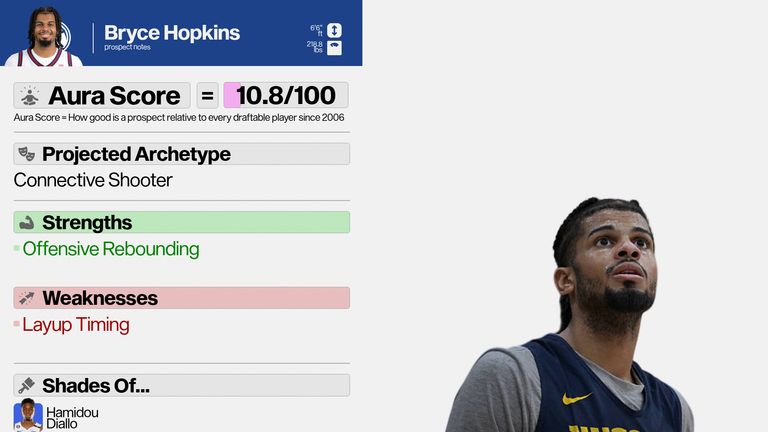
St. John’s played “chaos ball” last year, pummeling teams with their trio of bruising forwards/bigs, Ejiofor, Mitchell and Hopkins. Pitino had the Red Storm run an offense that featured the highest handoff volume in the nation, which could prove to be helpful for Bryce as he transitions to a DEN team that similarly tops the NBA year of year in DHO actions. He improved as a 3P shooter and drove the ball a ton, but isn’t the athlete Dillon and doesn’t have the feel x strength x self-creation hopes of Zuby, so I’m skeptical about his translation.
Notable Subtractions: Peyton Watson, Tim Hardaway Jr., Jonas Valanciunas, Jalen Pickett, Tarris Reed Jr., Bruce Brown, David Roddy, Julian Reese
Depth Chart + Roster Hierarchy
Franchise — Nikola Jokic
Core — Jamal Murray, Aaron Gordon, Christian Braun
Rotation — Zeke Nnaji, Julian Strawther, Tyus Jones, Lonnie Walker IV, Alpha Diallo, DaRon Holmes II
Development —Trevon Brazile, Bryce Hopkins, K.J. Simpson, Cam Whitmore
Cap Sheet
Offseason Overview:
In the summer following the Nuggets’ championship, Denver’s General Manager, Calvin Booth, sat down for an interview with the Ringer. He spoke at length about what he values when building a roster, their plan for building within the constraints of the CBA and making the statement that “if everything is optimized, we should win three or four [titles]”. Booth was brimming with a confidence he earned by making the shrewd moves that turned Denver into a title team, bringing in KCP for Will Barton & Monte Morris, signing Bruce Brown and drafting Christian Braun and Peyton Watson. He was militant at reducing “overlaps” on the roster, areas where players’ style or defensive limitations had cascading negative effects, identifying Bones Hyland as one such incongruent player and cutting him loose for 2 seconds.
A key element to his plan was selecting rookies that were “a tad older, a tad more mature, and played for a major program,” which DEN made apparently clear when they traded a 2029 future 1st during the Finals to split it to one 1st and 2 seconds. Booth was attempting to replicate the success he had with Christian Braun, utilizing the much cheaper rookie scale contracts to add immediate contributors with a good bit more runway than a traditional vet rotational player. The Nuggets brought in Hunter Tyson from Clemson, Julian Strawther from Gonzaga and Jalen Pickett from Penn State, multi-year college players who demonstrated all the intangibles Booth had tabbed as important.
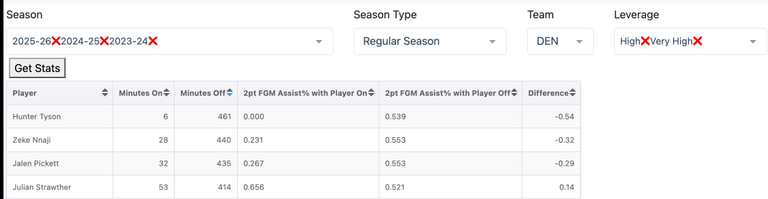
3 years later, only one of these players, Jalen Pickett, returned plus value relative to draft slot, who Denver opted to not retain this offseason. Hunter Tyson has 600 career minutes played and was traded away at the deadline, Julian Strawther has the 8th worst VORP in the class and less than 10% of their high-leverage minutes (clutch moments with the game in balance) has featured even one of these players they mortgaged a future trade asset to add. To make matters worse, Christian Braun’s offense has regressed so dramatically that his extension is now widely regarded as one of the worst contracts in the league. 3 years later, and the Nuggets have failed to advanced past the semifinals once, despite having the best player in the world.
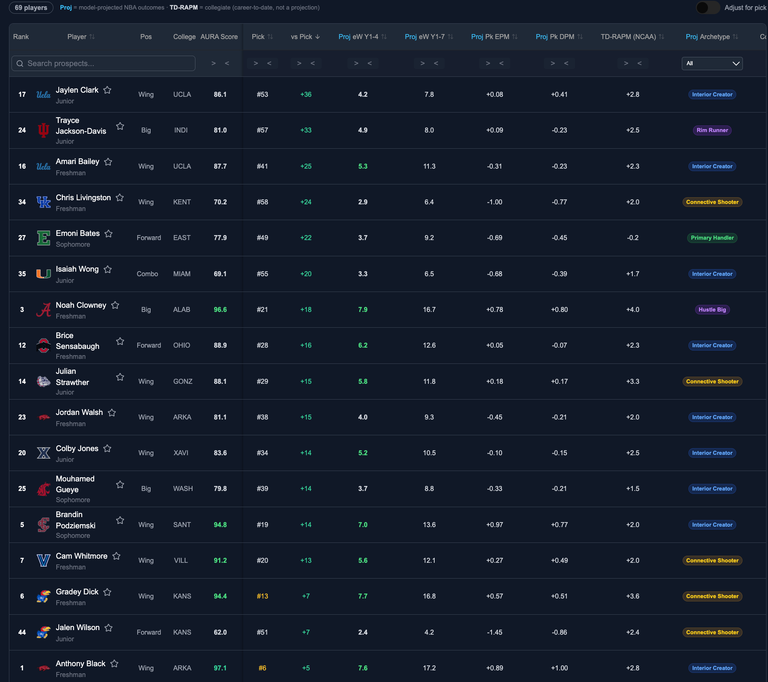
This approach had some validity, Booth just made a few misses in his selection of the players who needed to surround Jokic. He’s on the record valuing size and length, but this Nuggets team has been starving for athleticism. I also imagine they overindexed on quality of the collegiate program as a signal, as 2nd round players such as Jaylen Clark, Trayce Jackson-Davis, Mouhamed Gueye and Jordan Walsh all popped in my draft model, fit their system and have outperformed their 3 picks this far. Denver had enough of being at an athletic disadvantage, taking this offseason to take multiple swings across international leagues, in the draft and on the NBA free agency market, adding ++ athletes such as Trevon Brazile, Cam Whitmore, Alpha Diallo and Bryce Hopkins, operating with the premise that Jokic can make anyone work on offense.
Pre-Draft Areas of Need:
🥇 Athleticism: 27th in Dunk Rate (13.3%), 24th in Transition Frequency (1st year in the bottom 10 in Jokic era)
Addressed: DEN took chances on a bunch of different strong open-court athletes, in the draft (Brazile/Hopkins), by canvassing international leagues (Lonnie & Diallo) and with the Cam Whitmore signing
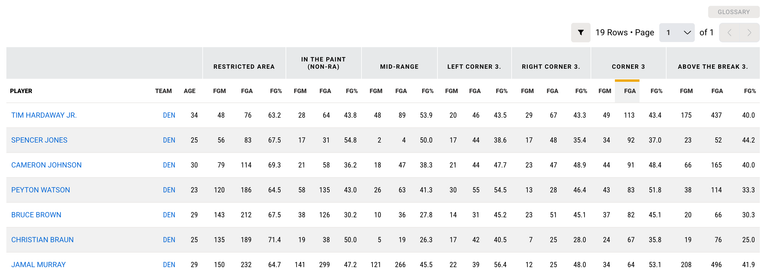
🥈 Shooting: #1 HC offense, #1 in OTD Jumpers, #1 in Corner 3PT FG% (44.2%), #1 in 3PT FG% (39.7%)
Not Addressed: DEN’s offense doesn’t generate a ton of corner 3s but they’re often high-quality looks. 3 of their top 5 in made corner 3s were lost in free agency/via trade, everyone they added are less willing/less proven shooters
🥉 POA Defense: 28th in opp Rim FG% (70.6%), 4th in opp Rim Frequency (28.8%)
Not Addressed: still have their main POA defender, while Peyton/THJ/Bruce isn’t the strongest trio, Demar/Diallo/Lonnie could be a downgrade
1) Who is the most likely casualty to the luxury tax at the deadline?
The Denver Nuggets’ owner, Stan Kroenke, is the largest private land owner in the country, staking a claim to the equivalent of 2 million football fields of farmland across Texas and New Mexico. He also boasts the world’s largest sports portfolio, owning stakes in not just the Nuggets, but also the Rams, the Avalanche, the Rapids, Arsenal and Arsenal WFC with the whole collection valued at roughly $22 billion dollars. His investment in these teams was a measly 3.8 billion in comparison, which makes him one of the most lucrative sports owners we’ve ever seen and enables him to do things like conquer yet another sport with a $4 billion purchase a majority stake in the Los Angeles Angels.
Paying the luxury tax arbitrarily is foolish, teams don’t win championships just based on having the highest payroll, but so is not retaining or adding talent because of the financial constraints that were imposed by previous deals, especially when the funder of said team is unbelievably loaded! Even the cheapest valuation for Watson would’ve ballooned their tax bill to $200+ million, which would’ve sent their total roster cost above $400 million dollars, but we’re talking about a team that generated revenue north of $380 million dollars last season. Peyton Watson shouldn’t have had to pay the price of his employer being unnecessarily frugal & frivolous with their previous extensions (Nnaji, Braun), especially since there’s ample room in Kroenke’s pockets. The Nuggets actively prioritized getting under the luxury tax at the 2026 deadline, moving Tyson for a 2nd, signing Tyus Jones for a pro-rated minimum and converting Spencer Jones’ 2-way to a rest of season contract instead of signing him to a standard contract, which ended up costing them dearly once OKC signed him to an offer sheet that Denver had to match this offseason. This is far from the last time the tax “stopped them” from retaining talent, which led to KCP and Bruce Brown departing the title-winning roster.
the CBA may APPEAR to be costing Peyton Watson & friends a lucrative deal, but…
1) RFA have always gotten squeezed 2) blaming the CBA allows owners to scapegoat an artificial barrier 3) a RFA in today’s cap environment didn’t inspire enough confidence to offer them an extension https://t.co/RJKCRyyIxUpic.twitter.com/Jzctyu475C
There are restrictions beyond the repeater tax, but don’t fall for the 2nd apron propaganda that owners selected to install as a scapegoat for financially motivated decisions. Teams don’t want to be above the 2nd apron any more than they don’t want to be in the luxury tax, and a team would need to be there for 2 years for it to be truly punitive. The Nuggets committed years ago to this core of Jokic, Gordon, Murray (and at the time MPJ) and should’ve been more diligent with the contract they offered Braun. Now they’re staring at the possibility of having to trade one of (if not more) Murray, Gordon or Cam Johnson to duck the tax once more, as they don’t have much sweeteners left to convince a team to take on a contract like Zeke Nnaji.
They got a 1st back for Watson, that they could try and trade with Nnaji to get under the 2nd apron. To get out of the tax, it’ll cost departing with one of their core starters, the nuclear option I think they’ll only take if the season is a complete catastrophe.
2) Is there any hope that Christian Braun can provide enough value to justify his deal?
$25 million dollars is a steep commitment to any player, but it’s even more risky when you’re paying a player just 3 years removed from being drafted, whose offensive viability is tied to your best player. The rookie extensions are designed to give teams a chance to negotiate favorable terms with their prospects in exchange for a long-term commitment, thus they make the most sense when the team gets a discount on the value teams around the league would offer in free agency (which are shorter-term contracts) by offering the safety of a longer deal. This is one of those instances where Denver should’ve just let this go to restricted free agency.
The problem with identifying these cheap contributors early is that they stop returning value if you overpay, which is exactly when Denver did in an attempt to reward him for his development and contributions to the title. It’s hard to imagine a team valuing Braun this highly on the open market, especially since he’s exclusively a complementary offensive player with one of the easiest shot diets in the NBA and one of just 2 starting players at his position in recent memory to attempt so few threes. Offensive impact goes beyond just putting the ball in the basket, Dyson Daniels is one such example, but Braun doesn’t have the disruption or passing feel of a Daniels to make him viable in the halfcourt. As a result, his path to coming close to providing the contract value he was paid for will depend on whether he can grow as a shooter and screener, with the bar for those offensive skills being higher if he can’t become one of the best on-ball defenders in the league.
3) Do the Tyus Jones & Demar Derozan acquisitions signify a commitment to a lower tempo style of play?
Denver has the privilege of using Nikola as the best offensive weapon in the league in their set offense, which is why they had the best offense in the league with the 6th highest % of plays in the halfcourt. Farming easy buckets in transition is an easy way to buoy offensive efficiency, so DEN being this dominant on offense with so little transition volume shows just how good Jokic (and Murray) were last season. This year though, they’re going to be missing so many of the shooters who carried their 3P efficacy.
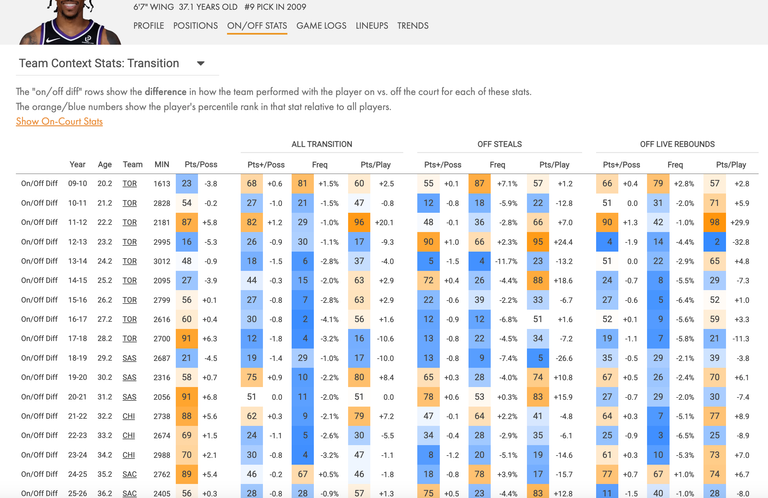
This Nuggets team is going to need to run as much as possible to compensate, letting some pressure off of Jokic to bang away in the post in the halfcourt. Tyus and Demar comprising a decent portion of their bench minutes may complicate this though, as they are both methodical players. Tyus used to lead high transition frequency teams in Memphis, but has been a net negative in most of his stops since he left. Demar is hands-down one of the biggest suppressors of transition play in the league, with just 2 seasons where he boosted transition frequency.
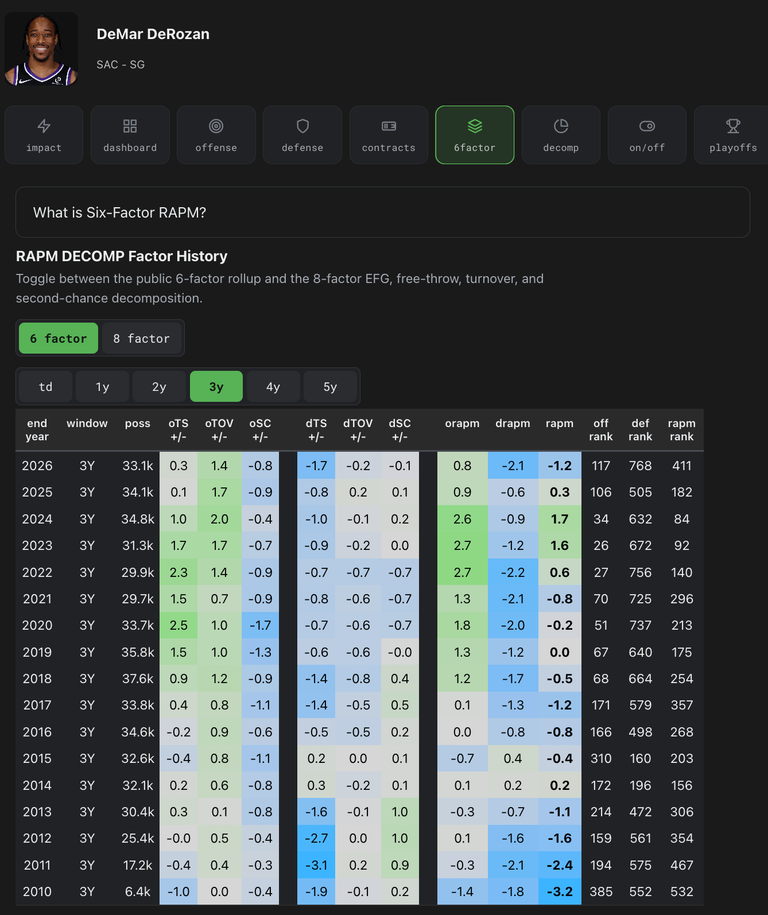
Denver could be doing this intentionally, as a lower transition frequency also comes with less turnovers, the area of expertise for both Tyus and Demar. Maybe the Nuggets are looking at these two to consciously slow the Nuggets down while they’re on the floor with the goal of reducing the turnover spike they’ve seen for years without Jokic. I’d argue that getting fastbreak points would be more beneficial over thousands of possessions, but this is a team that’s limited on handlers and limited themselves on options to address that issue, so this might be the best solution they had. DeRozan was more decisive in Sacramento, was excellent scoring out of screens and was still one of the highest FT rate guys in the sport, which could give them a scoring floor in the bench units.
4) Can DaRon Holmes, Marvin Bagley or Trevon Brazile stabilize the backup/spot starter 4 slot?
Aaron Gordon is second only to Joker in terms of both impact and importance to this team. They go as far as he can, providing a unique blend of vertical spacing, switchability, rim protection, short roll playmaking and out of completely nowhere, shooting touch from beyond the arc. AG shot 32.3% 3PT on 3.2 3PA, 68.3% FT on 3.2 FTA his first 10 years in the league after entering the league out of Arizona after a freshman season where he shot the 5th worst FT% of any drafted player since 2008. You could simulate his career 10,000 times and he would never develop his shot this effectively. His home, a warehouse dubbed “The Sanctuary”, where his bed is just feet away from half of a NBA regulation court, plus the time he spent in Orlando on higher offensive usage has allowed him to grow his game in so many different facets.
He’s one of my favorite developmental stories ever and is inconsequential to this team, as their vocal and spiritual leader, anchor of their defense and their most malleable player. Nagging injuries have sapped his effectiveness over the course of the regular season, moments that are exacerbated by just how rare and needed his skillset is. He’s so many players in 1, a big man with a wing’s mentality in all the best ways, which makes Denver really feel his absences. Holmes, Bagley and Brazile all have different elements of what makes Gordon great, but I believe Brazile offers the best combination.
We didn’t need to see a 99th%ile combine performance to know Brazile is a ridiculous athlete, but it was nice to see how freakish nature officially quantified. Trevon’s 7’4 wingspan and 41.5” vert gives him access to space above the rim Holmes & Bagley can’t access, best replicating Gordon’s dunker spot efficacy. Trevon also stretched his range beyond the 3P line this year, giving Joker a corner outlet option. He’s a strong rim protector and effective switching on to guards, but has not shown as much off the dribble as DaRon. Holmes is best suited to fulfill the big wing components of AG’s game, as long as the Achilles didn’t rob him of too much developmental time. The Nuggets will try these guys + Spencer to see who works best and I’m expecting Trevon to make himself very hard to keep off the floor.
5) How successful of a season does DEN need to have to assuage any fears about Joker’s impending player option?
We haven’t seen a player anywhere near Nikola’s caliber leave in free agency in nearly a decade, and it was never going to be Jokic to be the one to drawn to the bright lights of another city. He was as clear as possible on his intentions at media day, stating that he will sign next summer. There was never really any doubt that anything besides this would be the case, as Nikola has historically had a very hands-off approach to inputs on the team and is generally very low-maintenance.
I think it gets interesting if the Nuggets insist on not trying to do their best to be as competitive as possible. Despite his nonchalant manner, Jokic is very much so a competitor, and another embarrassing loss to one of the teams that ended their season may lead him to finally apply some pressure. It’s touch to see anything as success for a core that won a title beyond yet another ring, so I do wonder where the bar is internally for this team as they navigate the conflicting goals of contending and saving money.
Record Prediction
Combined Odds: 49.1 via multiple sportbooks
My Model Projection: 51.3 (5th of 30), +4.52 Net Rating, 80% playoff odds
Floor: 49-33 (-5 wins)
Since Jokic’s ascension in his 3rd year in the league, the Nuggets have had an impenetrable floor of at least 46 wins. Given the way he started last year before injury, I’d be shocked if this team wins less than 48 games.
Ceiling: 58-24 (+4 wins)
DEN was on a 58-win pace before Jokic went down with a left knee hyperextension. When we consider that he’s one of the most durable stars in the league (has played 65+ games every year of his career) and his lineups beat teams by 11.5 points per 100 last year, even the downgrade in shooting won’t be enough from keeping the #2 seed in reach.
Overall Grade: — C
Let me know if you agree with my predictions! What are your expectations for the Nuggets this season?
I’m a lifelong basketball enthusiast who blends film study and advanced analytics in my independent coverage of basketball and the NBA Draft across Tiktok, Twitter, Youtube, Substack and Instagram. I’ve also covered the Hawks for ~2 years as an accredited digital journalist for Afro News, and I am a member of the Atlanta Hawks’ Creators Collective.
-768x960.jpg)
-768x960.jpg)


Comments