Welcome to the 4th edition of my annual 30 teams in 30 days series, the most comprehensive and informative previews for every team in the NBA. Inside these posts, you’ll get up to speed with every team’s offseason additions and their roster hierarchies, learn whether they’ve addressed their biggest areas of need, ponder over 5 questions that will define their season and then decide whether you agree with my offseason grades and record predictions. For the first time, these articles will be exclusively posted on the Hardwood Collective and are paired with video deep-dives over on my Youtube and full-length podcast episodes over on The Fifth Factor!
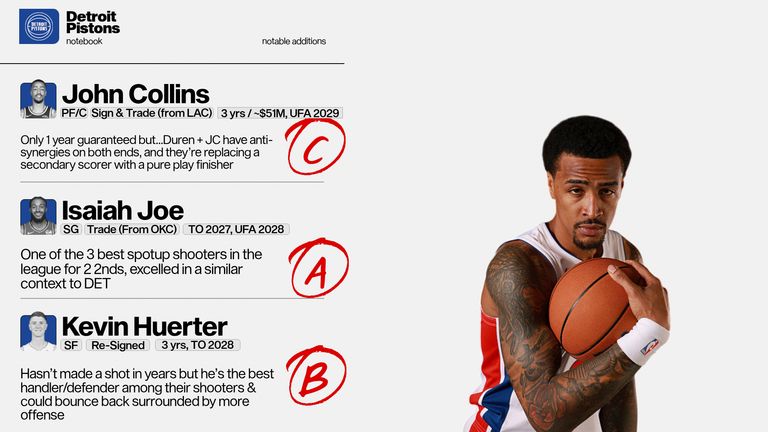
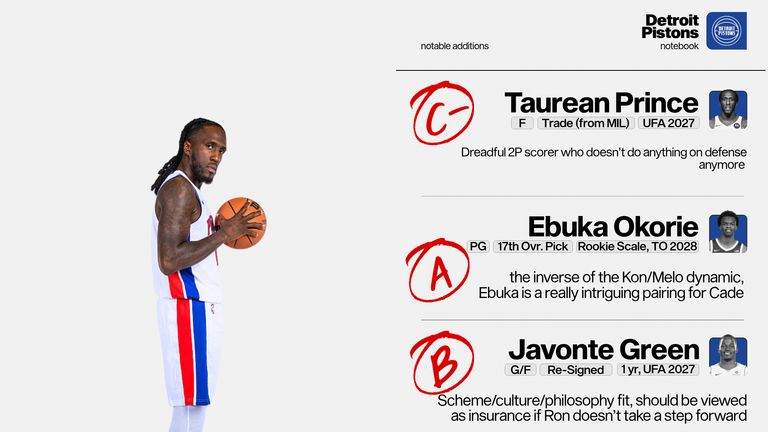
Notable Additions: John Collins, Isaiah Joe, Kevin Huerter (re-signed), Taurean Prince, Gary Harris, Ebuka Okorie, Javonte Green (re-signed), Ugonna Onyenso, Ausar Thompson (extension)
Draft Pick Comps & Strengths + Weaknesses
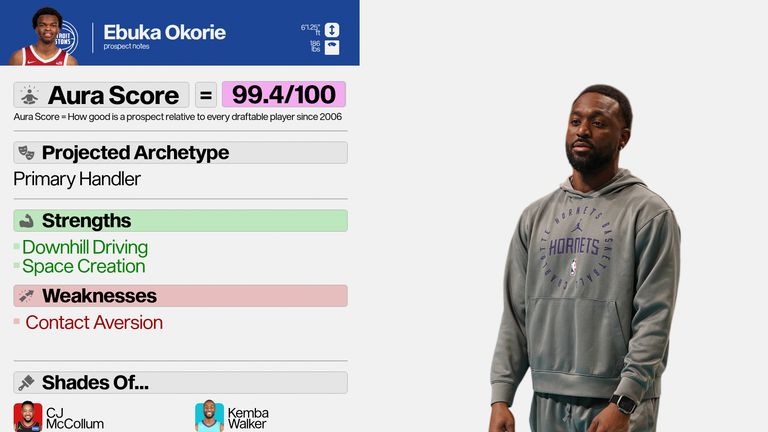
Ebuka Okorie:
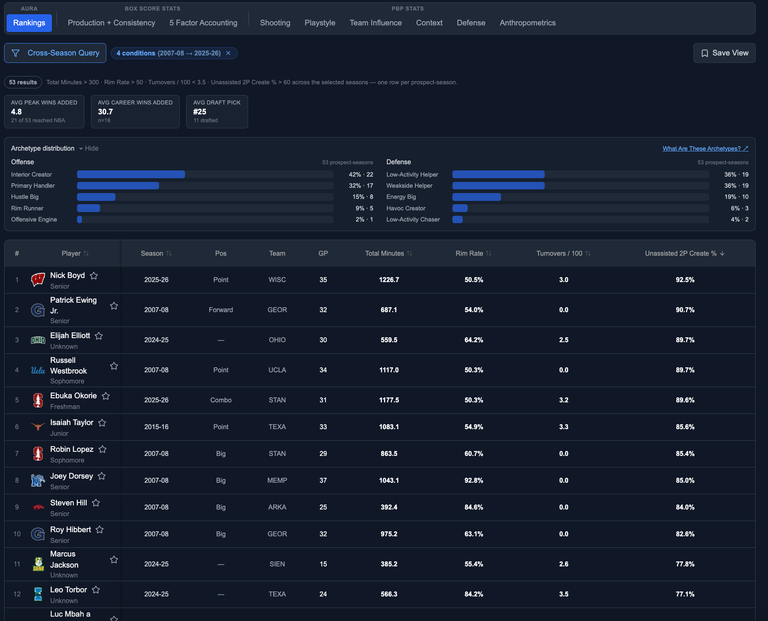
Okorie's combination of usage (30.1%) + high assist rate (23.9%) with TO aversion (10.4 TO% + 1.9 A/TO) is nearly unprecedented among freshmen. That low of a turnover rate while getting to the rim for 50% of his FGA is ridiculous, he had one of the lowest To rates on PNRs in the country, while ranking 4th in PPP. His 92 FT% w/ a 2.6 A/TO at Brewster pre-NCAA hinted at his offensive skills that he's used to destroy aggressive coverages all season.
Special handling ability + eye manipulation + spatial awareness & willingness to work off ball are some good foundational points to be a resilient scorer. Convincing a defender to help this aggressively off of the strong side corner is evidence of his ability to gaslight defenders into foolish mistakes. Stanford posted a 1.05 PPP in the HC with Ebuka on, 0.86 PPP with him OFF.
Unreal unassisted volume as well: 89.6% of his 2s were self-created, 59% of his 3s.Very rare to see a primary handler with this level of rim rate have so few rim assists, , most players who get to the rim this much and don’t generate assists are bigs, but this is a reflection of Stanford’s personnel limitations + how they played and not a shortcoming in Ebuka’s game. He averaged 3.9 3PT assists per 100 and about half of his PNR reps ended in a shot created for his teammates. Stanford ranked 296th in dunk rate and 15th%ile in cut volume, reflective of their roster really not featuring any above the rim players.
Aside from his 44.1 FTR, Ebuka has all the statistical indicators of being contact-averse. This could explain why he struggled so much as the rim even with his space creation and finesse around the basket. He doesn't get on the glass, foul or block shots at all, which presents a troubled outlook for even the most skilled guys
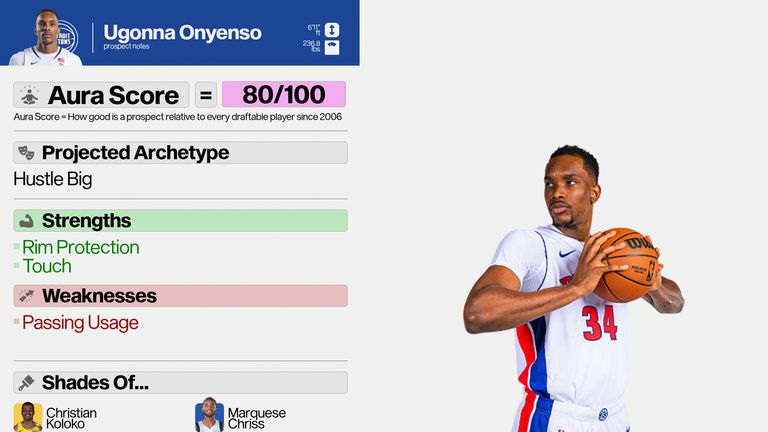
Ugonna Onyenso to the Pistons:
Excellent shot blocker that uses 7’5 wingspan to massive success. Absolutely destroyed any post player that challenged him, near 18% block percentage. Really good at playing the cat & mouse game in drop. Does have a strangely low portion of his blocks that get recovered by himself or his team, needs to do a better job at redirecting/keeping the ball in play to jumpstart transition opportunities. 22 of his 30 catch & shoot attempts came with De Ridder (their leader in postup volume) on the floor, showcasing some adaptability. Some of his offensive rebounds were likely cannibalized by De Reidder/Grunloh and being on the perimeter more than you’d imagine. Played so frequently with another big that just 21 assists in 36 games played feels egregiously low even if he only played 45% of their minutes. Virginia centralized their playmaking to their guards but if Ugonna’s path to coexisting with another big is just shooting the 3 I’m not convinced he’ll ever get enough volume. His touch is super soft at the FT line and in the paint however so perhaps there’s a chance?
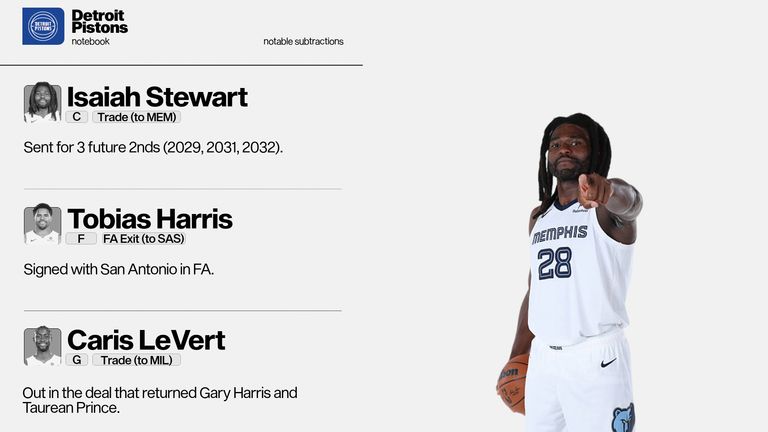
Notable Subtractions: Isaiah Stewart, Tobias Harris, Caris LeVert, Marcus Sasser, Karim Lopez, Malik Beasley, Wendell Moore Jr.
Depth Chart + Roster Hierarchy
Franchise — Cade Cunningham
Core — Ausar Thompson
Key Rotation — Duncan Robinson, Isaiah Joe, Paul Reed Jr., John Collins, Ron Holland II
Rotation — Daniss Jenkins, Javonte Green, Taurean Prince, Kevin Huerter
Development — Ebuka Okorie, Chaz Lanier, Tolu Smith III, Ugonna Onyenso, Isaac Jones, E.J. Harkless
Cap Sheet
Offseason Overview:
This offseason should've been one brimming with optimism for the Detroit Pistons. They had successfully taken yet another leap, winning 16 more games than they did in 2024-25, snagging the #1 seed with 4 of their 5 players who played the most minutes in 2022-2023. That was the year the Pistons wrote their name into NBA infamy, breaking the consecutive games lost record and getting beat by 8 points per 100 possessions worse than league average (40th worse in the 200s). Even considering the difficulties they faced in the playoffs, a 60-win campaign while winning at a T30 margin in the past 25+ years, all without mortgaging their future should've been a cause for unbridled hope for the upcoming season.
The issue was that a decent portion of DET's trials and tribulations in April was due to Jalen Duren drastically underperforming relative to his regular season baseline vs Orlando AND Cleveland. The Pistons front-office has been musing how to weigh the 70 game regular season sample where he was the best roller in the league (1.4 PPP), the 3rd best postup player (1.17 PPP), dominant on the offensive glass (4th in Points Added on Putbacks) and driving the ball exceptionally well (1.2 PPP, 3.4 TO%), vs a 14 game playoff sample where his overall efficiency fell by over 14 points, got blocked on 14% of his rim FGA, attempted 9 less true shot attempts per 100 , snagged 2% less offensive boards and saw his turnover% spike from 11% to 18%. It's one thing to struggle against a particular matchup, and an entirely other thing to be completely neutralized in every single facet of your game against 2 different teams.
Jalen Duren’s shortcomings have been ruthlessly exploited in the playoffs, creating a virtually unprecedented contract situation in this cap environment, as a potential All-NBA restricted free agent.
A tiny crack in the foundational core of this team appeared the moment Duren made All-NBA, by virtue of the 65-game rule, which boosted his earning potential to a maximum of 30% of the cap, or a 5-year, $287M contract. This selection fave Duren and his representation an argument to ask for the max compensation, as there's essentially 0 precedent for a player qualifying for the 5% bonus after making All-NBA and not getting the full max contract. This impasse sparked back and forth negotiations that threaten to create a rift between the front office and Jalen Duren, threatening the sustainability of the Pistons' core.
Pre-Draft Areas of Need:
🥇 Secondary Creation:
Cade accounted for HALF of their PNR volume, Daniss worst high-volume creator in the league (-10 creation rTS%), Post-Ups a huge part of their offense
Not Addressed: JC in for Tobias, Duren contact negotations, no other perimeter acquisitions
🥈 Quick Halfcourt Decision-Making:
5th highest rate of “Grenades” (late shot clock FGA) despite the highest transition frequency in the league, faced a Zone at the highest rate in the league (5% of possessions)
Somewhat Addressed: more .5 decision makers in the lineup
🥉 Spacing:
Opponents got out in transition at the 6th highest rate in the league, 5th worst on layups (53.9%), 8th worst on unguarded C&S 3s (1.148)
Somewhat Addressed: Isaiah Joe is a plus, Collins vertical gravity + some internal dev from Ausar & Reed as drivers could open up the floor in a non-traditional way
Season Outlook:
1) Who is going to lessen Cade’s offensive load?
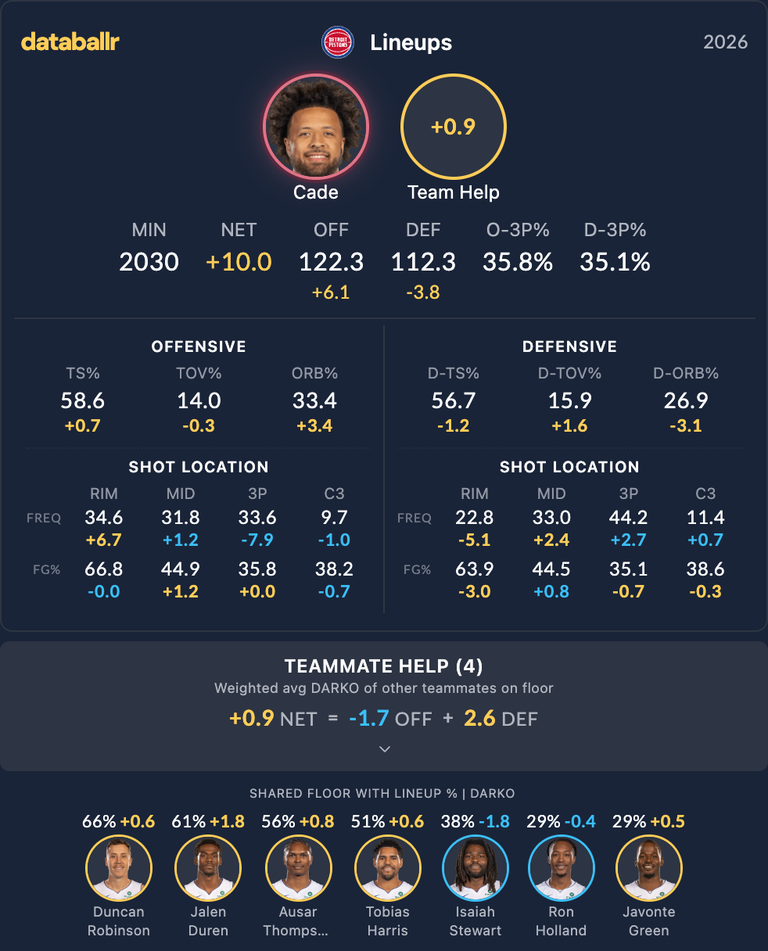
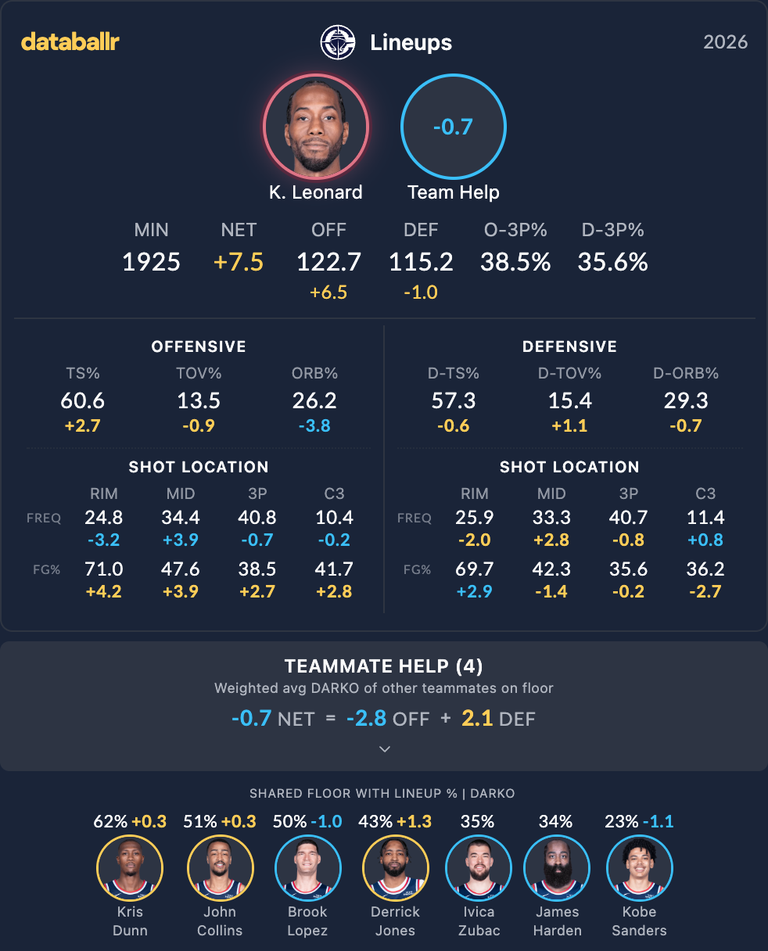
The perennial question that's been asked since Cade Cunningham was drafted is still left outstanding, even on the heels of a 60-win season. Cunningham has shouldered one of the largest creation burdens in the league for years, ranking in the 95th%ile or higher in Creation TSA the last 3 years, which has enabled Detroit to surround him with lineups that are heavily defensively slanted. The Pistons were the #2 defense in the league last year because of Cunningham's ability to carry the offense, with him and Kawhi being the only players in the league last year to take negative offensive teammate help to an offense at least 5 points better than league average.
Post-ups aren't a massive part of any team's offense in 2026, but for a Pistons team that's had a below average halfcourt ORTG since 2008, and ranked 16th last year even as the #10 overall offense last year, this fraction of their halfcourt attack was incredibly consequential. Detroit was tied for the 6th highest post-up frequency and they were 4th in PPP at 1.07 PPP, but they lost their most prolific post-up player in free agency to San Antonio. Tobias Harris accounted for 37% of their post-up possessions and scored 1.07 PPP, a full .10 over their halfcourt average. This allowed him to give Cade some much needed breathers, which were crucial in the playoffs.
The player who is stepping in to his starting position, John Collins, was actually the 2nd most efficient post-up scorer in the league, just on half the attempts. Aside from the volume, Collins was assisted on 82% of his post-up makes and got most of his work done on mismatches in transition or after defenses switched a PNR. He can assume some of the touches, but Collins needs the initial advantage created for him, as opposed to how Tobias can create an advantage for himself.
Tobias' 6.2 creation TSA per 100 will need to be divvied up among the starters and now that they have reached a decision with Jalen Duren, they need the rest of the roster to step up. John Collins can likely assume 2-3 of these possessions (career high 4.5 creation TSA back in 2022) and Ausar is going to be asked to do some more on-ball as well. He's been gradually ramped up in both his time on-ball and creation TSA year after year and began this year running 3+ PNRs in back to back games for the first time in his career. After he missed 3 games though, the Pistons seemingly forgot their investment in his creation development. Thompson wouldn't see back to back games with any more than 2 PNRs for the rest of the season.
I imagine Detroit was even more competitive than they realized, and abandoned the Ausar "backup PG" and "secondary handler" experiment once they shifted to maximizing regular season wins. As a result though, their now $160M investment has seen a fraction of his time on the floor as a creator, and he's so inefficient as a spacer that any time he's not on ball OR finishing plays is negative ROI. The Pistons didn't give him the reps while they were bad to really see if he was capable or not, so they're going to have accept the growing pains that come with throwing him into more of an on-ball role this year.
2) What does a happy compromise look like between Jalen Duren & the Pistons’ front office?
The pressures of the qualifying offer expiring October 1st at 11:59pm has brought a merciful end to the most drawn-out storyline of the offseason. If Duren would've accepted the QO (which he was reportedly threatening to do if they didn't up their contract offer), he would've played out the season as a Piston on a 1-year, ~$10M contract and became a UFA next summer, with a max earning potential of roughly $177 million dollars over 4 years. If they didn't come to an agreement and the QO expired, he would've remained a restricted free agent until Detroit either signed him or signed & traded him elsewhere. The reported agreed upon contract is a 5-year deal worth $200 million dollars, which will likely either be an ascending contract that starts as low as $34.5M (~19% of the cap, or an Aaron Gordon sized percentage) or could be a flat AAV at $40M (25% of the cap, or a Brandon Ingram sized percentage). Ultimately, Detroit was able to retain him for under the rookie max by meeting each other in the middle, keeping their 3 highest paid players for 67% of the cap, space that not either team that won 50+ games besides the Spurs can match.
This is by far the best outcome for both sides, as Duren would be risking losing out on a massive payday if he got injured or if the market wasn't willing to offer him the $177M in free agency, while Detroit is retaining a massive part of their offense. This is a team that was below average in all offensive playtypes besides Roll-Man and postup possessions, areas where Duren's fingerprints are plastered everywhere. He was probably the best play finisher in the whole league last year, and offers a lot more off of the bounce than the other hyper-efficient bigs who reached his level of converting on advantages. Cade saw a ton of blitzes out of PNR, which made Duren's ability to catch 10-15 from the basket and still convert extremely valuable. This fluidity also translated to his driving game, where Duren scored 1.1 PPP. He even had moments being effective out of inverted PNR, especially when he built up a head of steam by advancing the ball.
Offense has never really been the biggest issue with Duren, at least until the playoffs. Orlando was extremely aggressive with their PNR coverages, switching almost every on-ball screen and asking Suggs to roam. Franz was key to this scheme, as he could effectively check Cade and battle with Duren until help arrived. Detroit had to adjust by placing Ausar in the dunker to finally open up some opportunities for Duren, but Orlando's physicality had already taken its' toll. He was being jostled and hip checked at every opportunity, plus Orlando would foul him if he had even a hint of creating an advantage. Wendell Carter Jr. played stellar individual defense as well, as one of the few players Duren doesn't have a strength or speed advantage over. Cleveland should've provided a slightly easier matchup, though I think the mental battle was already lost. Jalen constantly played smaller than his 250+lb frame, bringing the ball low and just not being polished with his decision making. It was as if he could still feel Suggs lurking somewhere just waiting to block his shot.
Duren's trials and tribulations is a cautionary tale of going to battle in the playoffs with a playfinisher as your 2nd highest usage player, something Hawks fans should be familiar with. There are schematic adjustments to try and cover this weakness up, and playing with more movement shooters (Isaiah, DRob, Huerter, etc.) will help Duren be more viable in high-leverage moments, but he also needs to be honest about his areas of improvement. Orlando was able to completely take him off the table on offense and he has never in his career been productive enough on defense for that to happen consistently. 1.6 Blks per 100 is unbelievably anemic and Duren isn't getting deflections to offset that lack of rim protection. It's why opponents have been better at the rim with him on the floor throughout his career.
Detroit might've saved themselves $280M dollars, but the blueprint on how to stop them is still applicable with thos current roster build. A JC and Duren frontcourt is stacking their rim protection and creation weaknesses and neither of them pass enough to make this work beyond just being super efficient scorers. If Ausar wasn't the 3, this frontcourt would be in contention with Minnesota for the least passing + 3P volume 3 through 5 in the NBA, which can't be the best way to maximize their hundreds of millions of dollars. In my estimation, this roster is still a good bit away from being optimized around Cade.
Duren is accounting for just 17% of DET’s offense when he’s on the floor in this series, the 5th lowest 3-game USG% average of his season
cautionary tale about entrusting a play finisher to be a secondary scorer in April
3) Can Ebuka Okorie star in his role as a change of pace guard next to Cade? (hopefully sooner rather than later)
During our 2026 draft Guard preview with J. Kyle Mann, I talked about how Kon Knueppel was the yang to LaMelo's yin, with his contrasting playstyle effectively balancing out and validating the chaos that LaMelo harnesses every possession. Knueppel's ability to be a release valve for Melo while also throwing defenses off just off the virtue of being a more methodical player was a fascinating dynamic that I want to see more teams lean into. Cade Cunningham is one of the most methodical players in the association, ranking 12th in average second per touch (6.18 seconds). He excels when he's playing at his pace, carving out space with his broad frame and bumping defenders off their spot.
I was anxious to see whether the Pistons would explore the inverse of the LaMelo/Kon pairing in the draft, adding a guard who could inject some suddenness and twitch into their backcourt to complement Cade and boost their handling infrastructure. Ebuka Okorie felt like the guard who could bring those aspects and be available within their range and I think those 2 seconds they ended up giving up to move up 4 spots and select him will be well worth it. As we discussed in his profile, Okorie had a massive self-creation load at Stanford, but he's also exceptionally quick with the ball in his hands. I think his immediacy off the catch could be extrmeley effective after Cade lulls a defense to sleep and swings it to Okorie to attack a closeout.
We've seen Cade paired with a downhill guard in his minutes he shared with Jaden Ivey. This duo was problematic, as neither Cade nor Ivey could get up the amount of 3s a modern NBA guard must have to avoid seeing exclusively drop coverage and Ivey struggled to take care of the ball on his forays to the paint. Ebuka has superior shooting signals and the TO suppression we discussed earlier, so I'm not worried about this being replicated. Cunningham is a career 35.5% 3P shooter off the catch (847 attempts) and is at 37.6% the last 3 years on 566 attempts, with a large majority of this being off of offensive rebounds, broken plays or transition plays, as there hasn't been a consistent way DET has found to generate these looks for him in the halfcourt. Selecting Ebuka is one step closer to using Cade as the jumbo wing with elite processing that he was always meant to be.
4) How can Bickerstaff further develop Paul Reed’s dynamic handoff/screening with DET’s movement shooters?
Paul Reed saved Detroit in the 1st round, powered a 3-1 comeback then won his minutes again vs the Cavs. A lot of these low-minute players face a ton of skepticism—justifiably so—about whether they can handle a larger minutes load. Similar to my Day'Ron Sharpe analysis in the Nets' preview, I generally believe players with this type of profile are able to scale, but there are physical limitations to players, especially someone like Reed, whose motor is constantly going at 100%.
In the playoffs, Paul Reed exhibited some very clear synergy with Duncan Robinson. There was a particular clip I put out where Duncan was able to tell Paul Reed how the Cavs were going to cover the screen Robinson was going to set for Cade. DRob knew CLE wanted to show 2 on Cade, so he ghosted the step-up screen and veered into Reed's flare. Once CLE found themselves scambling, Paul Reed's man had to scramble and check Robinson, so Paul slipped and gets a wide-open layup with Donovan Mitchell as the low man. As the more nimble big, Reed's small space coordination and mobility makes him a more dynamic player on the perimeter, which I believe bodes well for how he could continue to play off of Duncan and their new addition Isaiah Joe plus the re-signed Huerter.
Detroit was the least efficient handoff team in the league last year, scoring just .822 PPP and they were marginally better with Reed on the court, as he wasn't involved in a good bit of those handoffs. Reed has a bunch of creative angles to deliver the handoff to the shooter that's sprinting off his hip and is elite at re-angling his screens. He also has the handle to dribble his way into another action if the first handoff is denied, or attack the big checking him 25 feet from the basket. Isaiah Hartenstein's presence boosted Isaiah Joe's handoff efficiency by 9 points, with iHart delivering those same types of creative passes and effective screens to free Joe up. DET could cobble some strong offense in the non-Cade minutes by playing Reed, 2 of DRob/Huerter/Joe and then flanking them with 2 havoc creators on defense, then embracing Reed's mobility as a hub in the slot and at the top of the key.
5) What type of player could be a target at the deadline?
There are two guys, one the Pelicans and one on the Nets. that Pistons fans have been clamoring for Detroit to add for years. I also have 2 players in mind I think they should consider adding at the deadline, but they're not Trey Murphy or Michael Porter Jr.
Jordan Poole is just one year removed from being a T5 pull-up jump shooter in the association. He attempted 87% of his jumpers off the dribble from beyond the 3-point line that year and scored 1.12 PPP. He offers a similar jolt of suddenness and creativity to the backcourt that a fully realized Ebuka Okorie would, and given that New Orleans was giving him DNPs, the Pels might be willing to move him for relatively cheap. This would allow Detroit to either come to terms to a friendly deal or let him walk,as he's on an expiring contract. Poole has an unfair reputation because of some of the lowlights that have gone viral, but he's truly a strong shot-maker at the position and has improved as a passer, posting his highest rim assists per 100 last year for a Pels offense that was bordering on overreliant on their rim FGA. He's functioned as a tenable defender for a strong defensive core and has just enough size to force turnovers. At worst, he's a stop-gap flier while Ebuka develops that can function in the important role Dennis Schroeder provided for the 2025 tram, and at best, he's a part of their core for the next 5 years that transitions to a bench role as Ebuka takes over the reins.
If you look at players who are 6'8" or taller and have taken at least eight threes per 75 possessions, you'll find players such as Obi Toppin, Quinten Post, Trey Murphy, Michael Porter Jr., and Brandon Miller. Another Brooklyn Net, Noah Clowney, is going to be the cheapest to acquire out of those guys. A .60 3PAr with a .35 FTR is worth taking a flier on, especially since I don’t think Brooklyn is going to extend him. Detroit would have to be confident in his 3P shot finally coming along however, as he's one of the elast efficient players in the NBA.
Those two are more attainable than Trey Murphy or Michael Porter Jr. If DET was settled on acquiring one of those bigger, more stationary shooters, the premier version of that archetype is certainly MPJ. Detroit would have to be more of a motion offense to truly maximize him however, as MPJ doesn't create shots for himself or others in a way that would really lessen Cade's creation load otherwise. He's reportedly looking for a $40M+ contract, which would do away with the flexibility in the core they've invested in.
The one concern I have with adding any offensively tilted player is how much it takes away DET's special havoc creation on defense. Ausar is so good on that side of the ball that maybe they could add someone who's a neutral to a slight negative (i.e. Jordan Poole), but it can’t be someone like Tyler Herro. Herro is a nonstarter for me— as is anyone who’s completely noncompetitive defensively, doesn’t have positional size, and doesn’t force turnovers. This also applies to any options who don't improving their lack of handling & passing such as Zach Lavine (though I could get talked into him depending on the salary), Norman Powell, Shaedon Sharpe, etc.
Record Prediction
Combined Odds: 49.9 via multiple sportbooks
My Model Projection: 47.6 (8th of 30), +3.01 Net Rating, 66% playoff odds
Floor: — 47-35 (-13 wins)
This Pistons team feels impossible to project without knowing the outcome of the Duren situation, so I’m operating with the most likely outcome, assuming he’ll be on the roster opening day. They addressed the shooting, but still having a gaping hole in the perimeter creation department. An elevated Paul Reed & 48 minutes of Ron + Ausar will terrorize opposing teams, though the Pistons will also be terrorizing themselves in the halfcourt.
Ceiling: 55-17 (-5 wins)
How many contract disputes with this much back and forth reached a resolution without some built up resentment? Whether it’s the QO or a long-term contract, I’m not sure how this team can re-integrate immediately. I see this team taking a stepback from their regular season total from last year whether their core remains intact or not, but I also wouldn’t be surprised if the additional creation reps for Ausar pay off in the long run.
Overall Grade: — B-, with potential to improve with the Duren situation pending
Let me know if you agree with my predictions! What are your expectations for the Pistons this season?
I’m a lifelong basketball enthusiast who blends film study and advanced analytics in my independent coverage of basketball and the NBA Draft across Tiktok, Twitter, Youtube, Substack and Instagram. I’ve also covered the Hawks for ~2 years as an accredited digital journalist for Afro News, and I am a member of the Atlanta Hawks’ Creators Collective.
-768x960.jpg)
-768x960.jpg)



Comments