Welcome to the 4th edition of my annual 30 teams in 30 days series, the most comprehensive and informative previews for every team in the NBA. Inside these posts, you’ll get up to speed with every team’s offseason additions and their roster hierarchies, learn whether they’ve addressed their biggest areas of need, ponder over 5 questions that will define their season and then decide whether you agree with my offseason grades and record predictions. For the first time, these articles will be exclusively posted on the Hardwood Collective and are paired with video deep-dives over on my Youtube and full-length podcast episodes over on The Fifth Factor!
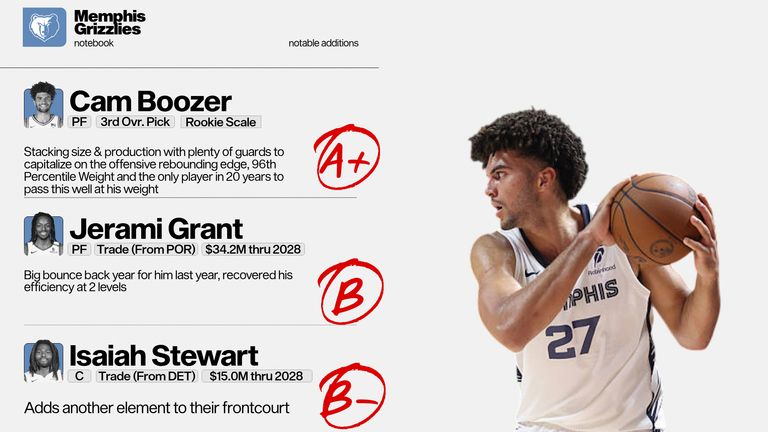
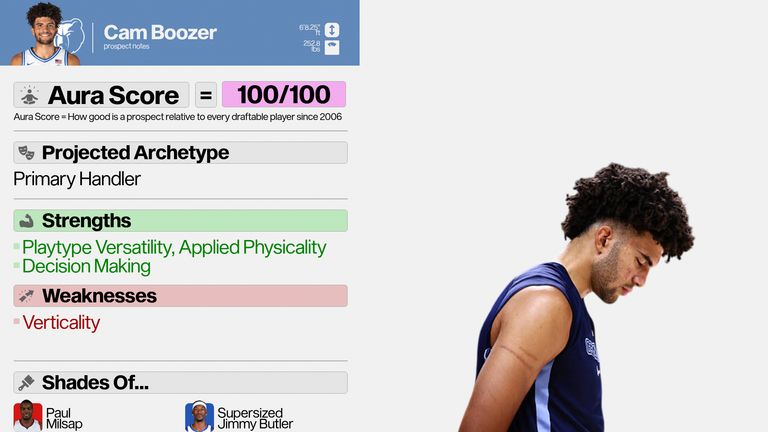
Generational intersection of size, touch, rebounding and processing speed gets paired with a coach who has a 2-hour lecture on Youtube detailing how to “Adapt your offense through variable big men”. It truly doesn’t get better than this, as Tuomas and Cam are a match made in heaven plus the the Grizzlies roster is tailor made for a player with Boozer’s skillset. His ability to shoulder the largest offensive load in the country while still dominating on the glass and remaining a neutral on defense is a massively positive indicator for superstardom. He enters the Grizzlies’ offense as a skeleton key, with the ability to facilitate out of the pinch post or slot, run 4/5 PNR with Edey, initiate AND receive DHOs on the perimeter, spray catch & shoot 3s, he can be any part of any action on the court. This makes him an exceedingly resilient prospect, one who projects as an abnormally consistent contributor early in his career.
21. Karim Lopez :
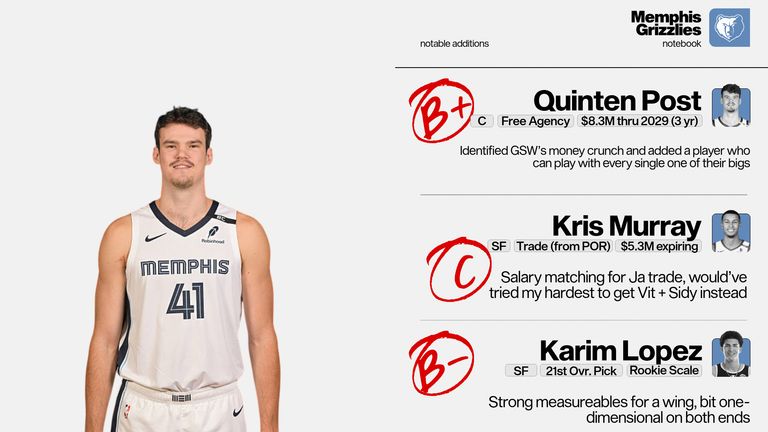
Memphis traded back from 16 to select Lopez at 21, a run of picks that I think could challenge for T5 value in the class which could make this a rough decision in hindsight, can't forget the 5 seconds in return though. I wasn’t a huge fan of Karim pre-draft, I imagine MEM had to have thought one of Graves/JQ would've been there at 21 too. Lopez dunked 25% of his rim attempts, weighed in at 220+ and was pretty impressive physically competing against grown men. Super high FTR for a lower-usage offensive player. His massive hands allow him to snag rebounds outside of a typical catch radius. He prefers to use Barkley-style drives to plow his way to the rim and can struggle when he can’t use his mass to shield the ball. Began the season with some hype due to him shooting 45+% from 3 over the 1st 10 games — on tiny volume — then regressed back to 30% after October. Made real strides as a playmaker, can get very creative when he’s able to get downhill in the HC or transition. Can make connective reads with relative ease. He’s inconsistent with his shot prep off the catch and his footwork is generally sloppy driving the ball, but he also exhibited some strong coordination defensively when his hips got flipped or he had to switch directions.
Richie Saunders to the Grizzlies:
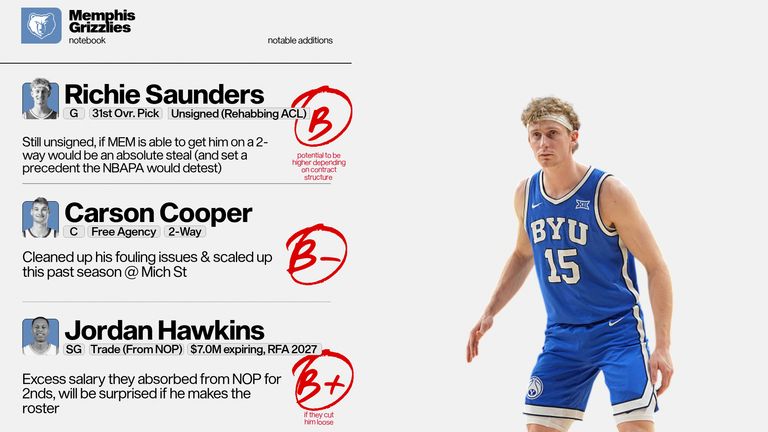
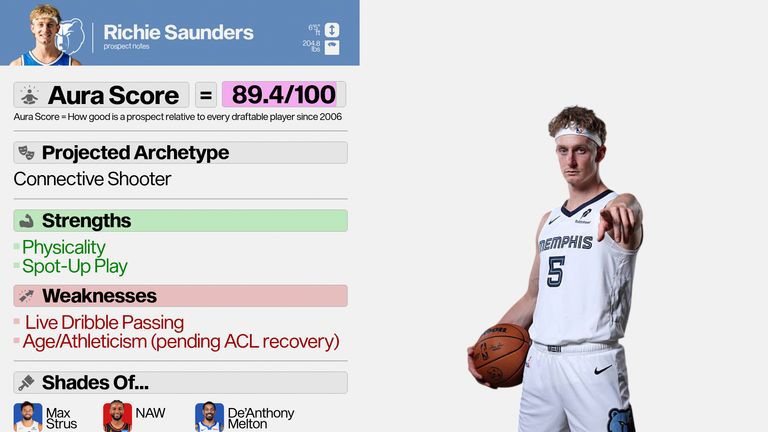
Was a big fan of Richie’s profile before the ACL tear and I’m still holding some stock. Career 60% from 2-point range, 30 FT rate, 6 Oreb%, 2 steal% and 10 3s per 100…he might be 25 but this is what I dream a complementary wing looks like. He’s got meaningful parallels with someone like Cam Johnson, but is far more physical than most guys in this mold in all aspects, getting to the FT line and gobbling up offensive rebounds. Physical movement shooters are one of my favorite archetypes, offering utility as screeners, spacers and drivers in a single package. They also seem to have some grittiness that makes the age less of a concern in the league, Sam Merrill/Max Strus/AJ Green/ Duncan Robinson all came in extremely old in their rookie seasons. Saunders didn’t get a ton of appreciation for what he meant to BYU’s offense, where he regularly saved stagnant possessions, generated additional FGA on the glass and kept the ball moving. He’s destined for Caleb Martin-esque moments in the playoffs.
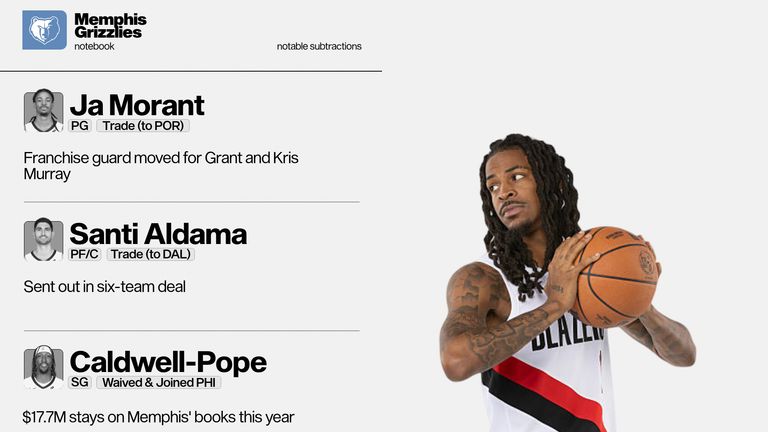
Notable Subtractions: Ja Morant, Santi Aldama, Kentavious Caldwell-Pope, Bennett Stirtz, Tarik Biberović, A.J. Johnson, Taj Gibson
Depth Chart + Roster Hierarchy
Franchise — Cameron Boozer
Core — Zach Edey, Cedric Coward
Key Rotation — Jerami Grant, Isaiah Stewart, Ty Jerome,Quinten Post, Scotty Pippen Jr., Cam Spencer, Jaylen Wells
Rotation —Walter Clayton Jr., Olivier-Maxence Prosper, GG Jackson II, Taylor Hendricks
Development — Richie Saunders (TBD); Javon Small, Jahmai Mashack, Carson Cooper, Micah Peavy, Karim López, Jordan Hawkins, Kris Murray
Cap Sheet
Offseason Overview:
We’re just 3 years removed from the Memphis Grizzlies being widely regarded as the strongest young core in the league. The Grizz were coming off of consecutive 50+ win seasons in 2023, achieving one of the most rapidly successful rebuilds in modern NBA history. It felt as if Memphis was at the precipice of a dominant era, with 3 playoff appearances as the youngest team in the league, positioning them on a trajectory that could only go up. At the time, their constant flameouts in the playoffs felt as if they were purely a result of inexperience, a byproduct of them being ahead of schedule that would rectify itself as they matured.
The front office didn’t seem to be have that same belief that this core was immediately ready to contend, moving on from several of their established, proven contributors after achieving the best season in franchise history (their +6.2 net rating in 2022 was the 1st time in their existence they beat teams by more than 6 points per poss). They aimed to cycle in younger prospects to fill their shoes, trading De’Anthony Melton for the draft rights to the 3rd highest BMI in Combine history (aka David Roddy, 31.3 BMI) draft rights & Danny Green’s salary, while turning to Santi Aldama, Jake Laravia & Ziarie Williams as the next in line for Kyle Anderson’s role. The defense remained stout even without the unique defensive playmaking of Melton & SlowMo, but that 2022 season proved to be the peak of this era of Grizzlies basketball.
I’d imagine most teams would’ve been far more aggressive after a 56-win season that featured 3 U23 players among their top 4 in total minutes played, but something held Memphis back from fully committing to this core. There were a smattering of reports that they were making offers for OG Anunoby, Mikal Bridges and even Kevin Durant, but no deal to add a complementary wing to their young trio materialized. Whether it was a lack of confidence in the offensive synergy, injury concerns or fears about immaturity, their hesitation was validated with Morant’s suspension & injuries, Jaren’s offensive volatility and apathy on the glass and Bane’s limitations as a creator. They traded all 3 of their previous core over the last 15 months, leaving their current roster without a single remnant of the 31 players who suited up for the 2022 and 2023 squad, resetting themselves as the youngest team in league once more, with a new focal point, head coach and approach to building themselves back into contention.
Pre-Draft Areas of Need:
🥇 Halfcourt Creation: .97 PPP in the Halfcourt (20th), 1.08 PPP w/ Jerome ON (.03 points better than the league leading Nuggets HC offense)
Addressed: A healthy Ty Jerome next to Boozer & a revamped Jerami Grant should make this an average HC offense at absolute worst, they punched above their weight last year
🥈 Defensive Rebounding: 30th in opponent OREB%, 2nd highest PPP allowed on offensive rebounds (1.18), 23rd in Box Outs per game (5.3)
Addressed: Injuries meant MEM was regularly playing undersized bigs and even wings at the 5 such as Taylor Hendricks and Olivier-Maxence Prosper, they will be one of the largest teams in the league this year
🥉 Frontcourt Passing: Bottom 5 in passes from Centers, Bottom 10 from Wings & Forwards
Addressed: Boozer has a case as one of the best passers at his size we’ve ever seen
Season Outlook:
1) Which guard takes precedence in touches?
After waiving D'Anglelo Russell, the Grizzlies have 18 standard contracts on their books as of September 30th, with about half of those being guards of some sort. The 3 players Memphis received as salary ballast to make trades work this offseason, Micah Peavy, Jordan Hawkins & Kris Murray, are the most likely candidates to be released to meet the 15-man roster constraint before the season opener. If this ends up being the 3 they waive, their sheer volume of point guards will necessitate some prioritization in the allotment of both touches and minutes.
Walter Clayton Jr., D’Angelo Russell, Jordan Hawkins and Kris Murray are likely the group of players that could be waived by the Memphis Grizzlies in order to meet the 15-man roster compliance standards, per @JakeLFischer on @BleacherReport.
Ty Jerome is the clear head honcho in the backcourt, shouldering the largest On-Ball% of anyone not named Ja Morant in his 15 games for Memphis. He continued his ridiculous off the dribble scoring efficiency from his 2025 campaign in Cleveland where he lead the league in PPS efficiency on pull-ups (1.215 PPP). This nuclear shooting, plus his handle & pace, was how Ty had one of the largest HC impacts in the league in limited minutes. His shot diet in Cleveland was already more creation leaning than you'd expect from a 3rd guard, which is how he was able to turn an even tougher shot diet — with nowhere near the same quality surrounding infrastructure — into another 90th%ile efficiency season. He hit every aspect you'd want for a player to show they're ready for a larger offensive role, with a steep increase in FTA and passing volume. Ty gives them instant offense and will be an extremely valuable bail out option for the inevitable possessions where their 1st and 2nd actions sputter.
Tuomas Iisalo spent a good chunk of time talking about how impressed he was with Ty Jerome in a limited sample size last season.
"He elevated our half court offense to completely new dimensions...he's somebody that we will definitely lean on offensively."
Cam Spencer had a ridiculous shooting season of his own, ranking 2nd to just Ty in OTD shooting efficiency. He also finished 3rd in PTS Added on Off-Screen and 10th in PNR BH reps. He was so good on-ball that Iiaslo would have the former 53rd overall pick create shots for their $200 million dollar player. Spencer has similarities with Ty beyond the pull-up 3P shooting, as both are unconventional creators who rely on touch and pace to convert on their scoring opportunities, though Cam is the much more willing and capable screener, which makes him a good deal more suited to operate as a secondary creator. Generally speaking, Jerome & Spencer should be able to coexist if they have 3 plus defenders on the frontline, though the defensive returns were so horrific last year that I think Iiaslo will keep them separate outside of dire scoring situations.
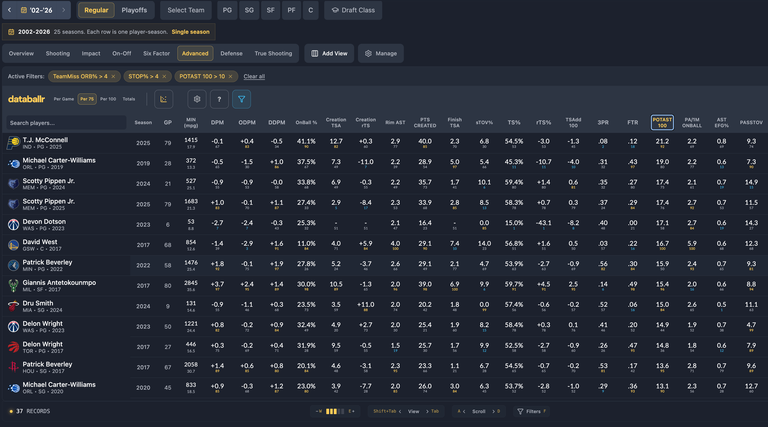
Scottie Pippen Jr is the guard makes everything work, with his suffocating POA defense keeping Jerome/Cam from having to navigate on-ball defensive responsibilities. Guards in this mold aren't usually above average in efficiency, with SPJ's catch & shoot efficacy differentiating himself among the defensive pests we've seen over the last 2 decades or so. He's shot 43% on 300+ catch & shoot 3s in his last 3 years and needs to ramp up the per poss volume to truly validate his shooting ability, especially since he's underwhelming at the FT line and from 2P range. He's by far their most disruptive defender and is crucial to keeping their defensive shell intact.
Walter Clayton Jr. doesn't have a role that's defined as clearly as the aforementioned trio, as Walter's signature skill in college (pull-up shooting) hasn't reached the level of Jerome or Spencer and he's struggled from 2P range. WCJ is also making a different kind of transition than Ty and Cam, scaling down in the league as opposed to gradually scaling up, which could explain why his shooting hasn't held with a higher % of those jumpers coming off the catch. This is a 90% FT shooter with a long track record of strong shooting signals so I'm expecting him to bounce back eventually. Javon Small has the most distinct skillset, with his superior twitch and verticality allowing him to exert pressure on the rim out of handoffs and PNR in a way none of their other guards can really replicate. I believe this plus his burgeoning OTC shooting will keep him safely on a 2-way if Richie does end up signing in MEM.
2) Is this the most versatile big man rotation in the league?
Tuomas Iiaslo partitions the center into 3 distinct offensive flavors: the Traditional Five, the Stretch Five and the Decision Making Five. Traditional 5s are characterized by heavy screening volume, with their main source of advantage creation being tied to their ability to create 4 on 3 situations by using their rolling gravity once they've walled off the on-ball defender. Stretch 5s stress defenses by pulling rim protectors and help defenders further way from their rotation points, with a tendency to peel out of screens to hunt 3s instead of thundering towards the basket. Decision Making 5s are the most dynamic, boasting both the handle and passing ability to serve as a crux for the halfcourt offense, absorbing the creation load from the backcourt. They usually function out of the "slot"[1]or above the key, constantly probing for ways to screen open a teammate, run a DHO or punish a sagging defender.
This iteration of Memphis' roster has players who cleanly fit into each designation. Zach Edey is undoubtedly their "Traditional 5", operating almost exclusively as a rolling big. Quentin Post and Isaiah Stewart are the "Stretch 5s", though Beef Stew would need to get back to 5-6 3PA per 75 to truly qualify. Cam Boozer is their "Decision Making 5", the big who will see the most usage as a passing fulcrum out of Horns actions, the pinch post, the slot, etc. If they ever play 3 big lineups, it will almost certainly always be Boozer as the 3rd big functioning more as a wing. This amount of optionality should be refreshing fro Grizzlies fan who had to watch their team struggle with depth at this position since Steven Adams' departure.
The only other teams that I think can make a claim to have more versatility in their frontcourt in the aggregate are all in the East. Charlotte has Naz/Moussa/Steinbach/Kalkbrenner, Miami has Bam & Giannis, Toronto has Scottie/CMB/Poeltl/Trayce, but I don't see these teams leaning into the creative aspects of set design to the extent Tuomas and the Grizzlies will.
3) What style of play best maximizes Boozer & Edey as a tandem?
Now that we know what role Edey and Boozer will slot in to for the Grizzlies' offense, we can talk about how they can be deployed to make the game easier for one another. On the defensive end, Zach Edey was in drop (or some variation of it) 85% of the time he defended a pick & roll. Drop is Iiaslo's preferred style of PNR defense, where he'll ask Edey to vary his depth depending on how dangerous the handler is as a pull-up 3P shooter. I'd be surprised to see aggressive PNR coverages such as blitzing or switching with Edey, as Tuomas prefers to be aggressive with his guard's pickup points instead of bringing the bigs further from the hoop. In SL we mainly saw Cam Boozer guarding the handler out of PNR, as they asked him to pick up near full-court the same way they would Scottie Pippen Jr. or Jaylen Wells. MEM was comfortable switching Boozer onto the screener whether it was a guard or a big, I imagine they'll be more willing to switch him onto a big than a guard in the league. While Cam is super nimble for his weight, he's still every bit of 240ish lbs and can be taken advantage of in space.
Offensively, this is a fascinating pairing. Edey loved to roll with the intention of getting a quick post-up touch in the lane, and I can already see Boozer lobbing an entry over 2 defenders or flashing to the middle to get a better angle for the guard to swing it to. Edey's vertical spacing can hold help defenders from doubling Cam in the low post, while his dives from the short corner will be that much more threatening with Cam rumbling down the lane out of the short roll. Expect to see a lot of Cam operating out of "Horns Out", a Horns alignment that starts with a cross screen for the decision maker, then is usually followed by some "screen the screener" action then a backdoor cut, then an on-ball pick that flows into other options. You can think of Cam as a QB that runs a RPO every single play, as he's just as dangerous handing it off to a cutter, throwing over the top to a corner spacer or running it himself to the rim.
These two also have excellent synergy on the glass, which will lead to lineups that absolutely suffocate opponents offensive rebounding opportunities while generating a ton of mulligans on offense. I see this team using passing and physicality to generate paint touches instead of the more commonly utilized drive and kick style we see today, with Cam & Edey as the physical embodiments of that style of play.
4) Can the FO find a way to use Jerami Grant + an intriguing young player on a buy-low opportunity?
Before I spoke with Adam Pike in my preparation for this series, I saw Jerami Grant as a player that didn't have much utility in Memphis. I knew that he had recovered his scoring efficiency from 2 rough seasons in Portland but I found it tough to see where he could provide a meaningful impact with all the young wings they've stacked. However, through our discussion and a deeper look at his game, I gradually began to see why Adam viewed Jerami as a nice fit with the starting lineup. He was one of the best spot-up players in the league last year, shooting 38.7% on 350 catch & shoot 3s, but most importantly, he was scoring above 1 PPP when driving out of spot-up opportunities. He's regained some of his forcefulness offensively, driving defenders back as he rips through closeouts.
Embracing physicality helped him draw fouls at the 96th%ile this past season, achieving the 3rd highest free-throw rate of his career relative to league average. As a result, he also posted just his 2nd season as a 60+ 2P TS% scorer (which includes FT trips). Only 9 players last year had a higher free throw rate than Grant on spotups, with his .22 spotup FTR comparable to players such as Paolo Banchero and Jaylen Brown. This "power driving" is going to be massive for a Grizzlies team that doesn't have a ton of immediate rim pressure athletes. Grant should have a much bigger role than I initially envisioned, but that also shouldn't stop Memphis from using his contract to try and snag a younger talent at an area of need.
Grant's $34M is by far their largest deal, as they don't have another deal comprising more than 9% of the cap. That much money makes it trivial to match salaries for one of the players a step down from supermax level, the Darius Garlands of the world. DG would be a phenomenal target if the Clippers want to try and reup the pick stash, with his chemistry with Jerome and Memphis' need for a true perimeter creator. They should also make calls to ORL to see if they'd be willing to move off of Jalen Suggs or Franz Wagner.
5) Is this roster more of a fit with Iiaslo’s principles, particularly his stint-based philosophy?
Based on Iiaslo's well-documented appreciation of dynamic bigs, we can reasonably draw the conclusion that this summer's acquisitions are a seamless fit with what their head coach values. He has another quirk that sets up apart from other coaches, an approach to rotations that drew the ire of his stars once it was fully instituted. Both Ja Morant and Jaren Jackson expressed frustration with the way their playing time was being managed, with Jaren posting the lowest minutes per game by a team's leader in MPG since the decrepit 2014 Spurs.
Woo boy…. Ja Morant didn’t appear to be happy with the coaching staff after the loss.
His response to essentially every question after the game?
Iiaslo believes in maximizing stints, not maximizing the amount of time a player is on the floor. That essentially means that he would rather his players expend all their energy in a short period of time, then get a quick rest, instead of playing 8-10 minutes at a time. Here's a snippet of Tuomas' response to a Grizzlies media member after a loss against the Lakers, in which he played his stars lower minutes than LA:
"You can argue that playing your star players more, that gives you more bang for the buck. Then you could say, okay, can we get the same spreading the minutes out more? Can we play with more intensity? Can we play with more pace?...I do know that it won’t work if you play your star players less, and you play with the same intensity as the other team.
check out the full interview here
For some players, this deviation from the substitution patterns they've grown accustomed to can feel like a disruption to their rhythm and flow. It's a strategy that works best with players whose games are more naturally inclined to giving their all on the floor, as if the effort levels aren't increased with the decrease in minutes, then there's no gain from playing your stars less. If Jaren and Ja were introduced to this philosophy earlier in their careers, maybe it wouldn't have felt like such a jarring change and we could've seen better output from both of them. By remaking the roster, Tuomas can instill this approach early into the foundational pieces of the team, which will make it so much easier to disseminate a belief in the stints once the core adopts his thinking. Additionally, Cam/Edey/Coward is a much better fit from a skillset and personality perspective for the stint-based rotations, due to the physicality aspects of Edey & Boozer's playstyle and Cedric Coward's unassuming countenance.
It also helps that they have so many options to cycle through at point guard and center, the positions that I'd argue rack up the most effort throughout a game. They've also stacked players who are for the most part, at the same stage of their career or have shown a willingness to buy into a role previously, which should minimize any contention related to opportunity. A lot of guys on this roster will wind up getting MORE chances to play because of the stint approach, giving OMax, Hendricks and GG windows to come in and spell the starters more frequently than they would on another rebuilding team. If it wasn't apparent, I'm a huge fan of this thought process and excited to see if and how it bears fruit as this team gets more and more competitive. At the very least, Tuomas is willing to try something different because he is constantly trying to find a novel way to create competitive advantages.
Because if you’re trying to do the same exact thing that everybody else, I’m not sure you should be expecting different type of results than the other teams. So I think it’s all about finding the competitive advantage.
If you're interested to learn more about Iiaslo and the Grizzles' system, I cannot recommend Adam Pike's work enough, both on Twitter and Medium.
Record Prediction
Combined Odds: 28.9 via multiple sportbooks
My Model Projection: 30.0 (24th of 30), -4.09 Net Rating, 7% playoff odds
Floor: 30-52 (+5 wins)
The Grizzlies won 25 games last year while playing EIGHTEEN guys who played less than 500 minutes, the 2nd highest total in NBA history. They were dominant in Edey’s minutes, added a ROTY candidate and are 10-11 players deep, wholeheartedly aligning this roster to better fit Iiaslo’s principles. It’s hard to see this team finishing below 30 wins.
Ceiling: 40-42 (+15 wins)
My one gripe with the stint based approach to rotations is that it can limit the amount of impact Memphis’ most dominant players can exert. Jaren carried their heaviest minute load at just barely above 30.1 mpg, which was the least MPG among team leaders last year. If Boozer plays 25-28 minutes per night like MEM’s wings last year, I think it’ll cap their ceiling a bit.
Overall Grade: — B+
Let me know if you agree with my predictions! What are your expectations for the Grizzlies this season?
Up Next: Detroit Pistons
Footnotes
↩if you extended the FT line until it met the baseline, then the slot is the pocket of space inside the 3P line on either side of the key
I’m a lifelong basketball enthusiast who blends film study and advanced analytics in my independent coverage of basketball and the NBA Draft across Tiktok, Twitter, Youtube, Substack and Instagram. I’ve also covered the Hawks for ~2 years as an accredited digital journalist for Afro News, and I am a member of the Atlanta Hawks’ Creators Collective.
-768x960.jpg)
-768x960.jpg)




Comments