Welcome to the 4th edition of my annual 30 teams in 30 days series, the most comprehensive and informative previews for every team in the NBA. Inside these posts, you’ll get up to speed with every team’s offseason additions and their roster hierarchies, learn whether they’ve addressed their biggest areas of need, ponder over 5 questions that will define their season and then decide whether you agree with my offseason grades and record predictions. For the first time, these articles will be exclusively posted on the Hardwood Collective and are paired with video deep-dives over on my Youtube and full-length podcast episodes over on The Fifth Factor!
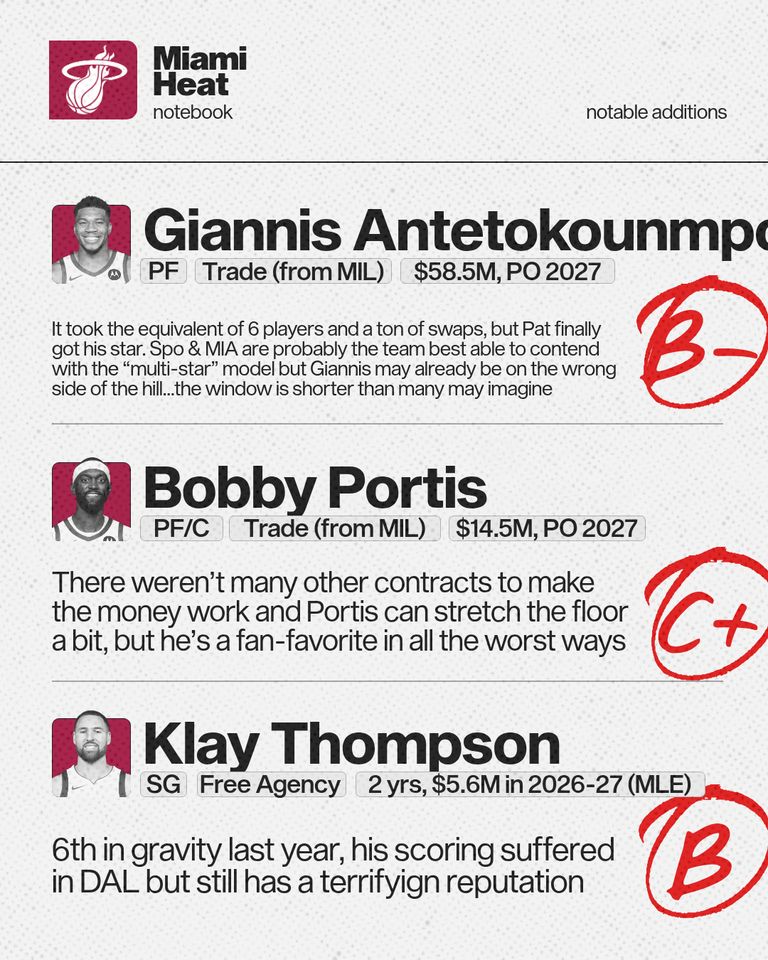
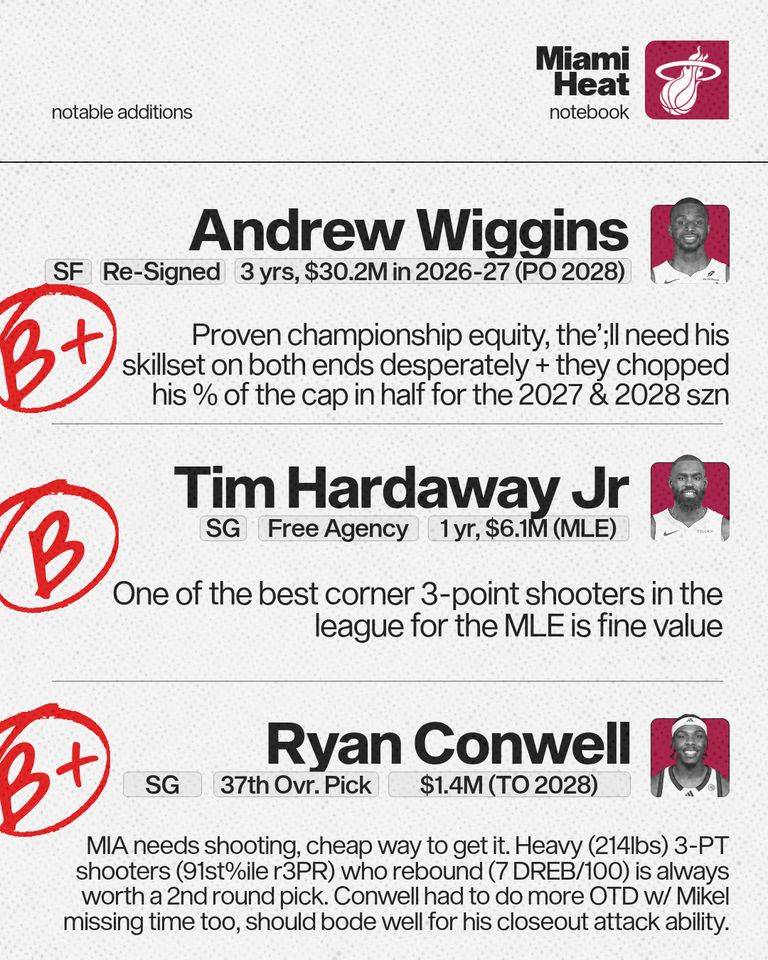
Notable Additions: Giannis Antetokounmpo, Bobby Portis, Klay Thompson, Andrew Wiggins (re-signed), Tim Hardaway Jr., Ryan Conwell, Simone Fontecchio (re-signed), Pelle Larsson, Vladislav Goldin (re-signed), Nick Richards, Keshad Johnson (re-signed)
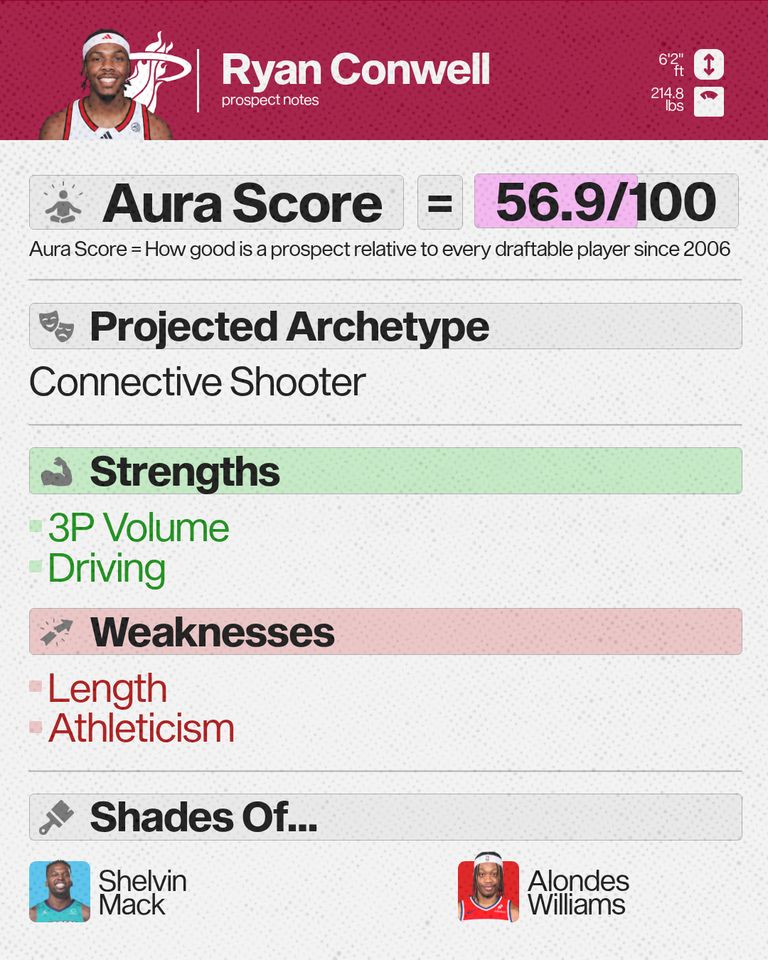
Draft Pick Comps & Strengths + Weaknesses
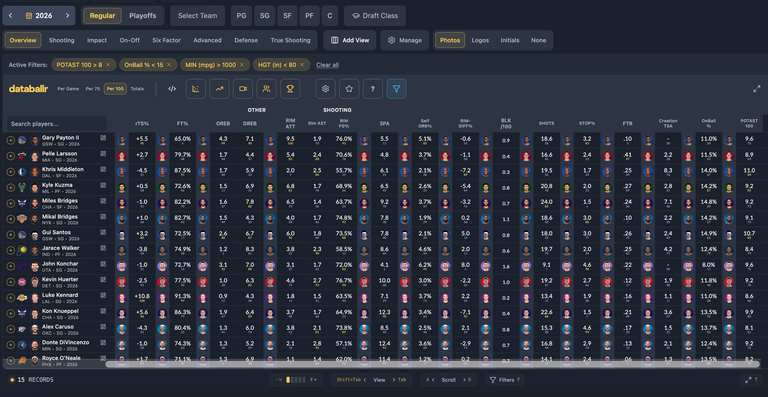
37) Ryan Conwell Conwell began his year at Louisville with a projected role as a secondary/tertiary handler next to future lottery pick Mikel Brown, only for back issues to end Mikel's season prematurely. This resulted in a larger on-ball responsibility for Ryan than he had sustained at any other point in his career, posting personal bests in assist rate, fouls drawn, and driving efficacy, all on the highest PNR frequency of his time in college (18.5%). Standing just 6'2 means that this time on-ball was extremely meaningful for his NBA translation, as he weighed in at 215 lbs with a +5 wingspan, plus size at the PG position that becomes a lot less tenable if he can't make on-ball passing reads or get up 3s out of PNR. Conwell has the shooting aspects down, attempting 65% of his PNR FGA from the 3P line (the highest rate in the country, Pat Kelsey encourages this type of shot profile as Mikel matched this) and shooting 42+% off the catch in his 2 prior seasons at Xavier and Indiana State. He's got a sweet, extremely quick left handed releases that tends itself well to pull-up shooting, with his mechanics allowing him to fire off the dribble moving to his left or to his right. The hope is that his time playing with multiple handlers has refined his decision making enough to be a connective guard at the NBA level, with enough size to not be a massive negative on D.
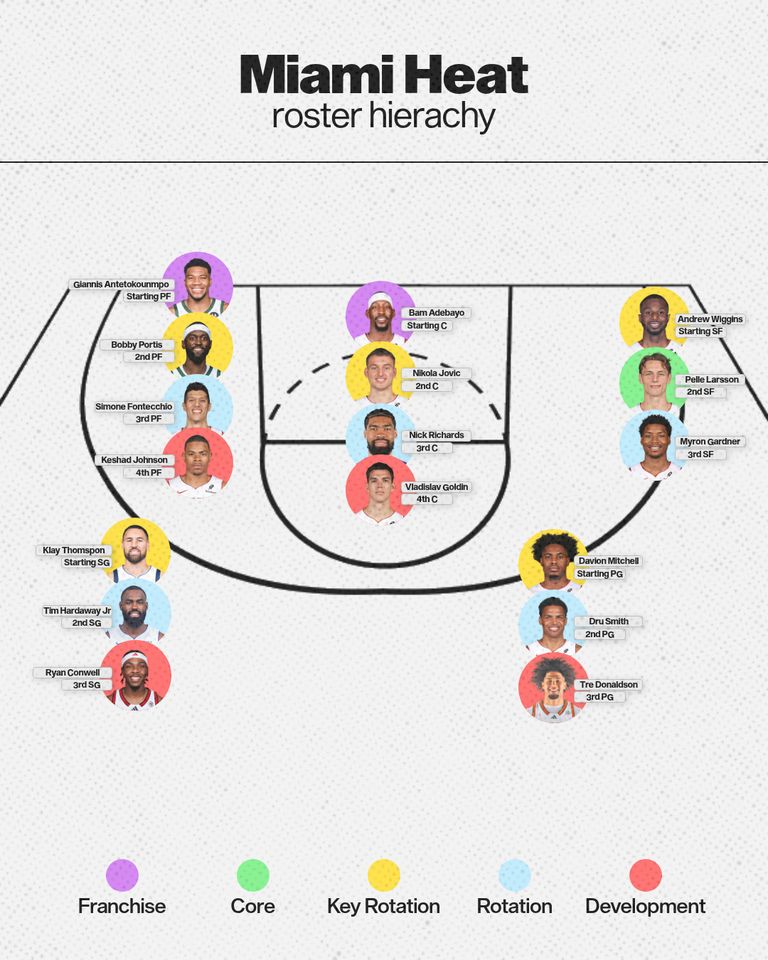
Key Rotation — Nikola Jovic, Andrew Wiggins, Andrew Wiggins, Davion Mitchell, Klay Thompson
Rotation — Bobby Portis, Tim Hardaway Jr., Dru Smith, Simone Fontecchio, Nick Richards, Myron Gardner
Development — Ryan Conwell, Tre Donaldson, Vladislav Goldin, Keshad Johnson
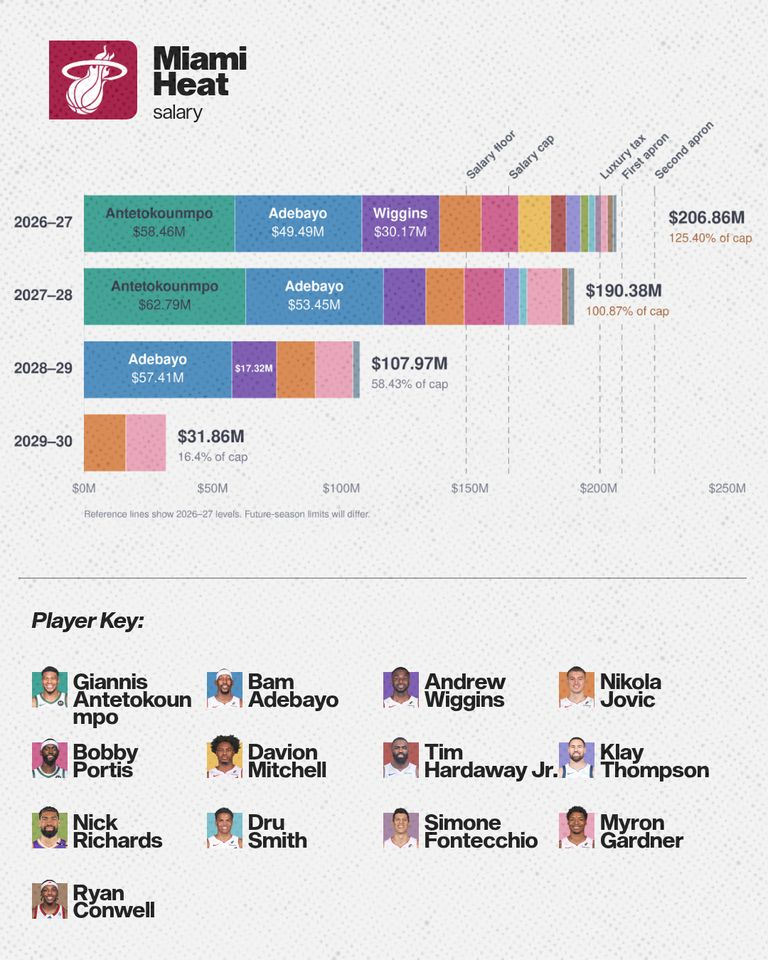
Cap Sheet
Offseason Overview:
The Heat have one of the most meticulously curated images of any sports franchise, going to great lengths to preserve their self-professed standing as the "hardest working, best conditioned, most professional, unselfish, toughest, meanest, nastiest team in the NBA." I've always felt like this branding presented an interesting juxtaposition with the vapid, glitzy city of Miami, but perhaps that's exactly why the organization upholds some of the highest physical standards in the association, utilizing the conditioning expectations to counterbalance the extracurricular activities that would otherwise distract their players. Whatever the reason, #HeatCulture is unmistakably a Pat Riley product, a guiding philosophy that the Godfather has ruled the Heat under for over 30 years.
Riley began his tenure as Heat team president in 1995, witnessing Chicago's 2nd 3-peat with MJ as their guiding star. The Lakers rose to power shortly after MJ hung up his Bulls jersey, ripping off 3-straight titles before Pat traded for Shaq to form another duo with an athletic young guard. He was able to land both Lebron James AND Chris Bosh in free agency just 5 years after Wade & O'Neal delivered Miami's first ever NBA championship, culminating in 2 more championships and 4 straight Finals appearances. The 2019 Jimmy Butler acquisition immediately yielded a Finals berth in the bubble and proved their run was more than just mere circumstance when emerged from the East once more in 2023.
As an elder statesman of NBA decision makers, Riley has witnessed (and won in!) every era of NBA basketball, winning a title in every decade besides the 90s and the 2020s, while appearing in 19 total Finals (just under 25% of championship games played since he began his career). The natural progression of the game means that it’s no longer feasible to build rosters in the exact same fashion Pat constructed his previous title-winning rosters, but that hasn't deterred the man from moving with the same self-confidence that led him to name himself as head coach a few games into the 2006 title season after his assistant stepped away to "take time to be with his family" (Van Gundy was hired as the Magic's head coach just a year later).
His reputation as one of the more successful architects in league history has been thoroughly tested over the last half decade or so, with Heat fans growing more and more restless as their FO seemingly whiffed on superstar trades. He reportedly refused to budge from a Herro + filler + a handful of picks package for Damian Lillard, just for Joe Cronin to wind up trading Lillard to the Bucks, then re-route Jrue Holiday to the Celtics in what felt like an intentional jab at Miami. Miami also refused to move a Nunn, Robinson & Herro package for James Harden in 2020. When Kevin Durant became available, the Heat declined to offer more than one first-round pick, Kel'el Ware or Nikola Jovic. The Heat faithful even begged for a chance to take on Bradley Beal's massive contract in 2023, just for ownership and the FO to decide that Beal wasn't worth the squeeze.
In an appearance on The Dan Le Batard show the summer after Boston won a chip, directly benefitting from Miami botching the Lillard deal, Pat responded to people calling him washed by saying, "Maybe I am.". At the time, this felt like a painful moment of self-awareness, the beginning of the Godfather's fall from grace. 2 years later, and it feels more like a tongue in-cheek response to those who would dare write him off at the ripe age of 79. Holding his cards close to his chest paid off in Miami landing the biggest fish to change teams in the offseason in at least a decade, and the Giannis trade looks even better when you consider the transactions Miami passed over to get to this point. We can debate the merits of superstar trades in this current era of NBA basketball (and we certainly will throughout this video), with Miami's roster certainly feeling the crunch of having 3 players nearly accounting for the entirety of the salary floor, though this team is in a much better position than they would've been if they overextended themselves to acquire the many players they've been linked to over the years.
Pre-Draft Areas of Need:
🥇 3P Shooting: 7.3 off the dribble 3PA per game (4th lowest), 19th in Corner 3P% (37.6%), 20th in 3PAr (37.3%)
Partially Addressed: Klay Thompson and THJ are good pickups, in addition to resigning Fontecchio, but MIL has an abundance of static shooters and not much pull-up 3P shooting ability.
🥈 Rim Pressure: Bottom 10 in restricted area FGA for 5 straight years, 15th in rim frequency (31.1%)
Addressed: Giannis has led the league in made shots in the restricted area in all five of those seasons and
🥉 : Transition Scoring: 24th in Transition PPP (1.097), 2nd in transition frequency and 2nd in % of live rebounds converted into transition opportunities (34.4%)
Addressed: may not have the same variety of handlers to push tempo but the Giannis combo (100th%ile in transition frequency for 9 straight years) with floor spacers should make this a much more devastating transition team
Season Outlook:
1) What lessons should the Heat take away from the success & failures of Giannis’ time in Milwaukee?
In an era of NBA basketball that hasn't seen a repeat champion in 8 years, it's increasingly becoming more of a fallacy to try and recreate what worked for previous champions, even for a team like Miami that's acquired the singularity that is Giannis Antetokounmpo. Thus, while there is a blueprint for what supporting cast worked around Giannis in the Bucks' title run that can help guide the Heat's iteration around the Greek Freak, they should also consider important data points from units that flanked him before AND after he won a title, while of course accounting for his aging curve, their current tools to build a roster and the elements that they may already have on this year's team.
Miami's slow start this year has prompted discourse about the difficulties of building a contender around Giannis, though the reality is the vast majority of MVPs are inherently contentious. We call players like Giannis transformative because of their incredibly unique skillsets, with that same rarity demanding hyper-specific accommodations to maximize superstars' games. Antetokounmpo is almost certainly one of the least immediately portable players of his caliber, due to his propensity to be on-ball at one of the highest rates for a big in the league, how much he likes to handle the rock in transition and his rim dominance/reliance/lack of spacing value. Hawks legend Jeff Teague spoke to some of his own challenges playing off of Giannis (he's a bit jaded about his time in MIL so have to take it with a grain of salt), making some thought-provoking points about the type of personality and game that works best with #34.
These defining characteristics of Giannis' game is where the perceived difficulty of building around him stems from, given the personnel that's theoretically needed to maximize his playstyle. From this lens, it certainly is challenging finding a big who can play drop coverage and stretch the floor, PGs who can both defend and navigate screens well while shouldering a pull-up 3P burden and remaining viable off the ball and perhaps most importantly, a wing scorer who can handle most of the perimeter scoring with enough passing feel and size to not kill the defensive shell or siphon too many touches from GA34. The true difficulty comes with finding these requisite skillsets in players that have the right personality, frictionless running mates who are talented enough to generate some offense on their own but not so ambitious/enterprising/scoring-tilted that they can't coexist with a fulcrum that often sniffs a 40 usage rate. As we discussed in the beginning of this question, Miami doesn't necessarily need to 1:1 replicate the most consequential players of Giannis' time in Milwaukee, but they do need to introduce and foster some of the most consequential skillsets that they brought.
There are 4 types of point guards Giannis has played with thus far; 1) the low-usage floor general mold: George Hill, Jerryd Bayless, D.J. Augustin, etc., 2) the bigger combo guard mold: Michael Carter-Williams, Malcolm Brogdon, Greivis Vasquez, Kevin Porter Jr. etc., 3) the dynamic scoring PG: Damian Lillard, Brandon Jennings, etc. and finally, his most successful pairing, 4) the disruptive defender PG: Jrue Holiday, Eric Bledsoe and Ryan Rollins. Jrue posted the best net rating of the 3 with Giannis, but Bledsoe was the starting PG when Giannis posted his only 60+ win season (and was on pace for a 2nd in 2020). Baby Bron would've been an absolutely perfect fit with Giannis if he wasn't cursed to be maddeningly inconsistent as an off the catch shooter, beginning his career with Milwaukee with a 80th%ile 58 eFG% and 38% from the 3P line off a standstill, then posting back to back seasons shooting below 29% from 3 (and 42 eFG% overall). All they needed was for him to NOT be the worst spacer in the league (which is exactly what he was in back to back seasons) because Giannis + Bledsoe lineups absolutely pummeled opponents at the rim, bashing teams with a 37.7 rim frequency (+5.6% relative to league average), shooting 69.4% at the rim (+6.6), while holding opponents to nearly a 10% lower rim freq. (28.6, -3.5) and just 57.5% at the rim (-5.2). Milwaukee was able to achieve this dominance by harnessing Giannis + Eric's physicality in transition and utilizing them both as handlers, screeners and cutters in the halfcourt. These minutes are also one of the few high-minute duos Giannis played with that forced turnovers at a league-average level, which is both reflective of Kidd's more aggressive defensive scheme than his eventual replacement (Bud) and Eric's savant-level defensive playmaking.
Rollins has the weakest net rating of the 3, but deserves grace for flanking an older version of Giannis, plus 50% of their minutes came next to Myles Turner and Kyle Kuzma. Not even league's finest saboteurs could disrupt the offensive harmony of Ryan + Antetokounmpo, posting a ORTG 8.6 points above league average. GA saw a big HC efficiency boost with Ryan on the floor, with his 3P versatility next to the Greek Freak leading to the Bucks shooting a ridiculous 45% on off the catch 3s with both Giannis and Ryan on the court together. Holiday merged all of the best qualities from Rollins & Bledsoe into one player, providing the screen navigation and defensive versatility to enable Milwaukee to sit in their drop coverage, while being a much more consistent 3P shooter that could toggle much more effectively on and off-ball. His overall versatility and decision making is what defined this pairing, posting a stellar defensive rebound rate plus the highest OREB and lowest TO rate of the 3, underscoring his ability to minimize negative chaos for Milwaukee by existing in a litany of roles on any given possession.
At 6'1.5" without shoes, the Heat's starting point guard is the exact same height of Eric Bledsoe and began his career with a similarly elite weight for his position (85th%ile). Davion doesn't quite have the stellar wingspan of Eric/Jrue/Rollins, who all have at least a 6'7 WS (Rollins has one of the craziest WS-H for a guard ever, +6.5", 94th%ile) nor the true positional size to crossmatch with players who would be mismatches for most guards, but he does have a ridiculous defensive tenacity and a feel for being in the right position to approximate some of the key defensive aspects of these 3. Mitchell isn't the level shooter Rollins is though he's shown development off the catch, which has paid off in his 40+% off the catch 3P shooting as a member of the Miami Heat. The weakest point in his case as Miami's PG pairing with Giannis is his lack of positive transition influence, both as a scorer and tendency (or lack thereof) to push the pace, though his ability to not turn the ball over at egregious rates could help mitigate some of this lost value if he can continue to make good reads on the break.
We don't have nearly as many examples of different type of bigs that flanked Giannis as he ascended to MVP-level play, with the vast majority of his minutes coming next to Brook Lopez. The success that they found together has led to a misconception that he needs to have a stretch 5 in Brook's mold to succeed, though I'd imagine Miami pretty definitively disagrees with that premise, as they made that belief plain when Kel'el Ware was included in the package that was sent to Milwaukee. I can't imagine the relationship was so contentious that MIA wouldn't have tried their hardest to retain Ware if they saw a need to pair Giannis with such a big, since these types of players are both incredibly rare and prohibitive to acquire. Thus, the Heat would be best off taking a different approach to Giannis' frontcourt pairing, a necessary shift that's mandated not just by their personnel, but by Giannis' defensive effectiveness as a roamer waning over the years. On defense, Bam should play the "Giannis role" while Antetokounmpo plays the "Brook role", as a majority drop-coverage defender focused on rim suppression, protection and rebounding, leaving the switching and flying around to Bam. Offensively, Bam has been on the ball at one of the highest rates for a big since his 3rd year, finishing almost every year in the 90th%ile in potential assists at his position. There will still be plenty of possessions where Adebayo is spacing for Giannis drives, but there should also be an ample amount where Bam is facilitating in the pinch post and slot. Essentially, Giannis should trend closer to being more of a true center on both ends, which he's already demonstrated by the 3rd lowest on-ball% of his career, the highest OREB% and his highest rim DFGA per 100 EVER.
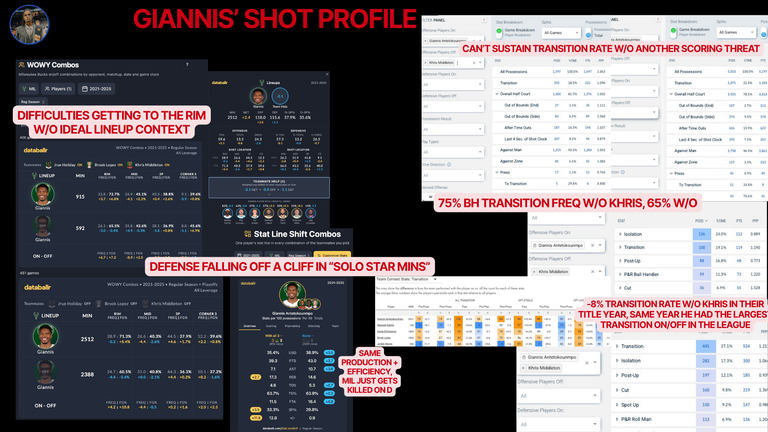
The most illuminating insights from his time in Milwaukee comes from his minutes with his most frequent teammate, Khris Middleton. They played almost 15,000 minutes together from 2016 to their last year together, with KMidd displaying the same drastic decrease in usage rate when he was on the floor next to GA as pretty much any other Giannis teammate, but without the corresponding dip in efficiency or playmaking volume that Bledsoe, Jrue, Dame, anyone who sustained offensive responsibility. Khris was the Bucks' best antidote to the "Wall", preventing teams from slanting their entire defense to stand in Giannis' way by drawing attention to the perimeter in both transition and in the halfcourt. In their title-winning year, Giannis saw a 8% decrease in transition frequency in the possessions he played without Khris pulling defenses out of his path, which resulted in the Bucks as a whole going from by far the most prolific fast break team to much closer to average. Not being able to maintain transition rate without another scoring threat probably means he should've got off the rock a lot more on the break, although Antetokounmpo was still able to be uber-productive in the "solo star" minutes he played without the ideal lineup context, but his bread and butter was effectively neutered, leading lineups that were below average in rim frequency, which got Milwaukee crushed from a point differential perspective, especially because the defense also fell off. The most dominant rim finisher being unable to sustain his defining characteristic is indicative of why hoops is a team sport, but it also shows that this version of his playstyle isn't viable for a team that doesn't have the same perimeter release valve. The defining takeaway is the same one we reached in the big man section, the best version of Giannis in a Heat jersey will almost certainly be attained by him playing more as a true 5.
2) How will Spo create passing infrastructure without a traditional primary handler?
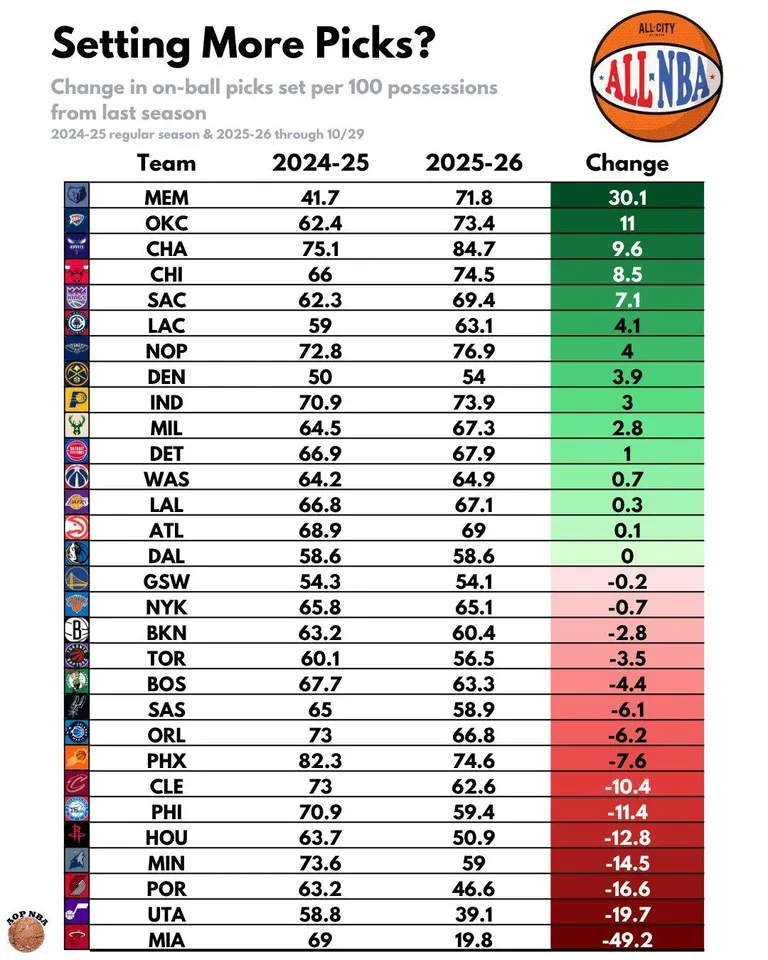
Erik Spoelstra has a well-deserved reputation as one of the best coaches in the NBA, thanks to his duality as a creative problem solver and excellent manager of superstar-sized egos. Last year's Heat team had a similar hodgepodge of guard talent, beginning the year without their lead PNR player, so Spo and the Heat installed principles from Noah La Roche's "Wheel" offense to compensate, using on-ball picks at the lowest rate in the league throughout the entire season. La Roche is a former Memphis Grizzlies assistant coach who was credited with building their free-flowing offense in Ja's absence, then was hired as a consultant before the 2025-2026 season by Miami. The Wheel is a decentralized, egalitarian offense that weaponizes the driving ability of all 5players with complementary respacing and cutting principles to generate paint touches and open looks. You can check out Adam Pike's excellent breakdown of the Wheel here.
This style of play led to Miami finishing 1st in drives, 1st in drive AST%, 2nd in hockey assists and 4th in passes per game, well outperforming their passing talent if they had stuck with a more traditional on-ball screen heavy offense. Their personnel was uniquely suited to this style of ball, with several players comfortable and capable attacking without a screen and a team-first mindset that has been drilled into the roster for the entirety of Spo's tenure. Bringing Giannis into the fold, especially at the cost of some of the more crucial components of that offensive style, certainly demands some pretty stark adjustments, though the benefits of playing that style and the growth of Davion, Pelle and others as off the dribble decision makers will persist even as they orient around a more helio style creator.
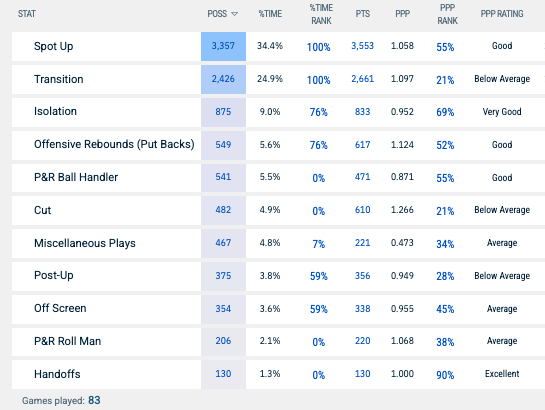
Through these first couple games, Miami is trending towards league average in driving volume and overall passing volume, but they've still ranked among the league leaders in assists and hockey assists per game. Utilizing Giannis as a post-up fulcrum and roller is the biggest difference in their playtype usage thus far, doubling their post and roller frequency. The playmaking is less democratic this year as expected, as Miami had seven players crack 10+ assists per 100 last year (3 of those guys were traded) and have just 4 in 2027. Less movement hasn't been an issue though, as Miami is shooting 5% better at the rim and scoring at the 3rd highest rate in the halfcourt (+2 points higher than last year), despite shooting just 32% on open C&S 3s after hitting 39% last year. It'll be worth monitoring whether the hyper-efficient finishing can get even better with more fortunate shooting luck.
2026 playtypes
3) Who among the Heat’s shooters has the best shot at consistently closing games alongside Giannis and Bam?
Pairing Giannis with strong shooters has been a winning formula for a decade-plus, as once Antetokounmpo unlocked some passing badges and found a more comfortable balance as a scorer and playmaker, he's had a much more positive teammate 3P% signal. AJ Green was his most lucrative pairing that also experienced a 3P% boost in his minutes with Giannis, shooting 44.2% on threes. Miami signed Klay Thompson on the buyout market to complete their shooter rotation after signing Fontecchio and Tim Hardaway Jr. in free agency, with Klay's movement being the clearest analogue to Green's skillset.
Thompson still finished 3rd in 3PA per 100 last year despite posting the worst 3P% of his career (still at 38%) and that #11 jersey still strikes fear into the hearts of defenders caught trailing him as he flies off a screen, although he's no longer much of a threat off the dribble or curling to the rim, which makes top-locking him a good bit more viable than it was earlier in his career. Being one of the worst 2P scorers in the league will encourage those types of coverages, which is a bug reason why, despite Klay starting alongside Davion, Wiggins, Giannis & Bam every game thus far, he's 10th in 4th quarter minutes played.
Tim Hardaway Jr. has been the shooter whose gotten the most tick in the final frame, a indicator of his superior ability to convert on drives (1.08 PPP on 8% drive frequency for DEN last year vs .68 PPP for Klay on a similar frequency). In the clutch minutes however, Pelle Larsson has flanked the starters in every such possession, which aligns with Spo's defensive first philosophy and also may be a prelude to his eventual insertion in the starting lineup if they can figure out the offensive fit.
4) Are Jovic and Larsson ready to be more meaningful contributors than in years past?
Veteran contributors are always important for a team with serious aspirations, though I anticipate Miami searching for more dynamism from their young fellas as the season goes along. The majority of the rotation is comprised of what I would call "static players", individuals whose skillsets and roles are extremely specialized and siloed. Klay, THJ and Simone are there to shoot and not do much else. Dru Smith and Myron Gardner are playing the disruptor role. Wiggins and Davion are a decent bit below the OTD creation threshold to scale consistently enough to offset the positional versatility (Davion) and passing weaknesses (Aaron) that block them from exerting a ton of influence outside of their designated role.
Nikola Jovic came into the league as a 6'10 wing/forward hybrid that enticed evaluators with a 22.5 AST% as a teenager against professional competition, a level of passing feel that can sometimes be indicative of growth potential. Unfortunately, Jovic also carried a huge TO rate (21%) despite a near neutral A/TO, struggled mightily to score in the half-court (45 eFG%) and had pretty much every indicator a player can have that suggests that play smaller than their listed height and shy away from physicality, with a .24 halfcourt free-throw rate, 15.7 DREB% and a paltry 1.6 BLK%.
These tendencies have followed him to the league, with his sky-high PNR TO rate his first few years and tweener positioning leading Spo to drastically reshape his playtype distribution from how he operated in Serbia. His 3rd year saw a decent uptick in production thanks to a FT leap and steady 3P shooting, which led Miami to reward him with a 4Y extension at roughly MLE AAV. Jovic has gained 30 lbs since the draft, which has made his time at center by far his best minutes in the NBA, especially because his skillset is a lot more advantageous when he's working against slower-footed bigs. He seemed to be more comfortable switching 1-5 than navigating low-man responsibilities, which leads me to believe his best avenue is continuing to embrace being more of a small-ball 5 with some PNP and driving ability. A drastic improvement as a rim protector is unlikely, but some added ability as a DREB'er could unlock some of the grab & go potential to positively influence transition play. This Heat team needs another option at backup center to spell Giannis/Bam that isn't Bobby Portis and if he can recover the 3P%, maintain a .50ish 3pr and get back to 80+% from the line, he's got the passing to play alongside their other bigs.
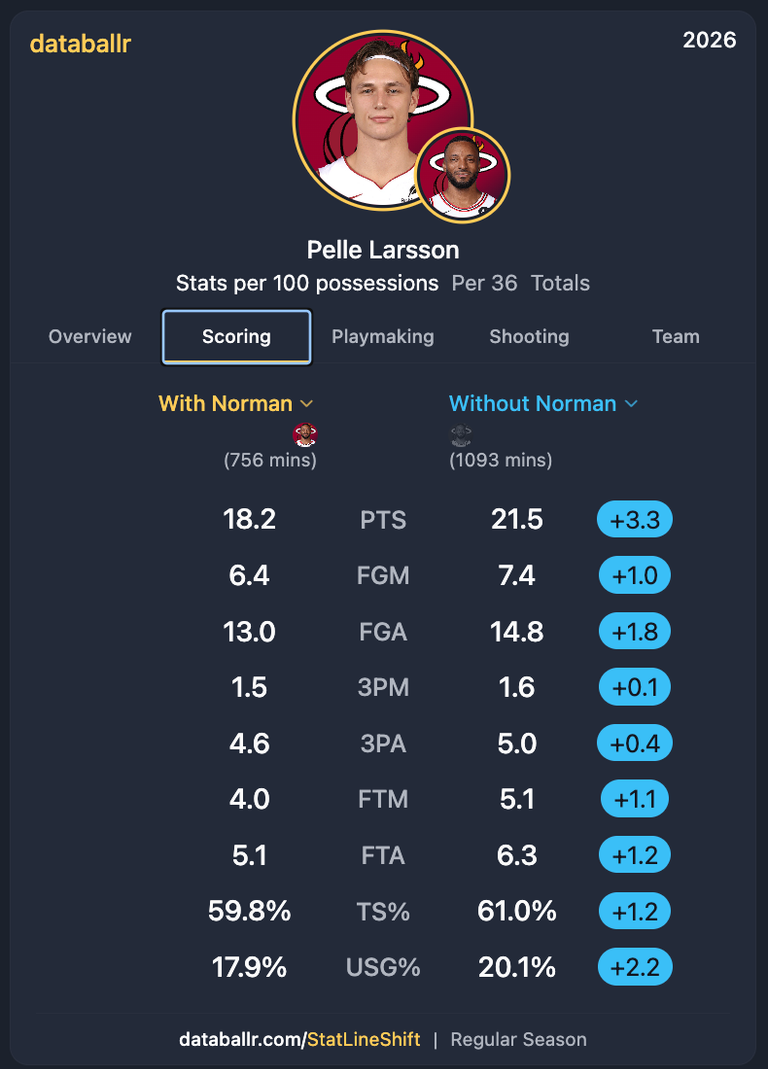
Pelle Larsson has an oddball skillset like Jovic, boasting an uncanny ability to get to the line for a player that's on-ball as rarely as he was last year, putting up a 97th%ile free-throw rate at his position, a .41 ratio of FTA to FGA that only big men have been able to achieve while self-creating so few of their shots. He has all the makings of a player whose vet was Jimmy Butler, utilizing a deep bag of pump fakes and deceleration to throw opponents off balance before drawing contact. In fact, he and Butler scored the exact amount of points per possession in isolation, finishing #1 and #2 in Isolation free-throw rate.
While most 3 and D wings have the 3P shot as the complementary skill to keep them on the floor, Pelle has this grifting superpower that demands ample playing time, even with a 8th%ile 3-point attempt rate. Larsson has an innate grit and toughness that's embodied by his driving approach and he's so solid with his rotations, positioning and cut timing that it's understandable why Miami saw the need to both retain him in the Giannis trade and extend him shortly after the trade completed. It's encouraging that his growth as a foul drawer translated rather quickly to this summer's FIBA competition, starring as Sweden's lead handler and torching teams to the tune of nearly 1.2 PPP as a PNR handler. A breakout season is likely and necessary for this team to be at their best.
5) What skillset will they miss most from the outgoing pieces in the Giannis trade? Are any of those skills attainable at the deadline or through internal development?
The most popular answer here is probably Tyler Herro's off the dribble scoring and pull-up shooting, especially since Miami has attempted, as a team, 11 pull-up threes out of PNR and Herro has already taken 18. Some may point to Kel'el Ware's spacing ability or Kasparas Jakučionis' passing, though Jaime Jaquez's driving and live dribble passing would be my pick. No member of the Heat drove more frequently than JJJ last year. His 17.4 drives per game ranked 17th in the NBA and he had a total of 1300-ish drives, more than Wiggins & Larsson combined. Jaime's overall HC impact clocked in at just the 6th biggest on/off among Heat players, but he had a massive influence over their ability to generate offense out of isolations including passes, scoring just .909 in these situations without him and jumping to 1.01 with him on the floor, the difference between 7th best and 27th best.
His own inefficiencies as a scorer and not getting to the FT line as much as he should've at this driving volume (6.0 drive PF%, 69th out of 82 players to drive at least 10 times a game) likely capped Miami's offensive ceiling with him as a proveribalcreator for an impartial offense, and the Heat are playing a different style HC O with a far superior lead driver, but that doesn't mean JJJ's feel as a cutter filling in behind Giannis' drives and ability to shoulder such a load wouldn't bear fruit. Pelle is going to be stepping into this role and should perform admirably, which does make the driving/slashing more directly replaceable than Herro's pull-up juice, Ware's size + spacing or even Kasp's playmaking, even if I consider it the most consequential "missing" skillset with Pelle as the sole complementary rim pressure player on the roster. I don't see the Heat mortgaging their future further to add a stretch big but if Giannis' defense continues to hold up and he and Bam perform well as a tandem, I do think they'll consider swinging a trade for some more on-ball creation to supplement the offense. The Godfather should prioritize players who have history functioning as a neutral team defender at worst, which tabs Kyrie Irving and Jordan Poole as potential options.
Record Prediction
Combined Odds: 46.2 via multiple sportbooks
My Model Projection: 44.5 (12th of 30), +1.60 Net Rating, 50% playoff odds
Floor: 42-40 (-1 wins)
All it really takes is Giannis missing 30+ games for the Heat to trend around being a .500 team. He’s just so vital to what they do, maybe even moreso than the Bucks roster he left to contend for a championship with. The variety in terms of personnel and driving style was how they were so much more effective on offense than their talent should’ve provided, it may be a big shift to switch that system to one that orbits Giannis.
Ceiling: 50-32 (+7 wins)
It’s rare a team wins a championship the season immediately following a massive trade, especially one that required the amount of outgoing personnel that Giannis did. I see this team potentially going so far as ranking as high as the 3rd seed, especially if Jovic and/or Larsson can snatch a larger role.
Overall Grade: — B
In the age of parity, depth & versatility has triumphed more than the top-heavy rosters of old. Miami has imbalances in their cap sheet, division of labor and overall rotation that can be assuaged by Jovic & Larsson, but in my estimation, this team is still a few years away from being correctly calibrated to contend. They'll have to hope that Giannis is still in good enough physical condition (and inks an extension) to continue to iterate around this version of their team.
Let me know if you agree with my predictions! What are your expectations for the Heat this season?
I’m a lifelong basketball enthusiast who blends film study and advanced analytics in my independent coverage of basketball and the NBA Draft across Tiktok, Twitter, Youtube, Substack and Instagram. I’ve also covered the Hawks for ~2 years as an accredited digital journalist for Afro News, and I am a member of the Atlanta Hawks’ Creators Collective.







Comments