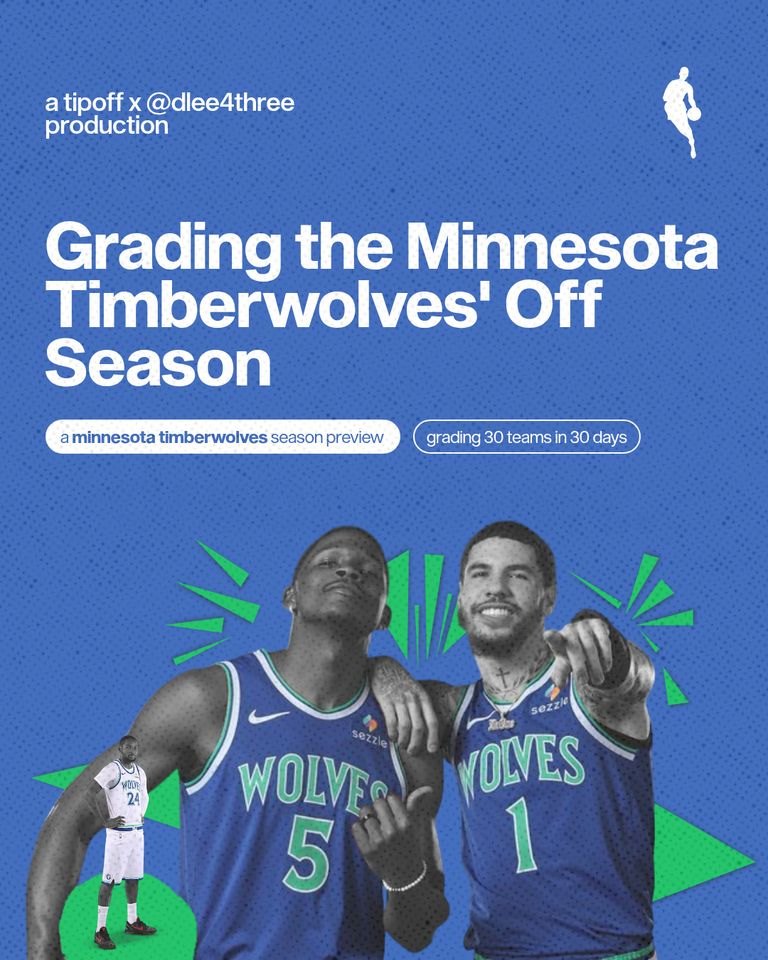
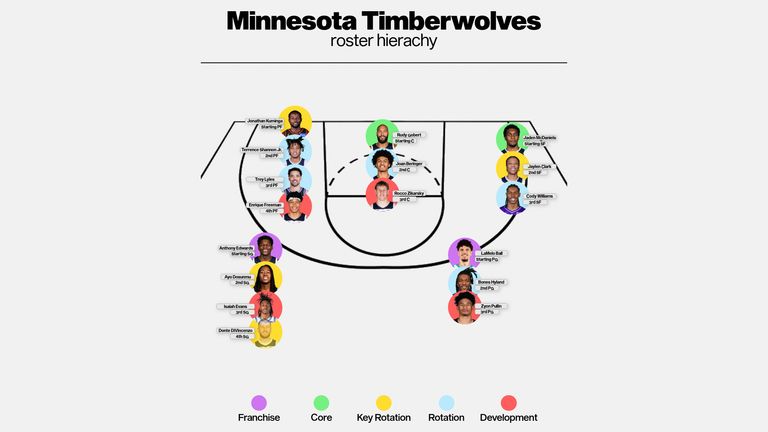
Welcome to the 4th edition of my annual 30 teams in 30 days series, the most comprehensive and informative previews for every team in the NBA. Inside these posts, you’ll get up to speed with every team’s offseason additions and their roster hierarchies, learn whether they’ve addressed their biggest areas of need, ponder over 5 questions that will define their season and then decide whether you agree with my offseason grades and record predictions. For the first time, these articles will be exclusively posted on the Hardwood Collective and are paired with video deep-dives over on my Youtube and full-length podcast episodes over on The Fifth Factor!
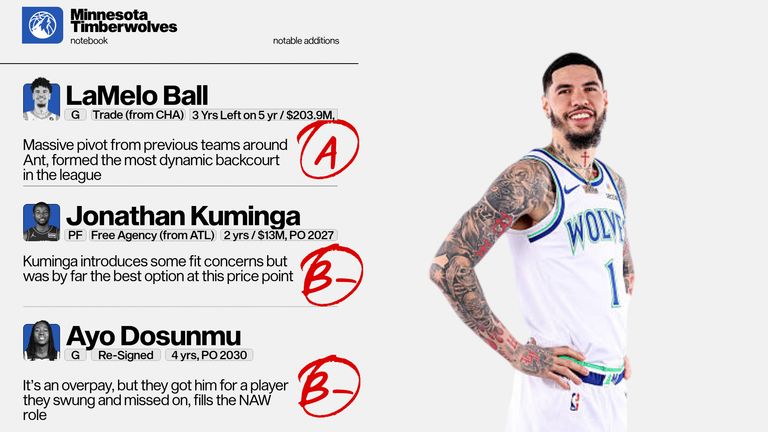
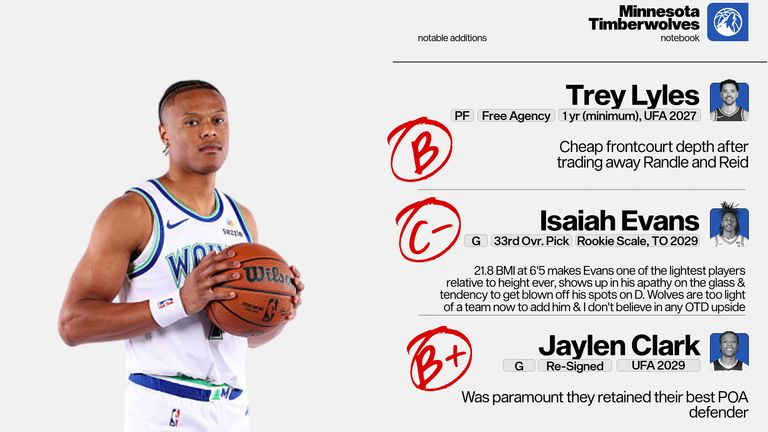
Notable Additions: LaMelo Ball, Jonathan Kuminga, Ayo Dosunmu (re-signed), Josh Green, Trey Lyles, Isaiah Evans, Jaylen Clark (re-signed), Bones Hyland (re-signed), Trey Kaufman-Renn, Cody Williams
Draft Pick Comps & Strengths + Weaknesses
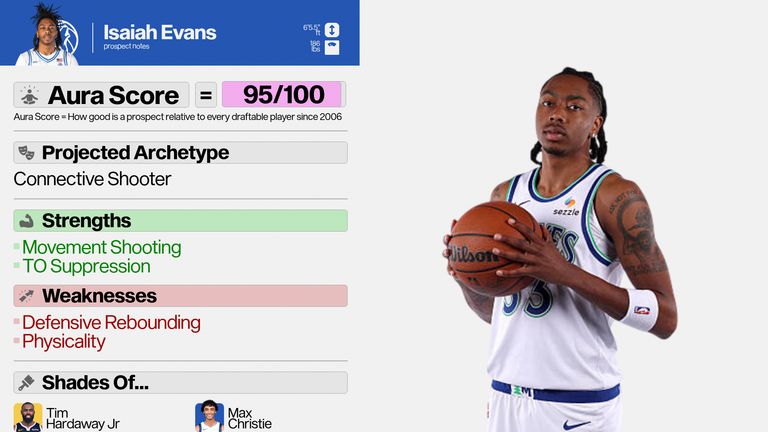
#33: Isaiah Evans
I thought Isaiah Evans was a relatively simple evaluation for the entirety of the cycle, up until I finished my model, upon which I was stunned to see him grade out with the 10th highest score in the class. Because collegiate samples are so tiny, it can be hard to distinguish a players' individual impact from being paired with dominant players, such as Cooper Flagg and Cam Boozer. For Evans though, his on-ball growth from his freshman year, efficiency remaining strong with Boozer off the floor (55 eFG% w/ Boozer on, 57 eFG% w/ him off) in addition to how well he complemented Cam does make me think that he's less 1-dimensional offensively than I imagined.
A part of this is because even without Cam, Evans' role was still the exact same. He was flying off of screens and DHOs just like he did with Boozer, because his movement shooting ability isn't as dependent on a lead creator as a stationary shooter or most bigs. Evans was often the player Duke looked to create out of structure once the primary action was denied, with their bigs reverse pivoting to run a weakside DHO with Isaiah to instantly stress the defense. It was in these moments where he displayed a rare flair for scoring for guys in his mold, which I believe can be attributed to how aware he was of both his teammates' positions and where defenses would be sending help from.
My gripes with his profile (and ultimately, Minnesota selecting him) begin with his 7th%ile weight and 24th%ile wingspan-height (length). 186lbs at 6'6 got him knocked off his spot, pinned on screens and knocked back several feet when drivers like Dailyn Swain went at him. Additionally, while movement shooters don't need to be paired with stars to be effective, they do require strong screeners, versatile bigs and sound decision making from the trigger-man. This is why Isaiah Evans remained a low turnover player without Boozer while the team as a whole turned the ball over nearly 4% more often (12.9% w/ Boozer + Evans, 16.3% w/ just Evans). Ironically, the past 2 iterations of Minnesota would've been a much better fit with his skillset, featuring KAT/Randle/Naz as hubs & screeners with Conley or Slow-Mo as the trigger men. Do the Wolves plan on featuring enough motion to make Evans' skillset viable? (Probably not in a similar style to Duke, but we could/should see a lot of guard to guard actions.) Do they have the hubs anymore? (They don't.)
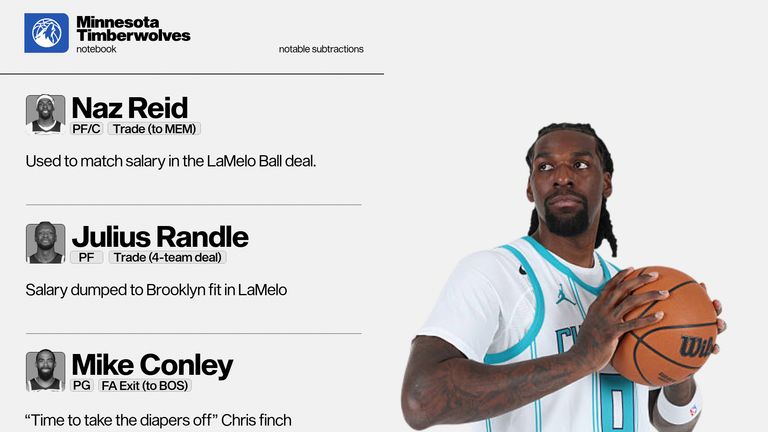
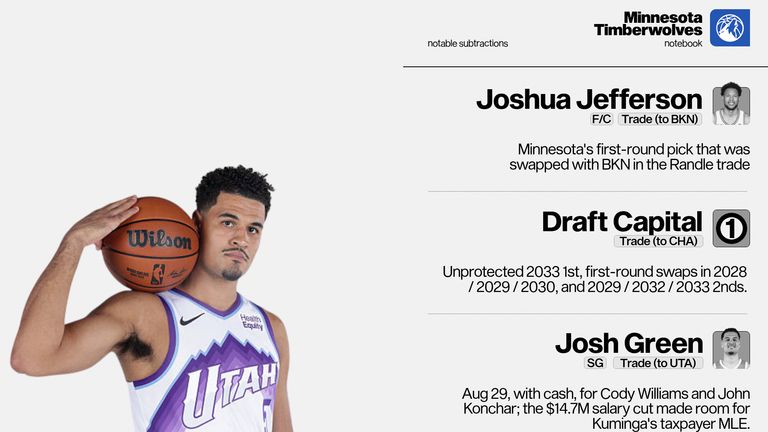
Notable Subtractions: Naz Reid, Julius Randle, Mike Conley, Kyle Anderson, Joshua Jefferson, Josh Green, John Konchar
There aren't many GMs in the league who would have the audacity to trade away all of their power forward depth in a single offseason, cash in on the financial flexibility nearly immediately and still somehow find a way to add a starter using nothing but the taxpayer MLE. Tim Connelley's aggression is borderline legendary at this point, and he's been incredibly proactive this summer yet again, completely remaking Minnesota's roster. The FO began this crusade to build a different type of team around Anthony Edwards by salary dumping Julius Randle to the Brooklyn Nets after yet another playoff stinker, finding a trade partner who wouldn't require them to give up a first directly. All Minnesota had to do to get off his contract was slide back from the No. 28 pick to the 33rd, which made them a non-tax paying team, generated a $33M TPE and freed up a ton of cap space.
They used this cap space to sign Ayo Dosunmu to a lucrative extension, then used all that newfound flexibility to pull off one of the more shocking trades in recent history, swapping Naz Reid & draft capital for LaMelo Ball. In order to make the money work so they didn't have to move off of Gobert, the Wolves expanded the Randle trade into a 4-team trade. With Randle in Brooklyn and Reid in Charlotte, the Wolves had suddenly went from being one of the more robust frontcourts in the league, to having a gaping hole at power forward. This became the next natural puzzle piece that Connelly and the Wolves FO had to identify, but because they were now a tax-paying team, their MLE was cut in half ($12M to $6M) and they no longer had the trade exception.
Minnesota was going to either need to use their non-taxpayer MLE or combine Josh Green, Donte (rehabbing Achilles) and/or Shannon Jr. to add that final piece. $6M doesn't go as far as it used to in the NBA, which makes it hard to add a starter at that small of a salary slot. Minny was prepared however, shrewdly courting both LeBron and Jonathan Kuminga all offseason, eventually landing JK for the MLE. Because of how much salary they brought in, MIN had to shed at least $2M to officially sign Kuminga as they were now capped at the 2nd apron. They could have waived & stretched a currently rostered player (which would've been much more expensive) or break up a salary into 2 smaller components and waive one of those incoming players. This is the rationale behind the Josh Green trade to Utah for Jon Konchar and Cody Williams, acquiring Jon with the intent to waive & stretch his contract for 3 years, while Cody is a revitalization project for a team that has no tradeable 1sts until 2029 and doesn't have control of their own pick until 2030.
The Wolves went from a potential 2nd apron team at the beginning of the offseason, to $50M below the apron after dumping Randle, $35M below w/ the full MLE + a $33M TPE after Ayo signing and are now hard-capped at the 2nd apron with ~ $4M worth of room. pic.twitter.com/CRP8KV4rpm
The end result is a brand new take on Edwards' supporting cast, born out of turning Randle's salary into a bunch of different flexible options. Minnesota is on its' third iteration of a contending roster in roughly four years, evidence of this front office's commitment to not waste time with a version of the roster that may have already reached its' ceiling. I think that that's a testament to just how aggressive Tim Connelly is. Now whether the aggression will pay off or not, we'll have to see.
Pre-Draft Areas of Need:
🥇 Rim Deterrence (when Gobert is off the floor): 10 defense since Gobert has arrived, including #1 in 2024, but bottom 15 in 3 of the 4 years in rim freq. allowed including 24th last year)
Somewhat Addressed: Kuminga + Beringer should offer more switchability which will keep Minnesota out of rotation, but Joan is still extremely raw
🥈Playmaking: 30th in Cut PPP, 28th in C&S Frequency, 2nd highest TO% (23.1%) and 13th in PPP when defenses committed on their PNRs in the playoffs
Addressed: LaMelo led a Charlotte offense that was the 2nd most efficient when defenses committed and was the best player in the league in such situations (1.08 PPP), has dealt with aggressive coverages for years even if he hasn’t sniffed the playoffs yet
Note: Teams with multiple on-ball creators tend to a have a lower portion of their FGA come off of the catch, but MIN should’ve been closer to OKC in frequency (a team with 1-2 players who should be taking a large portion of OTD jumpers and everyone else off the catch)
🥉 Off-Screen Scoring: 70%ile in Off-Screen frequency or higher last 3 years in the playoffs, but they’ve regressed to 27th%ile efficiency
Partially Addressed: LaMelo 84th%ile in offscreen PPP, Kuminga also familiar with high off-ball screening environments from his team in Atlanta & Golden State
Season Outlook:
1) Does swapping in Kuminga + Beringer for Randle + Reid help this team stop hemorrhaging opponent rim FGA in non-Gobert minutes?
The Wolves have been a T10 defense every year since Gobert arrived, peaking as the best defense in the league in 2024. It's not a coincidence that this peak was achieved in the year they were above average limiting opponent rim FGA, holding them to the 9th lowest rim frequency that season. This is a stark contrast to the defenses Gobert anchored in Utah (though his own individual rim deterrence has remained just as strong) that ranked top 5 in rim deterrence for 5 straight years. On paper, the Utah Jazz teams with Gobert being a more effective team at suppressing rim attempts than a Wolves team that seemingly has twice the athletic talent may not make sense, but the truth is the Jazz players did a much better job funneling players towards Gobert. Royce O'Neale, Joe Ingles and a younger Mike Conley were able to navigate screens well enough to drive players towards the Stifle tower, which allowed those teams to exert their desires over opponents' shot profiles with ease.
Minnesota has almost always played a different style of defense than the standard drop coverage they run with Gobert, since their backup 5 options haven't had the tools and skillset to play drop coverage. Playing at the level, aggressive PNR coverages opens up a team to get put in rotation more often while scrambling around to their assignments after putting 2 on the ball, which allows more chances for opponents to cut to the basket and attack mismatches. Done correctly, a team can hold their defensive shell intact even while constantly rotating. This requires engagement from all 5 players, excellent positioning and enough size across the board so no one player is going to be massively disadvantaged if they have to tag a rolling big or front a post-up player. This is where Naz Reid and Julius Randle's size was massive, as they were able to function effectively guarding other bigs, provided they were able to make their rotations on time. The biggest issue with this approach is that Minnesota didn't always have the size, connectivity or POA defense on the floor to successfully play ANY style coverage without Gobert cleaning everything up.
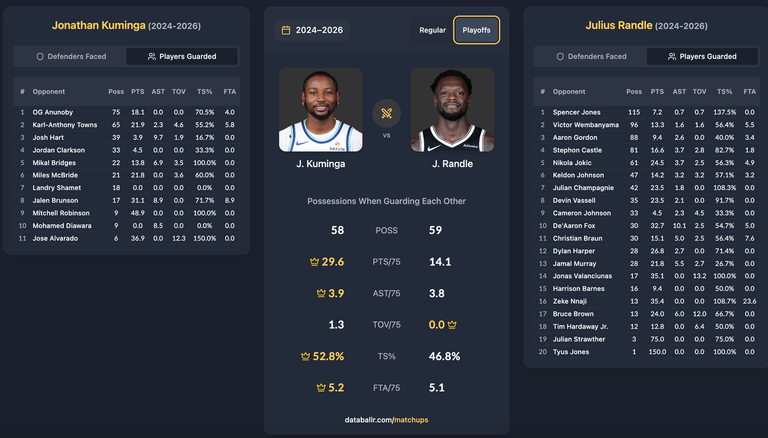
Swapping in Kuminga for Randle and Joan Beringer for Naz Reid immediately improves their ground coverage ability and lateral mobility, but they also come with a few dropbacks. Jonathan is best deployed switching ball screens than navigating weakside responsibilities as he can get a bit lost when he needs to make quick rotations. Additionally, Kuminga's one of the stronger wings in the NBA, but he's not 240ish pounds, which makes it less likely he can replicate Julius and Naz's ability to up and move down the positional spectrum. JK had strong moments defensively in the playoffs for Atlanta, winning possessions against KAT physically then switching and containing Brunson, but that was a relatively new development in his defensive toolkit. Prior to that series against the Knicks, Kuminga was very rarely used as a primary defender vs bigs and wasn't assigned to KAT until the Hawks got a bit desperate later in the series. He's also had a pretty middling impact on opponent rim FGA and FG% the last 3 years, and didn't have a noticeable impact signal in his brief minutes with ATL after being a part of strong defensive units in Golden State. (35th%ile in rim contests, -1.3% rim opp FG% last 3 years). The Wolves' defense would benefit massively if he can prove this utility is viable throughout the season, as McDaniels is better as a roamer, thus JK taking most of the on-ball defensive tasks would be ideal.
Beringer has seen very little playing time to this point, but put a lid on the rim in his short stints across the G-League and the NBA. He's better suited to play drop coverage than their previous backup 5s, though it's a bit early to be asking him to be the crux of a defense that can be hit or miss at the point of attack. His technique retreating defending PNR is pretty solid and he's great at navigating any additional screens, although he's quite vulnerable to pump fakes since he's still new to NBA pacing. More refined bigs were able to leverage his aggression against him and he can find himself overcommitting to ballhandlers. He can recover extremely fast thanks to his ridiculous athleticism, though he often left windows open for too long to make a consequential impact on the shot. This team will likely stave off opponent rim FGA more than the last 2 years off the strength of becoming a bigger team across the board and injecting some mobility into the frontcourt, but the extent to which they improve really hinges on how many different types of coverages Kuminga/Beringer allow them to play.
2) How can the Wolves offset constructing one of the lowest 3PA/passing volume frontcourts in the league?
Minnesota's wheeling and dealing this offseason virtually necessitated that they acquire Kuminga , but I do worry about the negative intersection of three-point attempt volume and passing ability with a starting frontcourt of Kuminga, McDaniels, and Gobert. McDaniels ranked in the 9th%ile in 3PA volume and Kuminga ranked in the 23rd%ile, Gobert has no utility outside of 3-5 feet away from the rim. Additionally, all three are high-turnover players relative to low passing volume, Jonathan Kuminga had his most productive passing season from a potential assists perspective, but he paired it with a 17.3 pass tov% (25th%ile) last year, which was in line with how inaccurate he’s been throughout his whole career. My hand-tracking for his time in ATL had his passing efficiency (basically how many points would we expect the team to score on TSA from his passes) as the 3rd lowest on the team.
Passing isn’t just about potential assists, it’s also relative to TOs and willingness in general (Kuminga was 29th%ile in PA/min on-ball). Jaden Mcdaniels ranked in the 41st% and Gobert ranked in the 24th%ile in passing tov%, which pretty much paints the picture that this frontcourt could have some clunky moments when these 3 are asked to function as connection points. It's not that Kuminga and Jaden cannot pass, rather that their assist volume and turnovers suggest they are not ideal high-level frontcourt decision-makers, especially as teams get better at blitzing ball handlers. Naz Reid's ability to play the 3, 4 or 5 while providing off-ball gravity that pulled defenders is a luxury they won't have this year, so Minnesota will need these players to make the next reads when defenses load up on LaMelo or Ant or shift their defense by sagging off one of their less prolific shooters.
The good news is that there’s no better backcourt to support such a frontcourt than one with a LaMelo-Ant tandem. Ball is one of the 5 best passers in the league and as we discussed in the areas of need, he was extremely efficient when defenses committed to his PNRs. Edwards has gotten increasingly more comfortable facing doubles in the playoffs, with his next point of growth trusting his bigs on the short roll. Gobert can make basic 1-dribble reads in the middle of the floor but has been looked off frequently by Minnesota's guards, they've got to be intentional about using Kuminga's cutting and Jaden's soft touch in the paint to give him outlets as he opens up towards the basket. If Kuminga and McDaniels can punish teams from tagging off of the corner, then the Wolves offense will be extremely effective. That will require a shot profile shift from at least one of them, turning their 40% midrange volume into an additional ~ 10% corner 3P volume.
3) Can Jaylen Clark refine his offensive skillset enough to fulfill a glaring need as a guard-focused POA defender?
One of the biggest areas of need in Minnesota's starting lineup is a POA defender who can truly enable McDaniels' off-ball defensive ability. On some nights, they may wind up turning to Edwards to compete against some of the best initiators in basketball depending on matchups, leaving the bigger forwards and wings to Kuminga & McDaniels. Ant can certainly hold his own and tends to look more dialed in when he's got a challenge in front of him, but how much can they reasonably expect him to exert on defense?
The recently-extended Jaylen Clark has been their in-house stopper the past few seasons, and Chris Finch has already trusted him with some brief stints in the playoffs. He's a 90th%ile offensive rebounder at the wing position and extremely disruptive defensively, but unfortunately, he took just 4 threes per 75 poss last year (15th%ile). Clark is limited attacking closeouts, an inflexible and stiff driver, and has an inconsistent jumper. As a result, defenses sag off him and load up on Ant, even 1 pass away from the strong-side corner. His cutting ability helps provide some marginal offensive value, especially out of the corner, but he's shot just 15/62 on floaters (~30%) and isn't an extraordinary offensive athlete, which means that he's easily walled off by a rotating defender. Ideally Clark would play a majority of his minutes with LaMelo, who would maximize his opportunities to finish plays, but Jaylen's role in the offense is also complicated by the starting frontcourt's skillsets and deficiencies we discussed.
The offense rebounding and feel means Clark in the dunker spot and screening is a good way to minimize teams ignoring him on offense, but the problem is that Minnesota features multiple players who are also maximized in that same role. This is a large part of why his minutes with Gobert have been absolutely dreadful offensively, even with such a huge boost in the offensive rebounding and the gains made defensively once Rudy gets to operate with a talented POA defender. Kuminga and McDaniels' improvement as spacers would make it far easier to play Clark more minutes, which they'll need in certain matchups or in the playoffs, but MIN will need to be vigilant about where they place him to avoid making life harder for themselves. I'd love to see them experiment with playing him out of the slot when he's sharing the floor with Rudy.
4) Will Anthony Edwards and LaMelo Ball comprise the highest combined 3PA for a backcourt since Curry & Klay? Are they gifted enough at their strengths to offset each other’s weaknesses?
Stephen Curry and Klay Thompson combined to make 9.3 3-pointers per game in the 2022-2023 season, breaking their own record that they had set multiple times over their years together. They each attempted more than 15 threes per 100 possessions to do so, a mark that has only been matched by themselves, James Harden, Damian Lillard and a bunch of movement shooters such as Duncan Robinson and Grayson Allen. Neither of the Splash Bros hold the record for per possession 3-point attempt volume however, that belongs to LaMelo Ball, who take the title from 2019 Harden by attempting 17.8 threes per 100 possessions last year.
56% of Ball's 3PA came off the dribble last year, side stepping his way into moonballs over outstretched contests with ease. He shot 36.2% off the catch and converted his OTD 3s at the exact same rate. Anthony Edwards was the best catch & shoot 3P shooter in the entire league, shooting 48.4% on 155 attempts. The bulk of his attempts (72.4%) came off the dribble, where he shot 35.6%. There's a clear opportunity here to tune Edwards' shot diet to take more off the catch, as he's shot 40% or better from 3 from a standstill every year of his career excluding his rookie year. We've already seen Ant scale up as a 3P shooter when he was paired with Mike Conley, whose ability to assume some of the ball-handling abilities boosted Ant's 3-point attempt rate for .40 to .43. Given how much more efficient Ant is off the catch and their shared ability to get 3-point attempts off in every fashion imaginable, I'm expecting this duo to seriously challenge the Splash Bros for the title of the most prolific 3P duo, especially since MIN may need this to be the highest-volume three-point pairing in the league to compensate for the skill limitations in the frontcourt. All they need to do is reach that combined three point attempts per 100 possessions to make it a reality.
Anthony Edwards on his fit with LaMelo Ball.
"I feel like I'm a natural two guard, at heart. I never thought I could develop any PG skills. Finchy harps on me passing the ball, but we got LaMelo, I'm happy." pic.twitter.com/tAW0yJAAmr
The potential for LaMelo and Ant to offset each other's fatal flaws is one of the other fascinating aspects of this pairing. The biggest wart in LaMelo's offensive profile has been his inability to be efficient at the rim, peaking as a 33rd%ile rim finisher as a rookie! His best raw rim FG% came this past year, where he shot 57.2%, a pedestrian number for a player of his caliber, size and length. His finishing is a long-running issue due to suboptimal takeoff angles, touch and strength, which are all exacerbated by being on-ball at one of the highest rates in the league. Edwards' Achilles heel is his playmaking, which has led to him becoming more and more unwilling to swing the rock as he ascended as a scorer. This has lead to some wild moments in the playoffs despite him displaying growth vs blitzes as he's racked up playoff experience. LaMelo's superpower directly addresses this limitation, placing Ant in his optimal (and preferred) role as a score-first player. This won't be a 1:1 mutualistic relationship though, as Ant isn't going to directly improve LaMelo's finishing to the same extent, but I am expecting more off-ball looks and a higher transition frequency for Melo, which should help him be a bit better at the rim.
5) Is this iteration of the Wolves’ better positioned to contend with the types of teams that foiled their previous playoff runs?
I'm fascinated in Minnesota’s bet on variance. The broader principles Minnesota has built this roster around — forcing turnovers, getting into transition and getting up threes at historic rates — are elements most teams try to win on a night to night basis, but Minnesota is going about incorporating them into a style in an unusual way. MIN isn't trying to emulate Boston's emphasis on maximizing spacing or replicate Golden State's movement heavy offense, the two avenues most teams have taken to juice their 3-point rates. They're going to have an identity that's much closer to D'Antoni's Rockets, but unlike those teams, I'm anticipating them to be a high-volume transition team. This is a more volatile, variance-driven team that has underwent a metamorphosis because of their shortcomings in the playoffs in the last few years.
Their exit in the 2025 playoffs against the Thunder was in large part due to how the Thunder shut down Julius Randle and while that "weak point" is no longer on the roster, that doesn't necessarily mean MIN is automatically better positioned to compete with OKC. San Antonio neutered Gobert's impact by blitzing Ant while leaving Wembanyama in a deep drop, which became problematic since Minnesota lacked dynamism out of DHOs and the short roll, leaving them with few ways to reliably put Wemby into conflict.
Minnesota can't realistically expect to win the paint battle against Victor Wembanyama, nor are they likely to beat Oklahoma City in the possession battle given Shai’s low turnover rate and OKC’s ability to force mistakes. Instead, Minnesota may try to shift the battle away from the rim and toward spacing, pace, and volume shooting. That does not mean the Wolves would stop attacking the rim entirely; rather, I see this shift as a philosophical change away from the more inside-out, methodical style they used with Randle and KAT. They will be able to reach a different gear of 3P volume this year, a level of embracing variance that was uncomfortable for them in this past season's series vs the Spurs. In a unique matchup such as San Antonio, having the ability to take more than half of your FGA from 3 is a necessary curveball they need to be able to get to.
Asked Jaden McDaniels what they learned about attacking the rim when Victor Wembanyama is on the floor.
"You just gotta act like he's not there. I mean, he's gonna get blocks. He's the tallest person in the world." pic.twitter.com/0FYBQpZeyp
This team also feels far older than they may appear with how frequently Antman has played in May, but LaMelo is 25 and Edwards is 24, so this move is not just about the immediate championship window. That's why even if Minnesota doesn't make a deeper run than in previous years in 2027, they added a fellow T10 offensive player to their young cornerstone, while retaining more flexibility going forward. Ultimately, Minnesota is better equipped to play a different kind of game against teams like San Antonio and Oklahoma City, even if it is not yet clear whether that makes them definitively better.
Record Prediction
Combined Odds: 48.6 via multiple sportbooks
My Model Projection: 46.7 (9th of 30), +2.95 Net Rating, 59% playoff odds
Floor: 45-37 (-4 wins)
The moves the Wolves made this offseason has introduced some variability into their playstyle by embracing the 3-point line and the ups and downs of LaMelo Ball as an on-ball creator. This team will get to the FT line less and are more reliant on 2 players more than ever, which may leave them vulnerable if Edwards and/or Ball miss time.
Ceiling: 58-24 (+9 wins)
We’ve yet to see Minnesota be a truly dominant offense in the Ant era, peaking as the 8th best ORTG in 2024 and 2025, but never quite breaking through the ~ 118 ORTG threshold. If they fully lean into being one of the best high-volume transition teams in the league and can defend a bit more cohesively with Gobert off the floor, we’re in store for an electric season.
Overall Grade: — A
Let me know if you agree with my predictions! What are your expectations for the Timberwolves this season?
I’m a lifelong basketball enthusiast who blends film study and advanced analytics in my independent coverage of basketball and the NBA Draft across Tiktok, Twitter, Youtube, Substack and Instagram. I’ve also covered the Hawks for ~2 years as an accredited digital journalist for Afro News, and I am a member of the Atlanta Hawks’ Creators Collective.
-768x960.jpg)




Comments