30 teams, 30 days: Washington Wizards | 2027 Season Preview
Washington is hedging a massive bet on Trae Young's ability to accelerate their development and instill a competitive backbone. Welcome to the 4th edition of my annual 30 teams in 30 days series, the most comprehensive and informative previews for every team in the NBA.
Welcome to the 4th edition of my annual 30 teams in 30 days series, the most comprehensive and informative previews for every team in the NBA. Inside these posts, you’ll get up to speed with every team’s offseason additions and their roster hierarchies, learn whether they’ve addressed their biggest areas of need, ponder over 5 questions that will define their season and then decide whether you agree with my offseason grades and record predictions. For the first time, these articles will be exclusively posted on the Hardwood Collective and are paired with video deep-dives over on my Youtube and full-length podcast episodes over on The Fifth Factor!
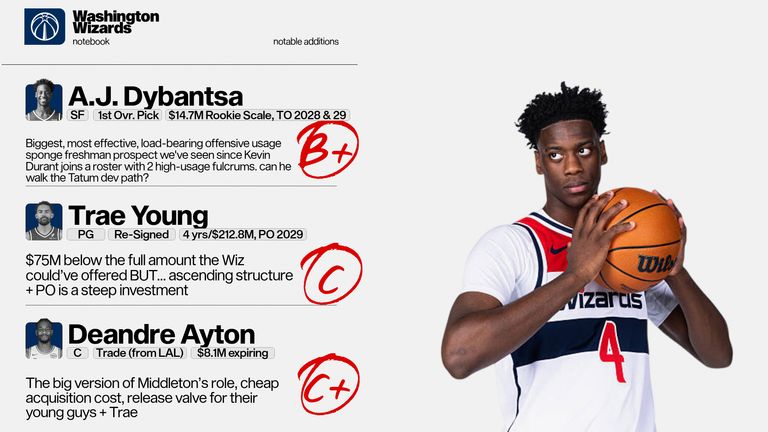
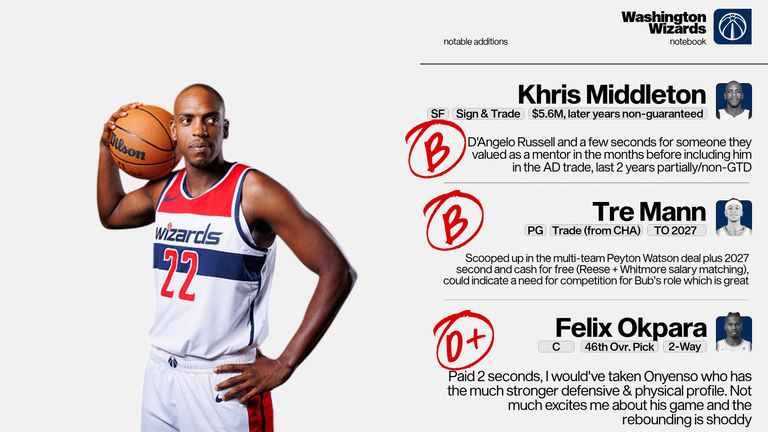
Notable Additions: A.J. Dybantsa, Trae Young (re-signed), Deandre Ayton, Khris Middleton, Tre Mann, Felix Okpara, Jamir Watkins (re-signed), Anthony Gill (re-signed), Trevor Keels, KeShawn Murphy
Draft Pick Comps & Strengths + Weaknesses
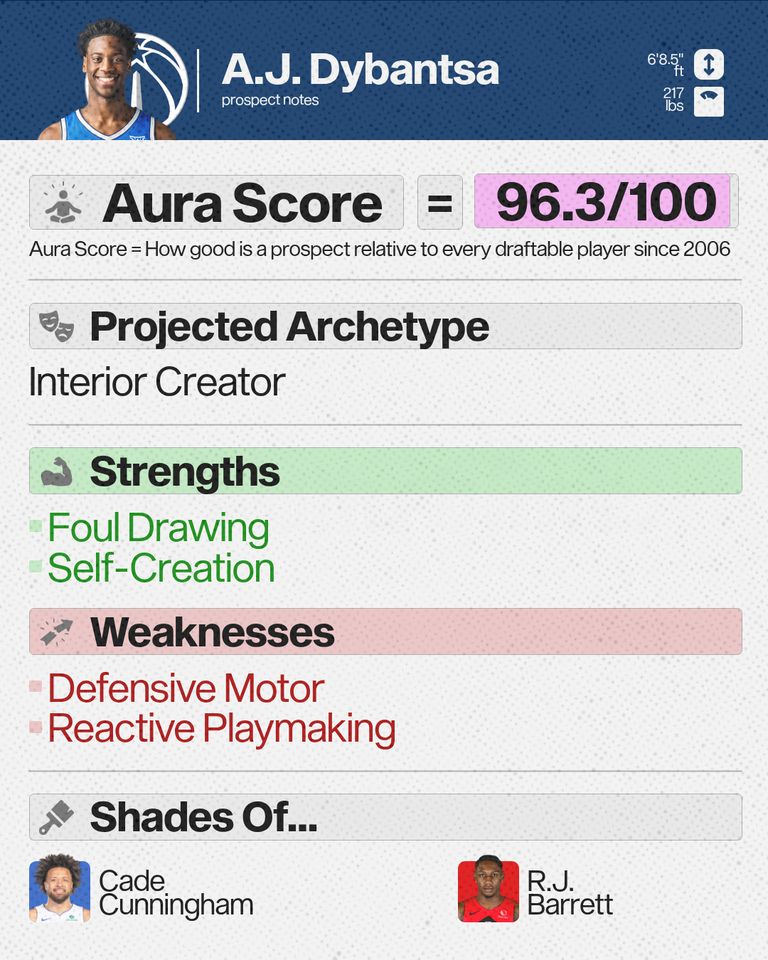
1). AJ Dybantsa
Dybantsa led the NCAA in points per game at 18 years old, virtually unparalleled precocious scoring production while self-creating the majority of his buckets. 82.6% of his rim FGM, 88.1% of his non-rim twos, 30.6% of his 3PM and 76.5% of his total FGM were unassisted, 99th%ile self-creation volume that he paired with the requisite frame & passing feel to potentially reach superstardom. He's one of a select few high-major freshmen to sustain a positive A/TO on 30+ usage, singlehandedly reshaping BYU's offense. 2025 BYU was one of the most high-volume 3P teams in the country under Egor Demin and generated an assist on 59.6% of their field goals. With AJ on the roster, they ranked in the bottom 60 in the nation in assist rate and below average in 3P rate.
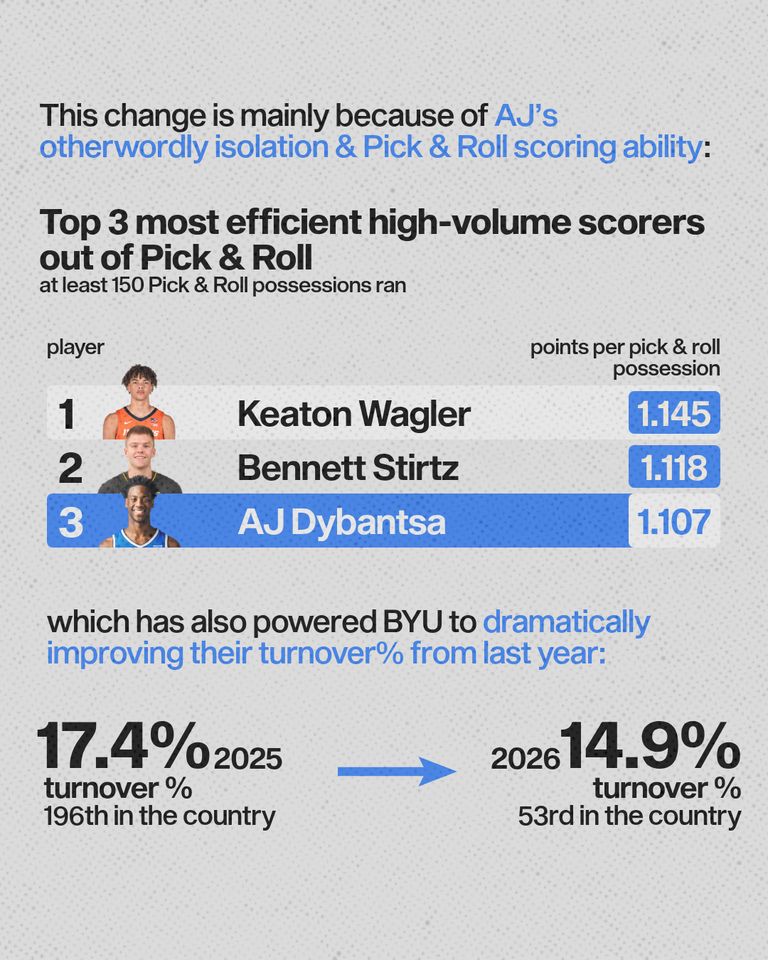
This is mainly because of AJ’s otherworldly isolation & PNR scoring ability, which allowed Kevin Young to centralize the playmaking AND scoring burden into his hands, with this shift helping to improve their TO% by almost 3 points from 2025. Dybantsa starred in this system, but it didn't necessarily lead to better offensive results for BYU as a team, especially once Richie Saunders tore his ACL. The '25 Cougars went 16-10 vs T100 teams with an offense 4 points better than the Dybantsa led team that went 14-12 vs top-100 competition, as AJ's PNR idiosyncrasies, playmaking footprint, defensive struggles and shot profile made the offense a bit inflexible.
AJ attempted an abnormally low amount of his PNR FGA from behind the 3-point line. 183 players ran at least 150 PNRs last season, getting up a 3 on about a quarter of their scoring possessions. AJ let a 3 fly on just 18% of PNR reps, opting for a paint heavy scoring approach which likely why AJ’s PNR numbers INCLUDING passes aren’t as strong as the other 3 elite PNR draft prospects, as he sees drop coverage more frequently and is a more capable scorer than playmaker at this point in his career. Dybantsa finished the season with a quarter of his FGA being from beyond the arc, an exceedingly low rate for a player whose playstyle indicates a desire to play as a #1 option in the NBA and run a good amount of pick-and-roll. High-usage NBA non-bigs this season have an average 3-point attempt rate of .39, which helps balance the coverages defenses have to throw at them.
AJ is such a gifted scorer that it’s not out of the question that he could approximate the scoring profiles of a Shai or a JB, though that's a narrow, treacherous path to walk and we've seen gifted self creating NCAA wings with a LOW 3PR (Tyreke Evans, Evan Turner, etc.) struggle to be as dominant in the NBA.
Players in my database in their pre-NBA year to have a 30 USG%, 20 AST% and a 3PR below .25
Dybantsa assisted on 23% of his teams' baskets while he's on the floor, a high mark for a player his size (9th highest at his size actually), that becomes a bit less impressive when you account for just how high his scoring usage is relative to that sample. His .70 AST/USG rate underscores his preference to score and was further emphasized by his minutes without Rob Wright. AJ’s AST% leapt by 7% as the lead handler, but his usage also spiked by 14%, which ended up dipping his AST/USG rate even lower despite upping the playmaking volume. AJ still keeps his units from turning the ball over without Rob (14.7% -> 14.3%) by playing this heavy isolation style that becomes even more pronounced when BYU plays T100 competition. Nonetheless, Dybantsa is a reactive playmaker who leans heavily on his scoring arsenal to compensate for his processing speed vs creative defensive schemes, which was evidenced by BYU’s assist rate dropping by 4.6% vs T100 competition.
I came into this season curious to see whether AJ could scale on defense with less on-ball responsibility, anticipating a bit of a reduction in his offensive role. He was still on the ball a ton, but that doesn’t excuse him contributing just a 0.8 BLK% and 1.0 STL% vs T50 teams. His inconsistent defensive effort was a contributing factor to BYU being ranked as the 2nd worst defense in The Big 12 through conference play. There isn’t much historical precedence for players AJ’s size becoming NBA level defenders while being similarly unproductive defensively in conference play. However, AJ’s ridiculous frame alongside his passable defensive on/off (he didn't make BYU massively negative on D) and moments of brilliance as a defender, especially vs Iowa State, give him a decent change at grading out as a neutral defender in the league on the low end.
Dybantsa’s ability to minimize turnovers by soaking up offensive usage, all while still scoring efficiently, is undoubtedly his greatest skill. It hints at an ability for a NBA team to surround him with talented defenders and task him with making everything click offensively, a la SGA/Harden/Cade. AJ needs to be more proactive as a playmaker and a defender, though he’s a better passer than 95% of the prospects his size, even if his best reads are predetermined at this point, and he improved exponentially in his delivery throughout the season. I anticipate him to be hampered as a scorer throughout his NBA career if he can’t 1) bulk up and 2) get up more 3s, though he became almost undeniable with his sustained individual excellence in Richie's absence.
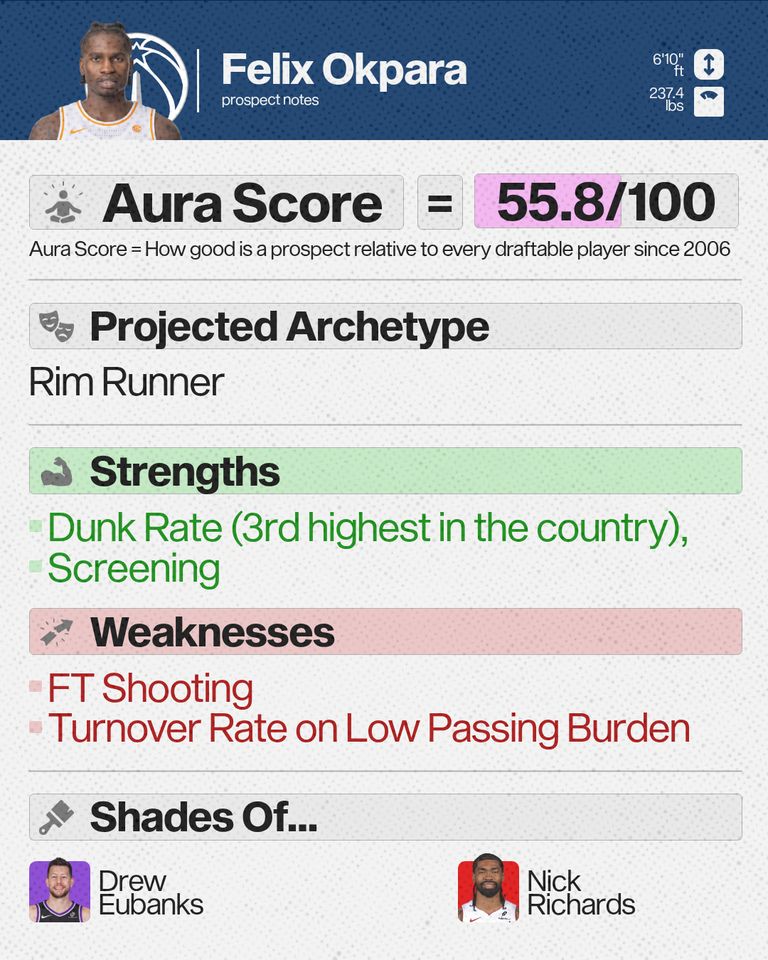
46). Felix Okpara I tried my best to find points of intrigue in Okpara's profile and I think the best I can do is applaud his physicality and relative mobility. Felix doesn't have the most overwhelming physicals, but generally did well on switches and was able to withstand bumps from opposing bigs without giving up much ground. That switchability is a part of the reason why he didn't rebound exceptionally well on the defensive glass, as he clearly has a nose for the ball on offensive rebounds. It's tough to see much more beyond the most simplest offensive role in his NBA future, consistently struggling at the FT line as a passer and on anything 3 feet away from the rim.
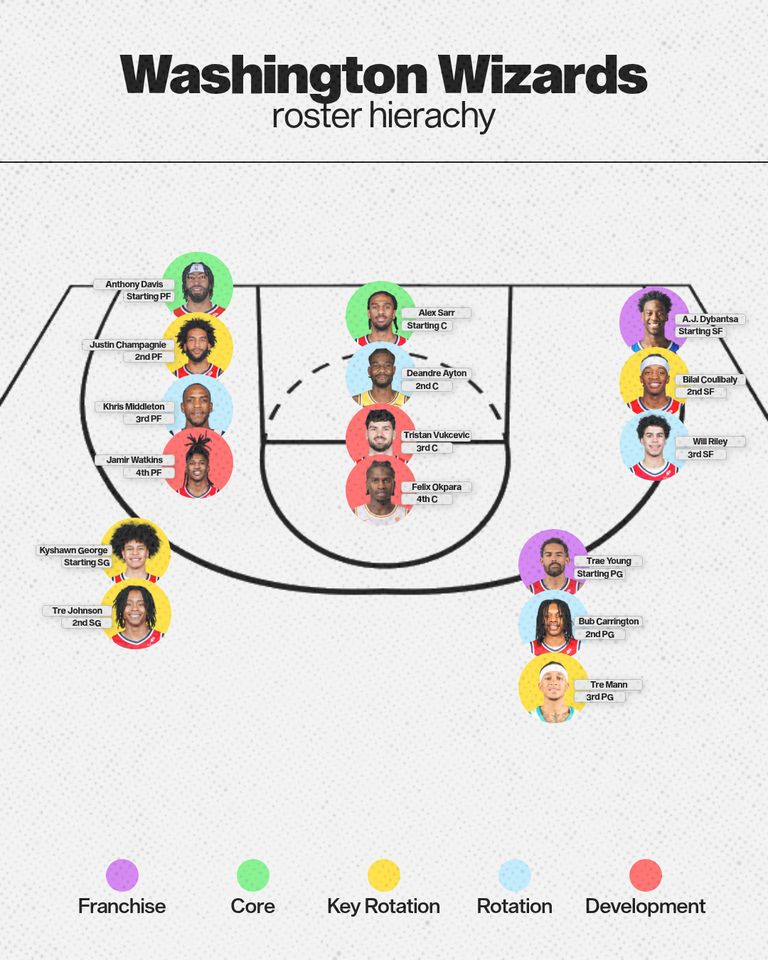
Key Rotation — Bilal Coulibaly, Tre Johnson, Tre Mann, Kyshawn George, Justin Champagnie
Rotation — Deandre Ayton, Khris Middleton, Will Riley, Bub Carrington
Development — Tristan Vukcevic, Felix Okpara, Jamir Watkins
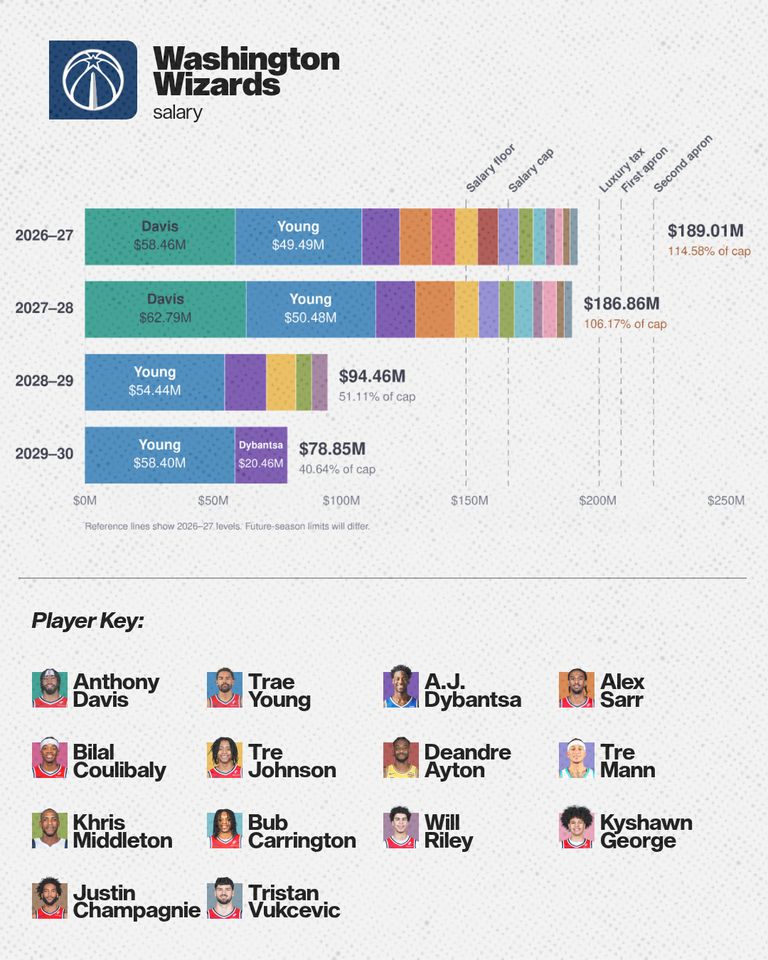
Cap Sheet
Offseason Overview
Ted Leonsis, chairman of Monumental Sports, operates a conglomerate of DC's sports teams, with controlling ownership stakes in the Wizards, Capitals and Mystics. He once stated that the Wizards would "never, ever tank" when discussing his goals for the 2018-2019 season where he envisioned them winning 50+ games (they ended up winning 32). This insistence on trying to be competitive at all costs is what led to several ill-advised moves, including signing Bradley Beal to a 5-year max with a player option AND one of the league's only no trade clauses, which turned into the worst contract in the league relatively quickly.
Lots of focus on the "will never, ever tank" quote. I think this one got overlooked.
“We said, ‘No excuses.’ It would be easy to say we have so many players out injured, but we’re not going to do that. We’re not letting anybody off the hook. We got to make the playoffs.”
It's not clear how the front office was able to get Ted to shift his dogged stance on tanking, but it's been 3 years since the Wizards fully committed to a rebuild, trading away any player that could've made them even slightly competitive in an attempt to secure the absolute best draft odds possible. The only other franchise that's experienced 3 years of basketball that was this uncompetitive is the Process-era Sixers, but even those teams didn't lose games by almost 12 points per 100 possessions in back to back years. Only the 2011-2012 Bobcats, a team that won 7 games in a lockout season with an 82-game pace of just NINE wins, can stake a claim to getting belt at an even more dramatic rate than the 2025 and 2026 Wizards.
The rewards for weathering a historic losing margin have been spread over the last 3 years, selecting Bilal Coulibaly & Tristan Vukevic in 2023, leaving the 2024 draft with 3 rookies after trading away Deni Advija for the 14th overall pick (Sarr, Bub, Kyshawn), then picking up another '24 draftee (AJ Johnson) as an additional sweetener for Khris Middleton's salary. The 2025 cycle brought Tre Johnson, Will Riley and Jamir Watkins to the capital via a trade with Utah on draft night in exchange for Walter Clayton Jr. The biggest prize of them all came a few months ago in the form of the #1 overall pick, crowning AJ Dybantsa as the first #1 pick in D.C. since Joh Wall in 2010. Washington also jumped at opportunities to facilitate salary dumps for cap-strapped teams throughout this period, acquiring players such as Jordan Poole, Khris Middleton and Saddiq Bey that allowed them to swing future trades for Trae Young and Anthony Davis.
The cost of acquisition for these former All-Stars was relatively low, presenting an opportunity to "buy low" on players that could help to set a competitive floor and reinvigorate interest in the team as the young guys come into their own. They turned their first buy low into a long-term investment into Trae Young, committing to the absolute maximum amount of money they could've paid him after picking him up for CJ McCollum and Corey Kispert's albatross contract. WAS will be paying Trae more than he would've made if he picked up his player option and they locked themselves into a 4-year commitment, a massive bet on his ability to boost the productivity of their prospects to accelerate their development and instill a competitive backbone into the team as a whole.
Pre-Draft Areas of Need:
🥇 Spot-Up Quality/Conversion: 30th in PPP (0.96), 29th in Spot-Up Shotmaking relative to Expectation
Partially Addressed: In his last fully healthy season, Trae led the league in teammate shot quality influence. Dybantsa/AD don’t have quite that same level footprint and will likely suppress their shared lineups spotup 3PA rate, though their gravity could make these fewer looks more lucrative
🥈 Rim Protection: 30th in Opponent Rim Frequency (36.4%), 23rd in Opp Rim FG% (69.1%)
Partially Addressed: Sarr had a much more positive signal defending the rim last year, as long as he or AD are on the floor they should remain pretty solid. The backcourt, some of the wings & Ayton will still allow a decent amount of drives that will put them in rotation.
🥉 Need 3: 27th in Halfcourt TO% (10.9%), 30th in TO% when Defenses Commit on PNR (20.3%)
Addressed: Trae/Dybantsa/AD will all either prevent TOs by getting shots on the rim or by improving the passing infrastructure
Season Outlook:
1) Who wins the 5th starter spot next to Trae, AJ, Sarr & AD?
In the 5 years that Trae Young was playing competitive basketball in Atlanta, his strongest on-court net rating (among his most frequent pairings) came next to Kevin Huerter and Bogdan Bogdanovic, dynamic shooters who were capable of firing off of movement, effectively drawing defenders out of Trae's drive paths and running weakside actions once the ball was swung their way.
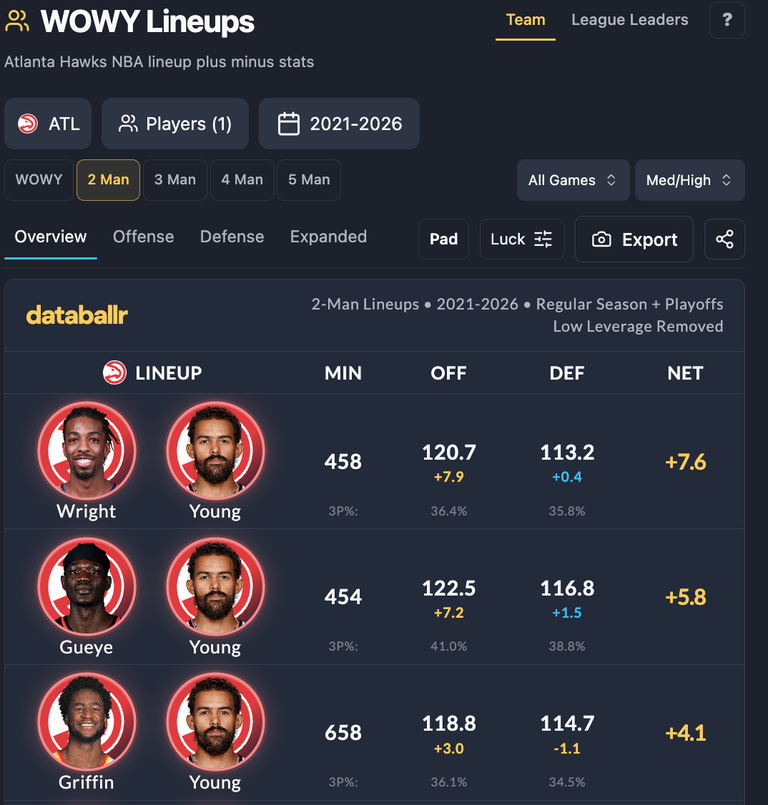
However, there was one player who he played just 500 minutes with in 2022 that enabled Trae to produce similarly potent offenses, but with a near league-average defensive rating. Delon Wright was Atlanta's skeleton key that year, the type of wing-sized defensive guard that could handle just well enough out of PNR to not kill the offense. Just having anyone who could handle with size next to Trae was generally a winning combination, further evidenced by his success with AJ Griffin and it's likely that if Dyson Daniels could've been paired with Trae while the Hawks had a spry Clint Capela and a slightly younger Young, we would've seen a similarly positive pairing.
This was the largest reason why the Dejounte Murray pairing was so catastrophic, Murray wasn't anywhere near the caliber defender his reputation suggested, thus he didn't offer the versatility and disruption that Delon brought just a year prior.
Trae Young and Dejounte Murray had the WORST 2-year on-court net rating of every All-Star duo since 2000.
-2.62 with Dejounte & Trae on the court❌ +2.78 with Trae on, Dejounte off ✅ -1.12 with Dejounte on, Trae off❌ pic.twitter.com/QBE1tBchpd
The Hawks further doomed their duo by flanking them with maybe the weakest passing frontcourt in modern NBA history that somehow also had virtually zero defensive versatility. The Wizards frontcourt of Dybantsa, AD & Sarr is certainly more talented and capable of connecting actions together than Hunter/Collins/Capela, but there's still parallels in terms of their reliance on the backcourt in getting them in a position to be most effective.
The Warriors and Pacers passed the ball way more than any other teams in the NBA this season
There's a non-negotiable rule revealed by Trae's time as a Hawk that the Wizards would behoove themselves to follow when it comes to pairing Trae Young with any other guard: they cannot make themselves any smaller OR more deficient defensively. A slightly older Trae who hasn't looked quite as bursty since playing through Achilles soreness years ago will need to be insulated to an even greater extent than he was 3-4 years ago. This leaves a clear optimal starter to insert next to Trae, Kyshawn George.
Kyshawn went through a late growth spurt as a teenager, sprouting from 5'11 to 6'8 in a matter of months. His time as a point guard gives him atypical passing capability for a player of his size, which likely makes him their 2nd most capable playmaker behind Young. He's flashed some defensive positonal versatility, spending about the same amount of time guarding Cade Cunningham, Scottie Barnes, AJ Green and Mikal Bridges, 4 distinctly different matchups. George was also their most efficient player off the catch by a decent margin last year (1.06 PPP, Riley was 2nd at 0.995). He's not their most disruptive or the most polished offensive option, but Kyshawn is their best combination of both aspects, which positions him as the choice that's most likely to find success playing off of Young, Dybantsa and Davis.
WAS may be tempted to play their 2nd most disruptive defender (their best defender in my estimation is Jamir Watkins, who is recovering from a torn ACL he suffered in summer league), Bilal Coulibaly, big minutes as a starter/closer in the hopes of the other starters giving him enough infrastructure to be somewhat respectable on offense, but his 25th%ile 3PAr is likely to really constrain the starters' ability to get up enough 3s with him sharing the floor with AD and Dybantsa. Tre Johnson has excellent offensive synergy but his presence would result in WAS asking AJ to guard other teams' best perimeter player nightly, which just isn't a realistic task for him as a 19-year old. Will Riley would make them far too slight across their frontline and I also think he's just too offensively tilted at this point to make sense next to Trae. Justin Champagnie is the only other option I'd really consider starting/closing lineups with, due to his insane motor, rebounding and defensive intensity, in addition to the big man skills at 6'6 that Washington may find hard to pull out of AD and Sarr.
2) What is the optimal role for AJ Dybantsa’s rookie season?
We haven't seen a player of AJ Dybantsa's draft status enter a situation playing off of multiple All-Star talents since Jayson Tatum began his career in 2018. If we widen our scope to include U21 rookies who started at least 40 games for a team that won at least 50% of their games, we can really see just how rare it is for precocious players to contribute a heavy minutes share to a decently competitive squad. This is reflective of the extremely rare occurrences where a good team is able to select a rookie who is good enough to immediately displace a starter, as the vast majority of rookies are flat out #NotGood for at least their first 2 seasons. Among these seasons, Chris Webber joining Don Nelson's 1994 Warriors that starred Chris Mullin and Latrell Sprewell is probably the closest parallel for the pre-existing ecosystem Dybantsa is joining in D.C.
Unlike Webber though, it's unlikely Dybantsa leads the Wizards in FGA or USG%, as he's decisively the 3rd option when Trae and AD are on the floor. This is going to be a massive usage shift for AJ, who's been exclusively a lead option since he was probably 4 years old. The closest thing we have to seeing AJ in an off-ball role is his time competing at FIBA, where he took a slight backseat to Mikel Brown and Koa Peat in U19 and Cam Boozer & Peat in the U17 tourney. Dybantsa ranked 3rd in TSA both years and had an overwhelming share of his possessions come in transition and off of spot-ups, a pretty stark contrast to the heavy PNR & Iso diet he feasted on in high-school and at BYU, though FIBA is such a high transition frequency environment and the US has such a physical advantage over most of their opponents that I'm cautious putting too much stock into how he operated within the halfcourt. However, he was much more effective as a driver than a shooter off the catch both years, which aligns with his preference to shoot off the dribble or slash his way to the rim instead of getting up 3s from a standstill.
The Wizards ran PNR at the 7th highest rate in the league in 2026 (39.3 per game), iso'd about 9.4 times per game and posted up around 3.5 times, so we can expect somewhere around a total of 55 to 60 creation reps per game. Trae, AD, Kyshawn and Tre Johnson were all roughly 90th%ile creation TSA players last year and it's likely Trae and AD introduce more P&R and Post-Up possessions, although both of them have taken on less of those playtypes in the last couple years. In his last fully healthy season, Young accounted for 64% of the Hawks per game PNR volume, so let's say he runs about 55% of Washington's PNRs, or ~ 22 per game. He and AD will likely combine for 6-8 Isos with 2-3 spot post-ups for Davis and we can throw in some inverted PNR for Davis as the handler, a playtype he got to more frequently the past 2 seasons. As the backup handler, George will run a decent portion of the remaining PNR volume and I'm thinking Tre will only really run PNR on the weakside, which should leave at least 8 total creation reps for Dybantsa, spread out among PNR, Iso & Post-Up situations. I don't think he'll be on-ball nearly as much as Cooper Flagg, who set the record for most on-ball responsibility for a U20 wing (that wasn't used explicitly as a PG, such as Giddey/Lamelo/Luka/Cade, etc.) this past season, settling somewhere between Franz's usage as a rookie and year 2 Brandon Ingram.
It would be ideal if Dybantsa could further develop the ancillary skills that Tatum and Anunoby had to lean in to in order to keep getting time on the floor, but I think his importance will somewhat jeopardize their ability to reinforce good defensive habits, whereas Toronto and Boston had plenty of playable veterans to swap in for their rookies if they weren't playing up to par or struggling to follow the gameplan. Champganie can provide a stark contrast and Davis should be able to command at least a decent amount of defensive accountability, though I wonder just how effective that'll be with how this defense could struggle. The early returns from preseason are certainly encouraging though, in terms of both Trae embracing being even more of a pass-first player and Dybantsa ramping up the intensity as a defender.
3) Does Bilal Coulibay get an extension?
The board man gets paid up until it's time for rookie extensions, with most franchises being much more likely to open up the checkbook for prospects who demonstrated offensive flashes before the defensive specialists. Coulibaly hasn't displayed much of note on the offensive end, remaining pretty stagnant at the FT line and being both a low-volume 3P shooter and incredibly streaky from beyond the arc. He did do a better job getting to the FT line and the rim in 2026 though, using his athleticism to get defenders off-balance and draw contact. Unfortunately, there aren't many signals of growth as a passer or off the dribble decision maker, plus his best defensive season this past year also came with a 90th%ile foul rate. Washington hasn't done any favors for him on offense over the years of course, but even considering how bad the infrastructure is, Bilal hasn't inspired a ton of confidence in his rotation viability, which likely means he'll be a restricted free-agent after the extension deadline passes.
Coulibaly was drafted as a project player that could maybe one day pair his physical tools with offensive polish, as an international prospect that didn't do much beyond the standard 3&D things over in France, so it shouldn't come as much of a surprise that he's got back to back seasons with sub a 45% true shooting percentage in the halfcourt. The difficulty in signing up for more years of this developmental process is that WAS now has so many different players at his position on a similar timeline. This introduces both a positional and financial crunch, as the Wizards need to parse out just how much they can commit to Bilal with Riley, Kyshawn, Tre, AJ and Jamir all capable of playing on the wing.
The lucrative contract they handed Trae also means that these extensions have to be extremely cost efficient, especially with the sheer volume of players they're likely going to want to retain. Isaac Okoro may be the best 1:1 comparison for what a contract could look like, as a similarly limited offensive wing that was extended the qualifying offer, then signed for 3y/$33M, ~ 7% of the cap at the time. An equivalent contract would make a decent amount of sense for Bilal's current trajectory.
4) Is AD the type of big that synergizes best with Sarr?
In Sarr's 2 NBA seasons thus far, he's played power forward for just 1.7% of his time on the floor. His most frequent pairings with other bigs came in minuscule stints next to Tristan Vukevic and Jonas Valanciunas, one of the brief moments where a lineup featuring Sarr was able to defensive rebound at an above average level. Washington was much more capable of cleaning the glass when he was able to play with plus d-rebounders at their position in general, as evidenced by his minutes next to Malcolm Brogdon and Kyle Kuzma. His ability to end possessions has been one of the biggest knocks on his defensive impact, ranking in the 18th and 39th%ile in DREB per 100, in addition to WAS somehow rebounding better with him off the floor.
Considering the complete lack of size Sarr has played with this far, Anthony Davis is an objective upgrade on the glass that immediately addresses Sarr's biggest weakness, weighing 210 pounds or so as a center. Even at 33, AD is still a 90th%ile defensive rebounder and a capable rim protector and most importantly, he's at least 250 pounds, which should allow Alex to more comfortably switch onto handlers on the perimeter. It's not out of the question that the Wizards can pretty confidently have both of their bigs play at the level of the screen, in drop, hedge ballhandlers or outright blitz opponents, a pretty potent combination of length and versatility that might insulate Trae pretty effectively.
The issues with this duo are more evident on the offensive end, where AD's shot profile, negative teammate shot quality influence and recent developments as a lower-volume passer whose motor doesn't rev quite as high as it used to threatens to impede Sarr's development and tank the Wizards' offense as a whole. My fellow contributor here at The Collective, NileHoops, puts it succinctly: "If there's one thing that current Anthony Davis doesn't remotely do, it's make the game easier for anyone around him...One of the game's biggest 3PAr repressors, has been a strong negative OREB influencer since '22 and is a complete white-spacer regarding defensive lineup impact". There's no justifying Davis being a 99th%ile midrange volume shooter with how poor he shoots from the elbow, especially because that level of FGA siphons potential 3PA volume for all of his teammates and dramatically lowers his ability to rebound his own misses (40th%ile or lower self-OREB% last 4 years).
Similar to the defensive side of the ball, the players AD is replacing in the frontcourt were often barely rotation level contributors, so Washington is going to benefit to some degree immediately just by having Davis, but that doesn't mean that it's what's best for Sarr. Alex made a huge improvement of on the offensive end last year because the Wizards positioned him as a finisher much more often than in his rookie year, rolling or slipping 10% more out of PNR, attempting 15% more of his FGA at the rim and finding him on cuts 5% more, which helped him finish above average at his position group in both rim volume and efficacy Additionally, while his slight frame gets him pushed around on the glass, being the biggest player on the floor pretty much forced teams to guard him with a center, which gave Sarr an advantage once he was able to catch in space against slower-footed bigs.
AD is going to demand teams put their center on them, which will inadvertently negate one of Sarr's biggest pluses on offense, similar to how San Antonio was able to stash a strong wing on Chet with Wemby checking iHart or roaming off of Dort in the Western Conference Finals. Continuing to improve his mismatch punishing ability is paramount, so it's good timing that he was able to both up the post-up volume and improve from an 11th%ile to a 84th%ile post-up scorer as a sophomore, because AD's midrange proclivity and similar PNR roll man volume will sap a lot of the moments where Sarr can function as a big on offense. WAS is stacking 2 bigs who have both voiced some displeasure playing the 5, which will make the overall division of labor and specifically, the willingness to set hard screens and crash the offensive glass fascinating to track. Trae feeding both guys enough to satiate their offensive appetite and keep them engaged defensively will be pretty important, and Keefe needs to ensure that AD’s obsession with elbow jumpers doesn't relegate Sarr to sitting corner, creating possessions where nobody is winning.
5) How viable is the Wizards’ plan to supercharge their path back to serious contention? What are the parallels & differences with the path the Rockets used?
The Rockets finished with a .500 or better record for 14 consecutive seasons from 2007-20, traded James Harden and immediately won at most 22 games for 3 straight years, finishing with the worst record, the worst turnover rate and the worse defense in the league twice over that span. After farming 3 top 5 picks and multiple first round selections, Houston accelerated their timeline by signing Fred Vanvleet in free agency for $130 million dollars, a 3-year commitment with a non-guaranteed final year that the majority of people called an overpay. They also traded away some of their recently drafted prospects to add Dillon Brooks. They immediately became a top-10 defense (119.7 DRTG -> 112.9) that turned the ball over at the 7th lowest rate (16.3% 0> 12.7%) in the league, improved by 19 wins and have remained a T10 defense that's won back to back 50+ games in the years after Fred and Dillon helped to embed the culture.
Dillon Brooks has a star-level influence on his team's hustle & grit
2023 Grizzlies: #2 in Blue-Collardness per 36 (my metric for hustle data) -> 24 Grizzlies: #17 after losing DB
There are similarities in the Wizards' approach to bringing their franchise to competitiveness. They've finished with the worst record in the league 2 of the last 3 years, had a bottom 5 defense and turned the ball over at an extremely high rate over that same span. Washington didn't have the incentive this summer to protect a traded 1st from conveying to a conference rival like the Rockets did, though it's likely watching the revenue dry up with the 2nd lowest attendance rate in the league was enough to light a fire to get more competitive. Like Houston, they went and got a point guard (for an eventual perceived overpay) to settle the offensive hierarchy and allow their young guys to play off the catch, then added another veteran to be a high-level play finisher that could relieve some additional scoring pressure.
There are 2 massive differences however, as the Wizards are doing the offensive equivalent to the Rockets' method and AD & Trae have much more expensive contracts than Brooks and Vanvleet. Generally speaking, I think defensive identity is a lot more transferrable than offensive aptitude, though they couldn't have picked a better player (that was realistically available, besides Lamelo this offseason) to boost the Wiz Kids ability to be viable offensively. How much more production can they get out of them with Trae at the helm? Will he able to facilitate meaningful growth that persists even when he's no longer a Wizard? The answer to these questions is what will ultimately decide whether he was worth that massive extension.
Trae also led the NBA in teammate shot quality influence in 2025, so CHA and ATL essentially made the same bet
that is, believing that their supporting cast has enough latent creation value in the aggregate, to reallocate that 25-35% of the cap that WOULD be a primary creator https://t.co/fqlqkpIJ9a
My Model Projection: 21.8 (30th of 30), -8.05 Net Rating, 1% playoff odds
Floor: 28-54 (+11 wins)
I remain skeptical that Brian Keefe wasn't able to maximize his guys to an extent some of the other coaches of tanking teams. Perhaps the imperative to lose games decisively was mandated by the front office, but even then the past 2 Wizards rosters have been hopelessly uncompetitive on a nightly basis. I’m not convinced that track record is fixed drastically by adding Trae and AD to fix the offensive hierarchy.
Ceiling: 40-42 (+23 wins)
If the young guns are able to lean into their complementary skills around Trae Young and AD, finding success by cutting and spotting up plus taking pride defensively, then this team has the makings of a pretty respectable offense. We’ll know the identity this team will align themselves with based on the 5th starter, and if they make the right choice (and AD stays healthy), WAS could find themselves sneaking into the Playoffs.
Overall Grade: C-
Let me know if you agree with my predictions! What are your expectations for the Wizards this season?
I’m a lifelong basketball enthusiast who blends film study and advanced analytics in my independent coverage of basketball and the NBA Draft across Tiktok, Twitter, Youtube, Substack and Instagram. I’ve also covered the Hawks for ~2 years as an accredited digital journalist for Afro News, and I am a member of the Atlanta Hawks’ Creators Collective.







Comments