Draft Notes: AJ Dybantsa
The highly touted freshman from Brockton, Massachusetts may be the most acute representation of one player transforming the complexion of a team’s playstyle of any prospect in recent memory.
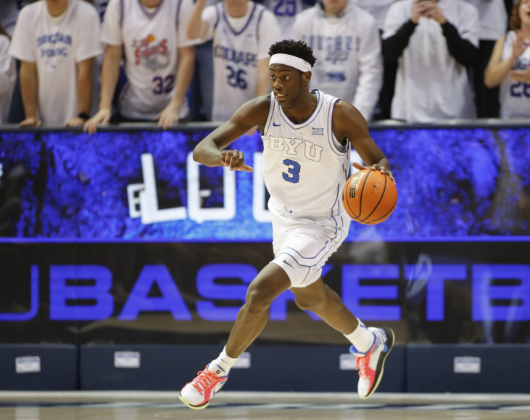
The highly touted freshman from Brockton, Massachusetts may be the most acute representation of one player transforming the complexion of a team’s playstyle of any prospect in recent memory. By all accounts Dybantsa opted to play his lone NCAA season for BYU over more conventional bluebloods due to the vision BYU head coach Kevin Young had for him. While most college basketball programs are synonymous with and identified by their systems, Smith ported his protean NBA coaching style to Provo. Smith’s willingness to shape his scheme and offensive identity around the talents of his star freshman paid dividends in the 2024-25 season when BYU finished 5th in ORTG in the NCAA with another 6’9 blue chip freshman, Egor Demin, leading the show. With Dybantsa’s comparably higher pedigree, the expectation was that BYU would replicate, if not exceed the offensive efficiency of the 2024-25 Cougars. Ultimately the Dybantsa lead group fell short of these lofty standards, and to be clear, I don’t believe this to be an indictment of AJ. In fact, the 2025-26 BYU team is an opportunity to analyze how a team built in AJ’s image may take shape. And establishing a frame of reference in the 2024-25 Cougars should be our first step in this analysis.
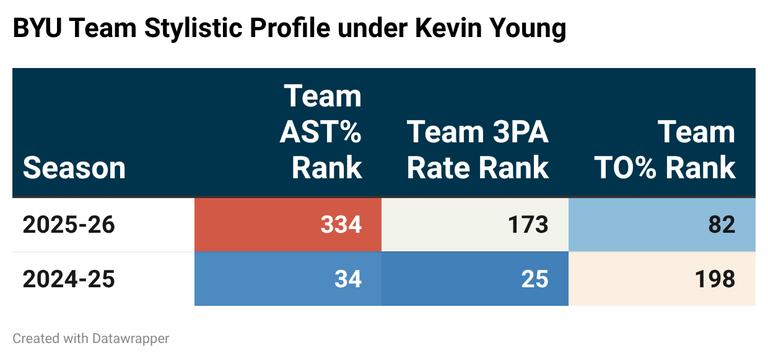
With AJ's 96th percentile Isolation frequency and midrange heavy shot diet, its unsurprising the Cougars 3PA Rate and TO% fell, however the team Assist% plummeting to a near worst mark in the country is somewhat unexpected.
The dramatic year-to-year shift in BYU's stylistic profile could be attributed to a few factors like roster turnover, after all BYU ranked 149th in the country in minutes continuity per KenPom. But with Kevin Young's coaching background in mind, I believe BYU's statistical complexion should primarily be attributed to AJ Dybantsa's playstyle. And in no way is deeming AJ responsible for BYU's playstyle meant to be a pejorative. The fact that a freshman could be the driving force behind a top 4o offense through his self-creation is impressive in its own right. Being the primary option on an elite offense without collective playmaking is rare regardless of the league. Of 17,030 qualifying team seasons between 17 leagues dating back to 1997, only 36 teams managed a 95th percentile League Offensive Rating while finishing with a Team AST% z-score less than or equal to -1. Of these teams only 4 teams replicated this feat in consecutive seasons, Paris Basket from 2023-25, the LSU Tigers from 2018-20, Kentucky from 2010-2012, and the Dallas Mavericks from 2005-07.

Assuming AJ's offense will be featured to a similar degree in the NBA as it was in college, it is reasonable to expect his playstyle having a similar influence on his NBA team as it did in college. By analyzing teams who have succeeded with similar profiles we can hope to glean insights on how viable building a team with this identity in mind can be. But upon further inspection, the teams above did not seem to have much in common, outside of the two filters applied in the query. The most interesting trend was how polarized these teams were when it came to their 3PA Rate.
-400x216.png)
I had anticipated low 3PA Rate to be a commonality between these teams since three-pointers are the most assisted shot after dunks. Intuitively a quality low AST% offense would use post-ups and isolation as their primary vehicle to suppress turnovers and create opportunities for second chance points. Paris Basket managed to break this conventional logic by centralizing their offense around two high volume pull-up shooters in Nadir Hifi and TJ Shorts. By now I'd understand anyone questioning the relevance Paris Basket and two sub 6'2 guards have towards AJ Dybantsa, but these factors are essential to understanding primary projection in the modern NBA.
As NBA three-point shooting has exploded, Team AST% has seen a gradual uptick as well.

Interestingly though, AST% amongst top-1o offenses has been roughly half of overall AST% improvement. My explanation for this discrepancy is that elite offenses with low AST% have been spearheaded by a different kind of primary in the 'three-point era'. If we were to treat the 2013-14 season as the unofficial arrival of the three-point revolution there is a noticeable shift. Not only has the number of teams finding offensive success with lower passing volume declined, but the kind of players leading those teams has changed as well.
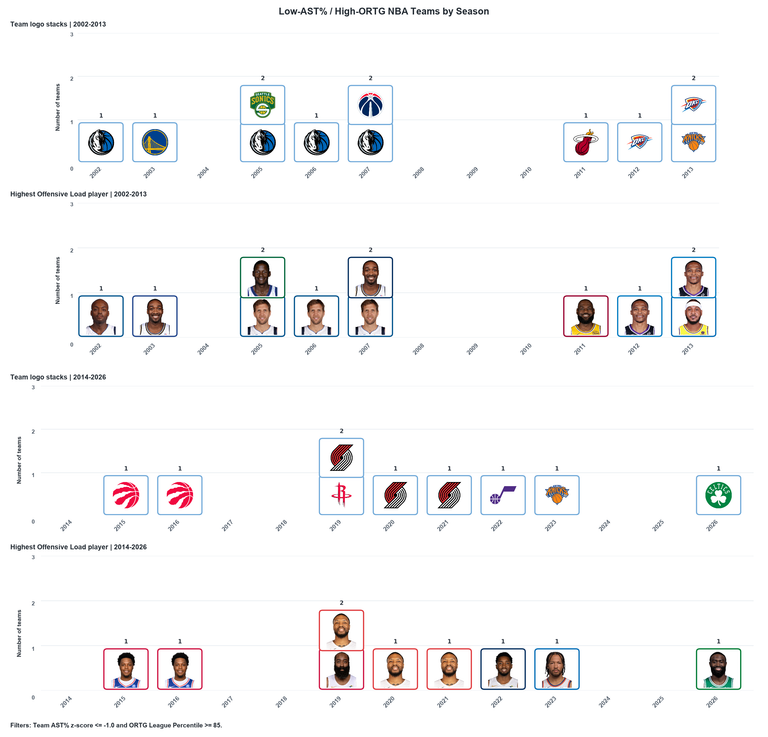
Since 2014, the highest usage players on teams of this makeup have had diametrically opposed styles. They have either been amongst the most prolific off-the-dribble three-point shooters of their era (Damian Lillard, James Harden, Donovan Mitchell), or downhill creators who frequent the mid-range (Julius Randle, Jaylen Brown, Demar Derozan). Broadly speaking, the former group is analogous to the Paris Basket duo's playstyle, and the dynamic between the two groups is representative of the fundamental question AJ Dybantsa must answer in order to warrant serious consideration as a championship caliber primary. Can AJ generate the shot quality necessary to justify the global effects of his playstyle?
In my opinion, in order to answer the previous question in the affirmative, one of two things would have to happen during AJ's development. Dybantsa would either have to signficantly overhaul his scoring process (i.e. shoot more threes), or he'd have to become one of the preeminent midrange scorers in league history, relative to era. With regards to Dybantsa's scoring process, I am fairly skeptical that he'll be able to dramatically increase his 3PA rate at his on-ball rate. A major benefit to this era of draft prospects is the backlog of pre-NCAA data available to reference for cases like these, and Dybantsa may have more data points at this juncture of his career than any prospect in history. Per Cerebro, across 113 career games Dybantsa has a career 3PA rate of 29.1%. Dybantsa's highest career 3PA rate of 33% came in the 2023 EYBL campaign where he had the lowest pick-and-roll ballhandling volume of his career! Additionally, BYU's offense frequently provided Dybantsa with opportunities to attempt pull-up threes via these 3-man 'Zoom' actions, as can be seen in the clip below.
The likelihood Dybantsa develops into an outlier midrange scorer is much higher in my estimation. Sporting a very respectable 79.6% career FT% (687 attempts) and a robust midrange scoring resume to boot, Dybantsa is significantly further along from a touch perspective than the Demar Derozan and Jaylen Brown phylum of scorer.

All in all, I do not think that Dybantsa's doomed to become a widely panned, 'the dynasty starts after you' player due to already being well ahead of these players from a touch and playmaking perspective. But for the projected top pick in what I'd consider a generational draft, it'd be a gross oversight not to consider the longterm ramifications of investing in a player with such a pronounced footprint on his team's playstyle. For a player in Dybantsa's mold the margin between all-star and championship level impact are infinitesimally small, and barring the aforementioned touch leap I do not envision Dybantsa becoming a championship level primary. If this prediction becomes true all is not lost though, Dybantsa's underwhelming defensive statistics do not preclude him from becoming a respectable defender due to his baseline processing and size. Historically there are many examples of players with Dybantsa's defensive metrics turning into capable defenders.

But realistically, Dybantsa's offense will be relied upon to an extent that this optimistic projection is rendered extremely unlikely and his defensive impact will fall in line with the high usage, low stock players of the past.

History would suggest Dybantsa will be a negative defender who imposes heavy restrictions on your offense. These teambuilding constraints is the basis of AJ falling to 6th on my board.

Comments