About the author
Nile
The Thrill Of Competition. Basketball Team Building and Rotations. nilehoops@gmail.com. Scouting/Analytics @CapitanesCDMX
When the spotlight leaves a prospect, there are two options: rise to the occasion with the skills that formerly brought them their hype, or falter due to a combination of perception and lack of adaptability.
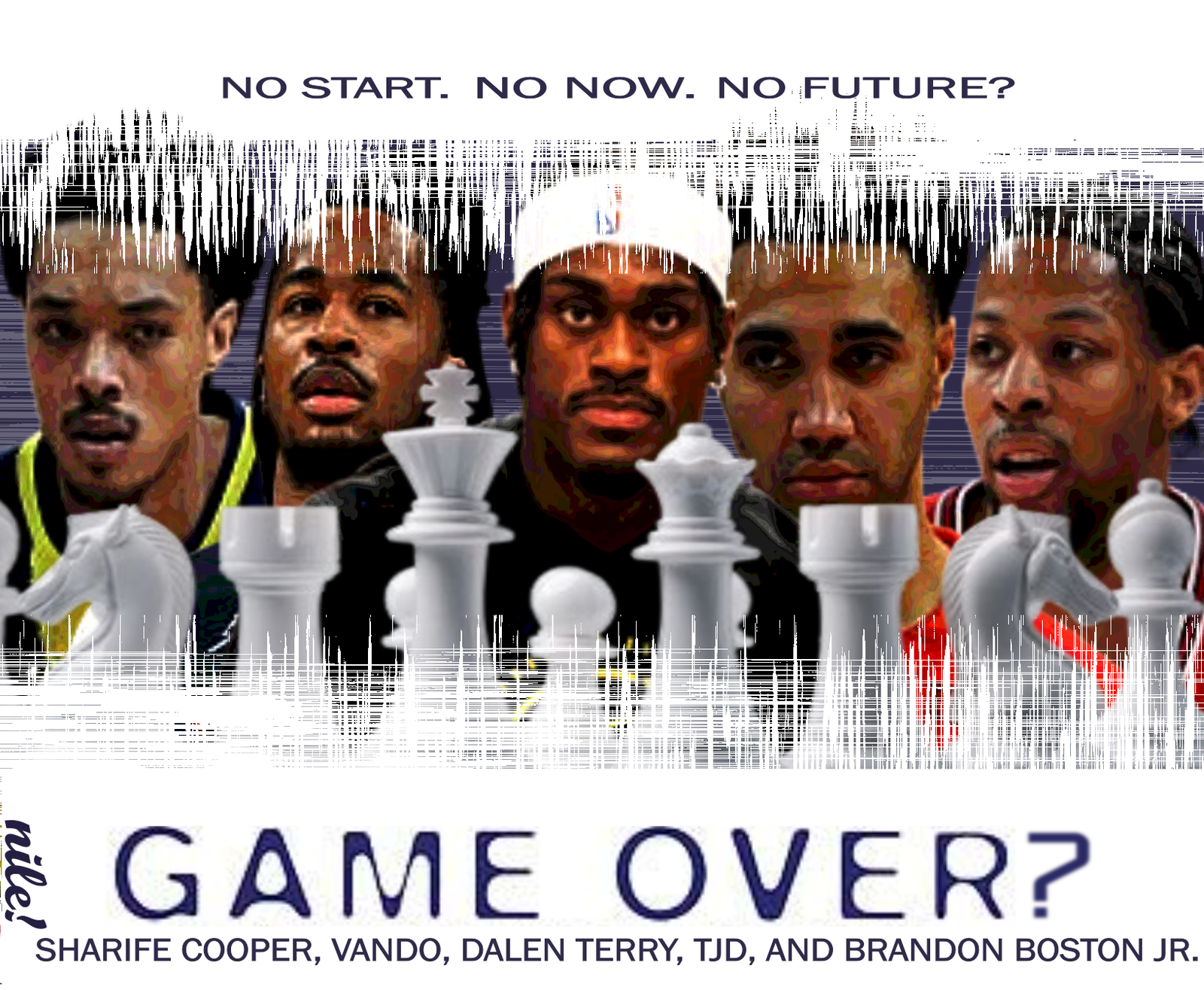
Redemption is mandatory in sport. Any gladiator who collapses from a single defeat was never to see the glory of eventual championship. I remember watching LeBron James leave the court after his semifinal defeat at TD Garden in 2010, his final game with the Cavaliers for half a decade.
The commentary team didn’t speak of him as a hopeless loser, rather as a gladiator who was in preparation for his next major battle months later, whether in Cleveland or otherwise. It would have been ridiculous for one to count James, a two-time MVP, out at this juncture. An apex predator can reach individual heights without being champion in a team game, but can a lower-ranking warrior? How should we evaluate prospects formally projected to be top-end talents that have, up to this point, failed to actualize the perceptions?
For prospects whose early careers haven't aligned with expectations, it's mandatory to reestablish projections, or fall behind in awareness of the talent pool. The title athletes provide prime examples to do so, hopefully identifying players capable of contributing to championship-level NBA rotations when returned to competitive, competent ecosystems.
McDonald’s All-Americans 🍔
— Shun Williams (@OntheRadarHoops) January 23, 2020
•
Georgia is well represented with Brandon Boston, Sharife Cooper, & Walker Kessler. pic.twitter.com/yrFQKK5x4C
Metro Atlanta has risen to the status of a true basketball development powerhouse. On the backs of talents like Dwight Howard and Josh Smith suiting up for the Atlanta Celtics to Anthony Edwards staying in-state with the Georgia Bulldogs or Collin Sexton traveling just a bit further to Alabama for their single NCAA seasons, the late 2010s appeared to have a clear passing of the torch with Sharife Cooper and Brandon Boston Jr. At the top of the 2020s, the city had its’ Point God and Wing Scoring Machine identified in Cooper and Boston.
Could the Athletes of Tomorrow duo’s next few seasons show us that Tomorrow is Forever?

Cooper’s suboptimal off-court career beginnings, namely an NCAA eligibility investigation unresolved until early January 2021, left him with substantially less game time to prove his league worthiness. The difference between Auburn’s team output before and after Cooper entered the fold was dramatic.

The easiest way to identify a primary handler statistically outside of their offensive load indicators (USG/AST%/etc) and team success is transition/pace influence. Auburn’s first-chance offensive process (i.e before an elite chance at an OREB) in non-Cooper games was comprised solely of non-elite shooters bombing threes and turning the ball over at an outlier negative rate. The massive decrease in 3PAr and TOV% would point to his influence enough, but converting most of these non-threes into transition attempts is how to turn a fringe top-100 offense into a fringe top-25 one.


The Atlanta Hawks selecting Cooper in the 2021 Draft, ostensibly to be Trae Young’s understudy, tracked; the franchise knew their infrastructure was built to sustain a first-percentile-sized NBA player. If Cooper could ever maintain the load and team efficiency that Young had, it would be an unquestionably successful 48th overall pick. Big-league opportunity was not the appeal for Cooper in Atlanta, nor in Cleveland, where he ended up after being released by the Hawks after a poor sophomore Summer League showing.
After unimpressive stops in Greece and France in 2024–2025, Cooper signed a two-way with the Washington Wizards/Capital City Go-Go in September 2025. He and former 5-star-turned-G League mainstay Skal Labissiere combined for 144 minutes of revenge minutes over seven Tip-Off Tournament games, posting a 19 net rating when together, and topped it off with another +14 duo net over their 132 regular-season G League minutes before the duo was called up to the parent team for a majority of the rest of the season. Departures of CJ McCollum and A.J. Johnson from the guard room via trade, and familiar face Trae Young sitting out all but five games to finish the season, created an opportunity for a ball-handler to be showcased and eat some minutes for the team to close out the season, which Cooper took in stride (alongside the likes of my GOAT Kadary Richmond, Alondes Williams, and tank commander Jaden Hardy later in the season). I was lucky enough to be in attendance as the Wizards took on the Kings in early February, and watching Cooper seal the game with two timely rebounds was inspiring.
The best player on the court for the Wizards is 100% unironically Skal Labissiere and there’s just nothing you can do about it. https://t.co/sxObSZvjPR pic.twitter.com/Z1qSSGIr78
— Nile! (@NileHoops) February 1, 2026
I knew the game wasn’t over for him then. Going into his age-25 season in ‘26, Cooper’s alignment with some of the game’s pantheon floor generals is still strong.

If Tyrese Haliburton was ~five inches shorter and didn’t have a stable ecosystem of Rick Carlisle, Lloyd Pierce, Myles Turner, Pascal Siakam, Aaron Nesmith, etc, etc on his side, how potent an engine would he be perceived? Haven’t we seen him in sub-optimal talent ecosystems before?


Haliburton’s team help? -1.8 Cooper’s? -5.7 Opportunity only sometimes equals ability. Finding equilibrium for every player in this regard is the analyst’s mission.
Just how valuable do we think blocking a few threes is??

The risks of playing the still-microscopic PG (listed the same 174 pounds as his pre-draft profile, which is surely not the case, but the NBA continues to fail the public by not requiring updated public weight records) with a sub-2 career STL% in high-leverage minutes is scary. Cooper has consistently rebounded above his size across his career, and his G League on/off defensive splits have never been much worse than the team baselines, indicating that pairing him with defensively talented lineups would be especially synergistic.
When I referred to Jalen Williams as “the quintessential deadball-era shooting guard” in my 2001 Age Rank notes, I failed to consider Brandon Boston Jr., who is at least equally qualified for the title, if not more. By virtue of being drafted at 19.6 years old at sub-190 pounds, there was really no functional difference between him spending his single NCAA season at Kentucky or going one-and-done after his senior season at Sierra Canyon. In fact, his season’s results insist he would have had significantly better draft stock in the above hypothetical. Is it a coincidence that three of the five lowest EFG% among Bart-era drafted players are featured in this article? Or that two of them were teammates? Yes, actually, but the idea that players who struggled with conventional efficiency during their highest-leverage job interview could be fighting an uphill battle nearly a decade later is within reason, especially from a determinist perspective. For example, one could determine that the author of Anatomy of a Missed Layup would eventually write in praise of three of the five lowest EFG% prospects in the NBA.
Nevertheless, I contest that Boston’s freshman season, outside of scoring efficiency that could be easily reduced to bad luck over a 25-game sample, was a fine baseline for NBA success.
Boston Jr. was one of the tallest players to register in the query, as well as having the fourth-lowest TOV%; athletic, unabashed volume shooters with even a modicum of touch and two-way feel have long been the game’s centerpieces. Missing a couple jumpers on a roster with sub-optimal spacing (293rd in 3PAr) and poor feel (221st in team oTOV%) while playing the second-hardest schedule in the nation is about as excusable a situation as possible. This didn’t help the former 5-star prospect get drafted before the 51st selection, but it shouldn’t have been very off-putting to an analyst who was a fan of him pre-NCAA.
For a player drafted so late, Boston was presented with about as much on-ball NBA opportunity as anyone his age, ever.

In relation to the NIL era, there’s a chance that Boston is the last player to see this specific setup. A prospect being drafted by a team that respects their creation ability this late could be an idea of the past. I know we see that guy directly below him; this is a quintessential Nile! buy-low.
That’s the kind of opportunity that dwarfs NCAA ‘development.’ In assessing his NBA worthiness, his relatively small sample has been promising, if not outright impressive for such a weak shotmaker.

Boston’s parallels with Middleton are just as notable as Cooper’s are with Haliburton, and this matters in that having true proof cases for otherwise fringe NBA talents makes the cases in their favor much more potent.

If nothing else, the rarity of the young, tall, two-way player that can unquestionably put the ball on the rim at high volume should be of interest to the league, especially under the playoff lens where 'emptying the clip' is so prominent. Even if it takes longer for the shotmaking to come along, or even if it never does, the risk is worth the reward.
The most substantial improvement he could make would be to his shot diet, as the doomed intersection of low 3PAr/FTr without outlier efficiency is untenable in most team ecosystems. With Fenerbahce this season, alongside 2nd-Team All-Euroleague recipient Talen Horton-Tucker, Boston upped his 3PAr to a career-high .42 and shot 51% on twos. Paired with a microscopic 9 TOV% and all we have to wait on to become an impactful NBA player is some thoughtful lineup structure (his best Pelicans lineup pairs were with Jeremiah Robinson-Earl/Yves Missi crashing the offensive glass, same with IHart/Justise Winslow on the Clippers), and eventual shooting progress building on the solid baseline he’s displayed at the FT line across his career, as well as in the G (36% on 163 attempts) and in his 2025 NBA season (35% on 160 attempts). If we shoot for Kobe and fail to meet KMid, could being a lower-leverage Jalen Williams variant, minus 30 pounds, be enough? I am sure of it, especially if the initial contract for the 2027 season will likely only have to be enough to get him back from overseas and have a league opportunity.
Consistent injury bemirement being the most common cause of a player’s consensus devaluing is intuitive; the most likely reason for a talented player to not be playing is a physical inability to do so. Vanderbilt, being the only victim of a consistent injury history featured in this piece, speaks to both my patience with athletic humanity regarding fitness and health and a unique fascination with his singular skill as potentially the most gifted rebounding prospect on record.
The relative statistical ease of evaluating rebounding as opposed to other ancillary skills like stealing or passing the ball (to procure an assist) is that a rebound is less reliant on a teammate’s help. There can be defenders who procure more or less steals than their ‘true’ defensive talent, and there can be passers whose teammate quality finds them ending seasons with marginally more or less assists. A player’s ability to corral a missed shot is usually an actualization of their own physical and processing ability; coaching principles (crashing glass versus transition) are more influential than teammate assistance, and comparing a player’s rebounding to similarly positioned players under the same coach is relatively easy.
Vanderbilt’s outlier prospect rebounding speaks not only to that individually valuable skill, but also hints at generational spatial awareness at his size and frame; Edey and Clingan being that level of rebounder at eighty and sixty pounds heavier, respectively, is much more ‘typical’, in as typical as outliers can be. Thus, it’s likely that the ~220-lb Vanderbilt’s ball-gathering skills could be applicable in defensive ballhawking, regardless of his meager NCAA metrics across such a small sample.

Though not as light as Vanderbilt, the concept could apply minimally to ’26 prospects like Chris Cenac, Hannes Stienbach, or a long-term sleeper like Texas A&M big Jamie Vinson IV (reported +6 wingspan).
This ability to solve problems unconventionally (read: without shotmaking ability) when gifted with the frame and motor to do so has allowed Vanderbilt to return two-way lineup value when consensus belief suggests this to be impossible.

In short, the game is clearly not over for Vanderbilt UNLESS his 2027 coaching staff, whether that be JJ Redick’s or elsewhere, keeps inexplicably forcing him to shoot threes. This sentiment would have had even more strength if his upward FT% trend from his 2022–24 seasons would have persisted (67% on 306 attempts versus 58% on 92 attempts in 2025/2026), though his shot diet change has decreased his FTr substantially; there’s a chance he’s still this level of improved FT shooter and he’d be as potent a 2PT contributor as ever if he wasn’t being used one of league’s rarest archetype: the anti-spacer. Via NBA.com/stats, all nine of his 2026 playoff 3PA were ‘wide open’, or attempted with at least six feet between him and the defender. Compare his lineup impact to his 2022 playoff minutes in Minnesota, where he classily attempted zero threes.


Here’s an idea. If/when the Knicks lose Mitchell Robinson in free agency, let’s reunite Vando and KAT for a similar effect. I could also make OKC’s ‘no rebounds’ ecosystem an ideal spot for Vanderbilt, especially if Hartenstien departs and Center Chet and Rim Protector Jalen Williams make their returns from 2024.
Relative perception for Jackson-Davis makes his evaluation much more pertinent for me than the field. The 57th pick in the 2024 NBA Draft, there is little precedent for even one successful NBA season, and one could call his career a ‘win’ based on only his initial campaign. As someone who ranked the Indiana big #11 in his class, I anticipate much more from his career. A cataclysmic sophomore slump as a finisher relegated him from the Warriors’ center of the future to a dispensable asset, which was actualized when he was traded to the Raptors at the 2026 trade deadline. Even with some regression from his rookie season and Indiana sample, his career finishing numbers aren’t as damning as one may believe, and his profile in totality is actually really promising, even containing some clear outlier traits.

It’s counterintuitive for someone who’s been marred with finishing issues for two seasons, but I think a team that uses the center heavily in playmaking duties should seek TJD’s services; he needs to dribble and facilitate more to maximize his value fully. The Warriors used Jackson-Davis in a role more akin to Kevon Looney than to Draymond Green, leaving a gifted playmaker underutilized.
I present them as prospects to highlight the absurd removal of usage from the NCAA to NBA levels for TJD. His OREB value has been strong, but that’s really not the way he’s proven to most affect the game. Being free from Golden State’s Curry-centric style, restrictive enough to disturb first-ballot Hall of Famers, could be enough to reset his outlook. Even beyond that, other rotational issues are observable in his lineup pairings; occasionally, it’s clear that two otherwise neutral-to-positive contributors react in a poisonous manner.


Jackson-Davis has spent nearly twenty percent of his NBA minutes next to a player that’s dragged his lineup net ratings down by seventeen points. This isn’t even inherently an anti-Hield argument, as he spent ~400 more minutes on the court without TJD on the floor than vice versa, and his lineups were even better; there is no greater coaching malpractice and lack of receptive, results-based planning than allowing this situation to hamper their team. I wrote about this concept regarding Jayden Quaintance, in comparison to Jaren Jackson Jr. and Jalen Duren, as seen above.
If Jackson-Davis remains on the Raptors, there is precedent for centers in Darko Rajakovic’s system to amass higher on-ball/assist totals, like Kelly Olynyk’s 23.4 AST% across his two seasons in Toronto or even Scottie Barnes’ utility as a playmaking big if all goes especially well.
Of the handful of players in this feature, Terry’s career success would be the most gratifying for my long-term evaluation process. I was enamored with the Arizona guard/wing/transition wizard, and was willing to go to great lengths to defend the apparent holes in his profile due to his intersection of age, size, feel, and aura.


I can now concede that my ranking of him 13th, above Ryan Rollins, Walker Kessler, Jalen Duren, etc was egregious due to his lack of offensive volume. Where I will refuse to concede defeat is in denying that his Lonzo-esque shades as a prospect and pro can be valuable, especially so in environments more similar to Arizona than Chicago.
As with TJD, playing with one egregiously weak fit can tank a lower-minute player’s metrics early. It has not benefited many Bulls players to share the floor with Patrick Williams since he was drafted, and he is Terry’s third-most frequent career teammate.


The incremental statistical improvements made when separated from his least-compatible teammate help to clarify exactly what role Terry will play on more thoughtfully constructed rosters. A 6'6, 7'0 wingspan player pushing a 2.6 assist-to-turnover ratio that’s anchored a -4.8 defense with -0.9 D-DPM teammate help is simply not your standard replacement-level 23-year-old.

I do understand the implications of rostering and heavily utilizing a player that simply cannot influence team oTS (the most important factor), but I specifically envision Terry next to either of the massive shot usage prospects in the 2026 NBA Draft, those being AJ Dybantsa or Darryn Peterson.
May the return to glory be as strong for these prospects as their high school and college ascensions were.
Nile!
About the author
The Thrill Of Competition. Basketball Team Building and Rotations. nilehoops@gmail.com. Scouting/Analytics @CapitanesCDMX

Comments