Hand-Tracking the 2025-26 Atlanta Hawks Offense
My motivations for building the tracker, defining "organized offense" + some of my favorite insights from the hundreds of hours I've committed to this project
Hello everyone, I finally locked in on catching up with one of my favorite projects outside of The 5th Factor, a Hawks version of the play-by-play trackers that have been popularized by Tim_NBA, and Adam Pike. Their work + Google Sheets templates helped me immensely as I learned more about the Hawks playbook, I really can’t understate just how vital of a foundation their work + Boswer2Bowser’s Action dictionary was for me as I learned the Hawks’ playbook.
The full tracker is available to all of my current paid subscribers effective immediately, and will remain exclusively available to paid subscribers given how time-intensive manually tracking playcalling is. If you would like access to the spreadsheet, you can upgrade to a paid subscription, refresh the page and you should be able to access the link to request access at the bottom of the story.
I’ve been pretty vocal about the lack of data the NBA as a whole provides to its’ fans, particularly relative to the MLB or NFL. About 3 or 4 years ago, NBA.com had a “CourtOptix” tab that had all types of informative and interesting player tracking data, including double teams, passing charts relative to position on the floor plus robust passing and shot quality data. That tab is how I was able to validate my analysis on the severe playmaking limitations of the Hawks frontcourt in the Dejounte/Trae era.
Siakam made 339 passes out of the paint last season, the entire Hawks starting frontcourt combined for 92 total passes. Pascal had 4x more assists from the paint (103) than Clint, JC, and Dre combined (25). pic.twitter.com/Wn3peKnusz
— David Lee (@dlee4three) July 17, 2023
When the NBA partnered with Sony’s Hawk-eye Innovations, that tab disappeared from existence. None of the historical data was archived and all I have left from one of my favorite data sources to this day are a few measly screenshots I tweeted out. The league’s refusal to empower their fans to consume the game on a deeper level is how we get a culture that’s distinctly anti-analytics. Privatizing the insights that inform fans deeper is why there was so much backlash against Luka’s blowby% from the Finals.
it’s a real stat, just not publically available: https://t.co/niHH77KqO8
— David Lee (@dlee4three) October 12, 2024
Of course, it’s not free for these companies to create these insights, so it’s expected that the juicier stuff is kept proprietary and internal to the league itself. There’s a competitive advantage angle as well I presume, though I’d hope that teams are informed enough to not stumble across a series-shifting advantage on Twitter. Nonetheless, I don’t really see any argument against these companies/the NBA providing a customer/fan level subscription to Second Spectrum, Synergy, etc.
There are so many people doing phenomenal work with the limited publicly available data already, so I can only imagine just how quick that perceived gap would close between the public analyst and league personnel would close if even a fraction of these data sources were shared.
Reddit post (comment) of the day pic.twitter.com/2OgwNQeMnc
— Sam LaFrance (@SamLaFranceNBA) March 9, 2026
That day may never come, so I decided to build my own Second Spectrum. There are gaps in my tracking I wished I thought of when I first defined what I would track, but the current state still provides so much more granular data that I could get anywhere, even if I did have the aforementioned softwares. The most interesting insights from the tracker begins with a concept of “Organized Offense”.
What is Organized Offense & why does it matter?
I define “Organized Offense” as a set play-call that is pre-determined to craft a specific advantage for a player or player(s).
been thinking a lot about this response
— David Lee (@dlee4three) March 5, 2026
every team/coach has visuals or signs of play calls but in the typical absence of those tells on replays, i’ll categorize plays as “organized” based on player movement, how often I’ve seen the action, situation, etc. https://t.co/2cmzQ3VuoB
JJ Redick shared his thoughts on Organized Offense a couple days ago after a reporter cited hand-logged stats from Tim. Redick establishes 2 of the biggest challenges of trying to log a team’s plays without working for them: 1) how do you know when a play is called & 2) how does that team define organized offense?
Outside of the verbal and physical signals I’ve come to learn from watching Quin Snyder on the sidelines, I truly don’t have any other way besides recognizing staple actions, understanding the situation & parsing out how the players move on the floor. There’s an intentionality in the movement of guys when they know the playcall & most out-of-bounds/clutch plays are organized, but the lines can be blurry outside of those situations.
The clip below is a SLOB1 play that begins in “Stack”2 formation, has NAW loop around to set a “Rip”3 screen for the inbounder, then get a DHO from Onyeka with the intention to get Embiid to step to the level of the screen and vacate the paint.
Here’s another good example of how I identify organized offense. Snyder initially stacks 2 fists to indicate their “Inverted Spain PNR” set, a staple down the stretch where Jalen initiates the offense from the top of the key with Nickeil and Dyson screening for him.4 Bryan Bailey seems to suggest otherwise, so Snyder then calls for their “Pinch” series.
After Dyson draws an offensive foul, Quin Snyder initially calls for “Inverted Spain PNR”, then switches to their “Pinch” series
— David Lee (@dlee4three) March 8, 2026
CJ enters the ball to Jalen in the Pinch post and ATL runs some off-ball action that results in Bona checking JJ
JJ does the rest. pic.twitter.com/YeAzqt4iyb
The play begins with CJ walking the ball up while Jalen sets an “Away”5 screen for Nickeil to curl to the basket. However, since we just saw Quin call for their Pinch series, we know this is a preliminary action to clear the corner, not intended to craft the primary advantage on this possession. If I didn’t see Quin call this, Nickeil turning his head and then looping around the stagger is another indicator that this play has more layers than their typical motion offense. The ball is then entered to Jalen in the “Pinch”6 post while NAW runs off the stagger. It’s at this moment that they generate the specific advantage the play was intended for, Bona switched on to a handler AWAY from the rim. Alexander-Walker forces Bona to switch on to Jalen by setting an Inverted PNR and Jalen does the rest.
It’s highly likely that the Hawks may not use a single bit of verbiage that I just used to describe this play, as NBA teams have so many different ways to describe the same things BUT I try my hardest to preserve the base principles of each set by with the generic terms I use when logging plays. Snyder’s system is notoriously complicated (and I mean that in the best way possible) and he regularly switches his signals to call the same exact action, sometimes in the same game.
Phone ran out of storage mid recording smh but this reminded me of this Deron Williams interview w/ how many different ways the same coverage can be called
— David Lee (@dlee4three) February 22, 2026
Heard from multiple guys that ATL’s offense + signals are particularly complicated https://t.co/7TIAYb5IHd
So why does it matter that my tracker can distinguish “organized” offense from non-organized? Is it inherently bad to run non-organized offense (aka freelance)?
In the halfcourt, most NBA teams will either run sets, run a PNR or run a PNR to isolate a poor matchup. In all 3 of those instances, the offense could or could not be organized. It’s the layers to the action, the weakside movement among other things that distinguishes organized offense from freelance. The average half-court offense is worth 0.97 PPP this year, and when the Hawks offense is organized, they score much more efficiently than when it is not.
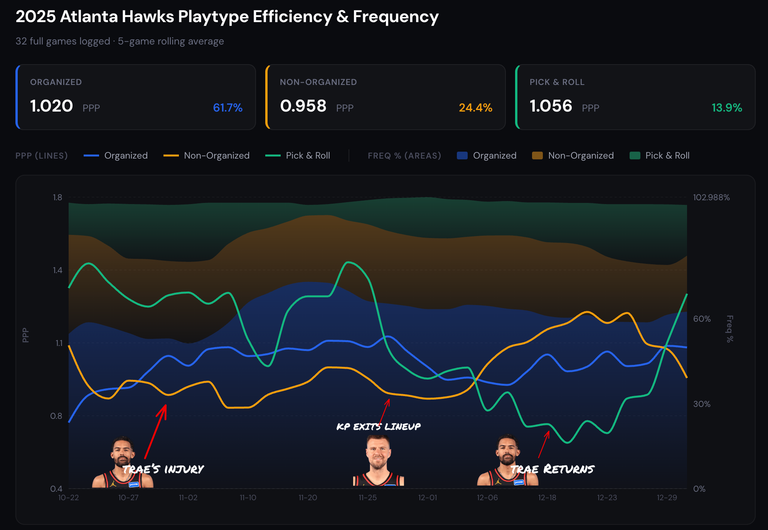
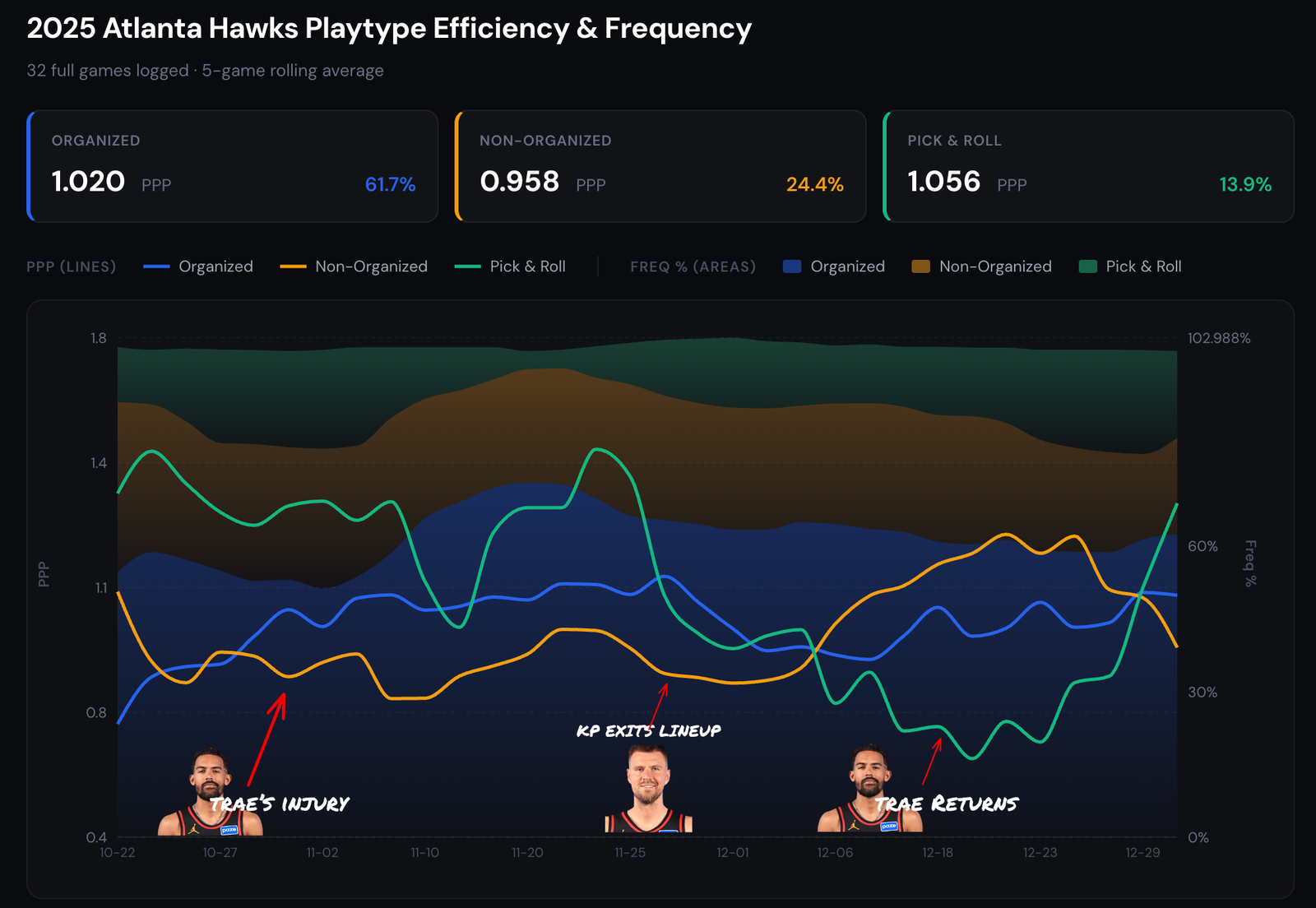
Tracking the offense in these 3 different silos also helps isolate how individual players’ impact these 3 ways to run offense. Trae’s injury sent ATL’s PNR frequency into a tailspin, necessitating that they run more organized sets to offset their lack of shot creation talent. Porzingis’ absences had a similar effect, as losing his hyper-efficiency and mismatch attacking led the Hawks to slowly trickle PNR back into their arsenal. Once Trae returned, the organized offense from a frequency perspective remained stable but rebounded from an efficiency perspective. I can’t wait to see how all the other personnel changes fluctuated these factors.
How to Use the Tracker + Some Quick Insights
I’ve fully logged 50% of the Hawks games thus far (32 games) and am scheduled to catch up fully by March 19th. Since I’ve got some work ahead of me, I can’t quite go in as much depth as I’d like to in this article, but there are definitions in the spreadsheet and please don’t hesitate to ask me any clarifying questions. I’m going to walk through the sheet + point out some of my favorite discoveries since building the sheet.
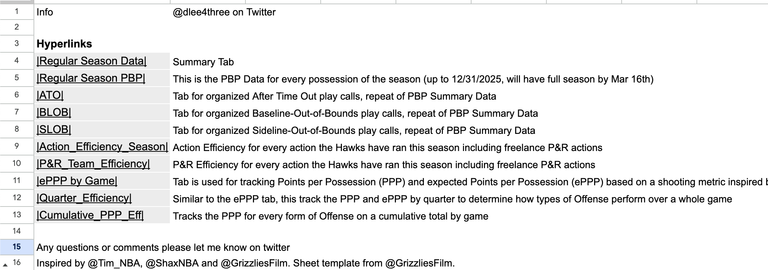
This is the info tab, with hyperlinks to the different tabs in the spreadsheet.
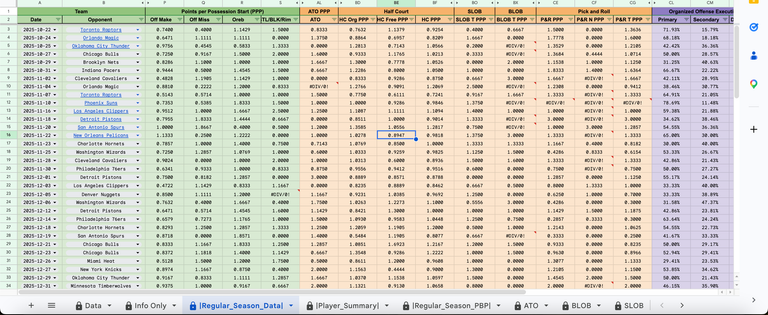
The Regular season data tab is a season summary that breaks out offensive efficiency based on how the possession started, whether it was a SLOB or BLOB scenario, if the organized playcalls generated a primary or secondary advantage, alongside some of the frequency and PPP data.
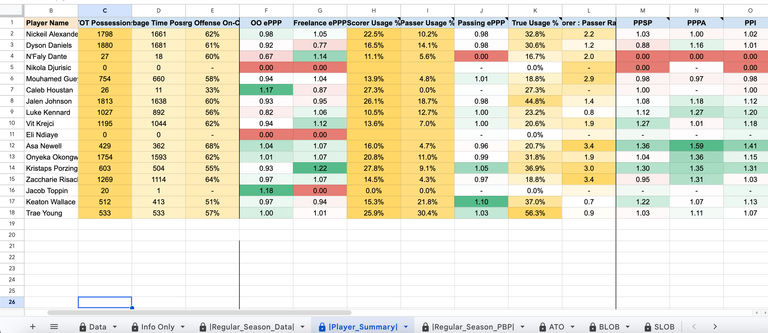
The player summary tab looks at the player level impact on playcalls, their usage, points per potential assist, self-created shot-making, all types of stuff. Special thanks is in order to who I attribute this tabs’s design to entirely. Some of my favorite takeaways from this tab include Keaton Wallace suppressing the organized offense more than anyone else in the rotation (no bueno), Zaccharie Risacher’s ludicrous potential assist passing efficiency on the lowest true usage of anyone in the rotation and Luke Kennard ranking as their most efficient self-creator.
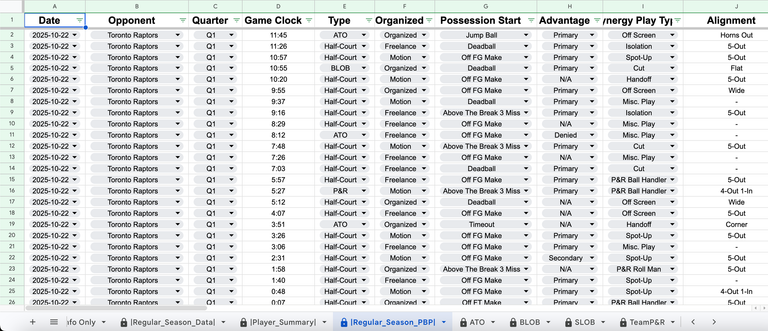
The Regular Season PBP is the main running ledger and is where I track each play. The ATO/BLOB/SLOB/Team P&R/Post-Up are specifically filtered for those individual scenarios.
P&R Team Efficiency breaks out the Hawks’ scoring and expected scoring efficiency based on the type of P&R they’re running. It also has shot profile data and defensive coverage frequencies. I should mention that for a play to be categorized as a pick&roll, it has to directly lead to a scoring opportunity for the handler, screener or from a receiving player (max 1 pass). Possessions that end with a make after several passes/resets that spawned from a PNR are still categorized as a PNR from an action perspective, but they won’t be included on the PNR tab.
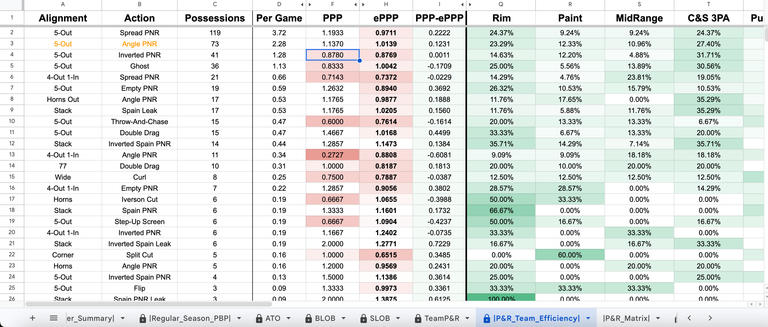
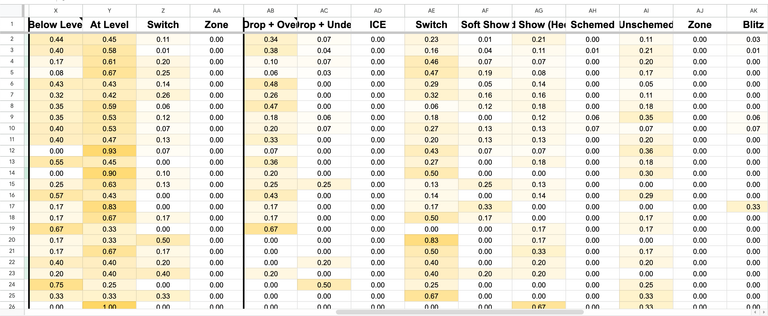
This is why the overall Action Efficiency tab has different counts for the PNR plays. This tab can be used to find the most efficient playcalls + the ones that get to the rim the most frequently, among other things. ePPP stands for expected points per possession, which is calculated on a per player basis based on the shot + scenario.
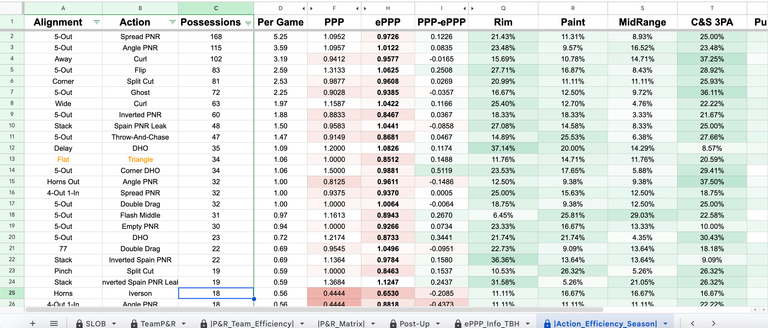
Atlanta is the 2nd most assisted offense in the league, meaning their made field goals are assisted at the 2nd highest rate. That means that so many of their baskets feature at least some type of action, which really makes this sheet useful for understanding how and why this offense functions the way it does.
For example, it makes intuitive sense that the Hawks would run a lot of “inverted PNR”7 but how often do they run it? Who are their most frequent screeners with Jalen Handling? How efficient is this action? How often do they get to the rim? There was no way I could ever answer these questions and confirm my intuition without this sheet. As Jalen’s role became solidified with Trae/KP out, the Hawks ramped up his PNR usage, capitalizing on his size to put teams into a major dilemma, as most teams want to switch on-ball screens.
Their Inverted Spain PNR action is one of their most efficient play calls this season, sitting at 1.136 PPP and is their most efficient PNR call overall.
There was a clear midseason shift to prioritize this action over two of their LEAST efficient actions in 2025, Ghost8 and Inverted PNR. Before the Hawks started ti ramp up the Spain PNR calls, it was common to see Snyder dial up a spread 5-out look with Jalen at the top of the key and Jalen/Dyson setting a screen in the middle of the floor. The Inverted call in particular boasts the lowest ePPP of any action with decent volume, because ATL was really struggling to get to the rim in these sets.
The sheet also has ePPP game & quarter breakdown tabs.
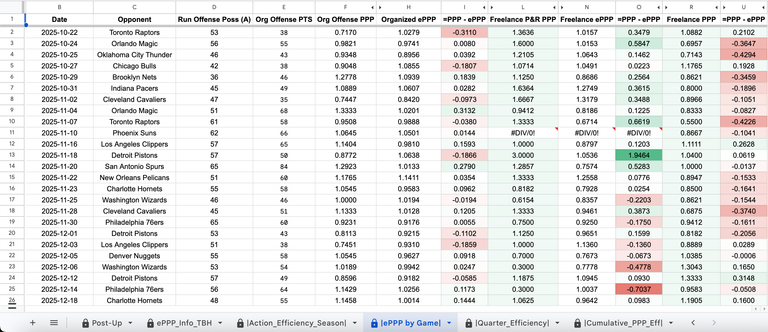
I have plans to build out a PNR matrix that shows coverages, shot profiles, screening combos + efficacy as well as some player dashboards to visualize how individuals impact what plays are called and am open to any and all suggestions you all may have. I am limited to the data I’ve already tracked and you’ve probably noticed that there’s no defensive data9 that I’ve talked about thus far so I can’t do anything with that sadly.
As with everything, I hope that this sheet is informative for you all and I’m so excited to continue to share insights from what I’ve learned as I add in all the new data + visualizations. If you would like access to the spreadsheet, you can upgrade to a paid subscription, refresh the page and you should be able to access the link to request access at the bottom of the story. Paid subscribers, you can click on the link below to request access just in case I missed you when I sent out invites!
Thank you for the support over the last couple of months. I hope that you all enjoy this tracker:
https://docs.google.com/spreadsheets/d/1AIo8CLiSKtQrPqI6MlNaS8hq8IZit_-eq0jBrauMNlI/edit?usp=sharing
Hit me with any and all questions or requests you may have!
[1][2][3][4][5][6][7][8][9]Footnotes
- ↩sideline out of bounds
- ↩my default verbiage for when ATL bunches 3 or more players in the middle of the floor for varying screening actions
- ↩a back screen typically set by a small to send a big on a backdoor cut
- ↩more on this in a bit
- ↩an off-ball screen typically set for a player lifting out of the corner, quite literally ‘away” from the play
- ↩an alignment that’s defined by a player receiving a pinch post entry with an empty corner, pinch can be at the elbow or further down the court
- ↩when a guard sets a ball screen for a big who’s handling the ball
- ↩a guard to guard screen, where the screener typically “slips”, not making contact with the defender
- ↩i really regret not tracking whether a center was guarding Dyson

Comments (6)
@davidramonlee_82s71
@dlee4thre3_2lkbg
@davidramonlee_82s71
Test
Test
hi