Draft Notes: Bennett Stirtz
Stirtz's outlier 2-PT efficiency relative to his team's pace bodes extremely well for his interior scoring translation, and is a stealthy indicator of hidden upside.
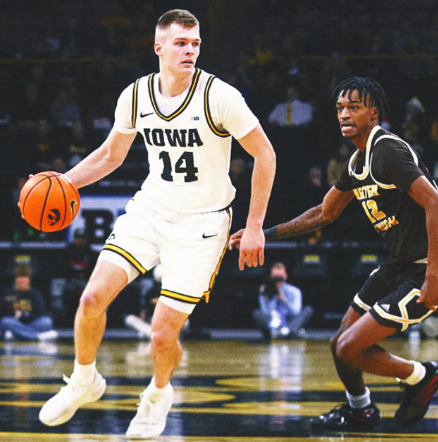
6'3 Iowa Senior guard Bennett Stirtz put together one of the more anomalous careers in modern NCAA history. Considering how heavily my analysis weighs pre-NBA statistical production, I want to address a concern the reader may have with the efficacy of this approach. The risk run, in my opinion, with placing an outsized importance on pre-NBA statistics (especially all-in-ones), is that they are ultimately a reflection of how effective a player is in their CURRENT basketball environment. Its relatively straightforward to glean what a player’s strengths and weaknesses may be in a vacuum, but assessing how a player interacts with teammates and how suited they are to complimenting perpetually fluctuating personnel groups is the primary goal of these evaluations. This consideration is especially relevant to Stirtz's evaluation due to the unique stylistic profile of the teams he's played on.
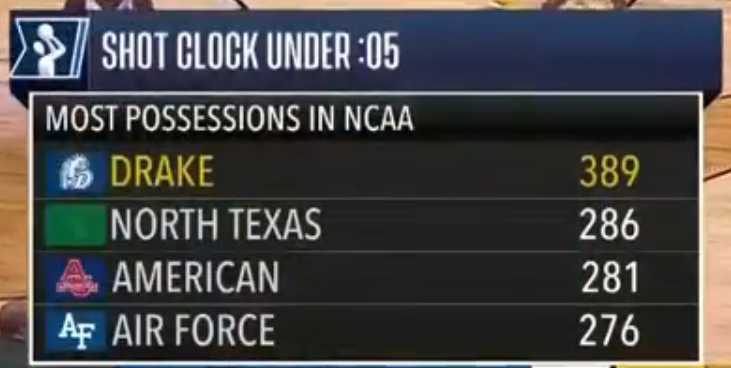
Since the 1996-97 NCAA season, there have only been 44 teams to post a rPace (Team Pace-League Season Average Pace = rPace) z-score of -2.1 and finished at or above an 85th percentile Net Rating. Of these 44 team seasons, there were only 19 unique teams, meaning that the majority of these NCAA teams deliberately played at a slower tempo as a feature of their coaches’ philosophy. Teams like Tony Bennett’s Virginia, Randy Bennett’s Saint Mary’s, and Bo Ryan’s Wisconsin are synonymous with a deliberate, half-court based offensive system, and Stirtz’s head coach Ben McCollum is quickly gaining a similar reputation. In fact, of the 4,915 NCAA team seasons on Ken Pom, McCollum's 2024-25 Drake team had the 3rd lowest rPace, meaning they played more half-court basketball than virtually any team relative to their competition. This initiative lead to one of the more unique team shooting profiles, as seen in the screencap below.
What makes the team tempo especially relevant to Stirtz's evaluation is the consistent effect a slower pace of play seems to have on guards' two-point scoring profile. Pulling the guards who consistently played under these team level constraints with a similar level of offensive responsibility to Stirtz revealed an interesting trend.
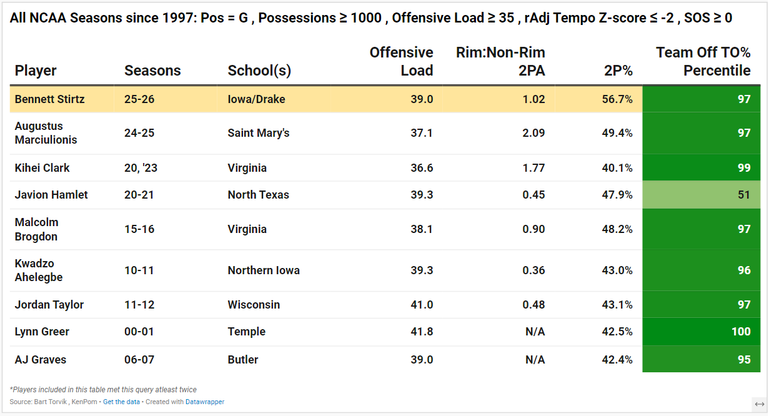
The table above sheds some light on the rationale behind this stylistic decision. With the added control from slowing things down, teams are able to improve their turnover margin, and this trend persists outside of the query. "Among teams that played at least 2 standard deviations SLOWER than league average, the median Offensive Turnover% Percentile is 60.7. But the tradeoff associated with this improved turnover economy seems to be added strain to the two-point scoring process for guards who inhabit this ecosystem. It is no coincidence that the guards with the most balanced two-point scoring process were amongst the most effective interior scorers. Without finding a happy medium between midrange and rim scoring, the likelihood of a guard's two-point scoring 'falling through the floor' increases. Stirtz's outlier 2-PT efficiency relative to his team's pace bodes extremely well for his interior scoring translation, and is a stealthy indicator of hidden upside.
Although I believe Stirtz's NBA translation should only be made easier by his experiences in such a restrictive NCAA environment, the specificity of McCollum's system does raise some questions. In professional basketball, team pace has a much narrower distribution within each league. In the NBA for example, only 5 teams have had a rPace z-score ≤ -2 since 2002. Bennett Stirtz will be asked to play in the open court significantly more than ever before in his career, and despite how efficient he has been throughout his college career there are still questions of how Stirtz will look creating advantages outside of structure. Stirtz does not possess the most dynamic handle, and it is not uncommon to see him walled off when he's forced to create without a ballscreen.
Stirtz constantly resets within the offense in order to maintain control over pace, this pitch-and-chase between Stirtz and his big is termed a 'Boomerang' within many offenses. When evaluating Stirtz there were many times where I wondered if this would be a hinderance to his NBA translation. What if his tendency to probe defenses via these Boomerangs and re-screening was symptomatic of a dependency on McCollum's scheme to manufacture paint touches? And when Stirtz wasn't consistently provided the luxury of extremely deliberate pace and elite screening (seriously McCollum coached bigs are amongst the best screeners in basketball) his offense may falter.
The evidence of Stirtz's self-creation not being up to snuff with NBA lead guards isn't entirely film-based either. In his Junior and Senior seasons respectively, 25.5% and 30.6% of Stirtz's rim makes were assisted. These values were in the 30th and 19th percentile amongst roughly 5000 players who shared Stirtz's positional designation (minimum 100 rim attempts).
Comparing Stirtz's playtype distribution to his positional peers in this draft class reinforces the idea that McCollum's scheme and Stirtz's skillset was more of a symbiotic relationship than I'd previously thought.
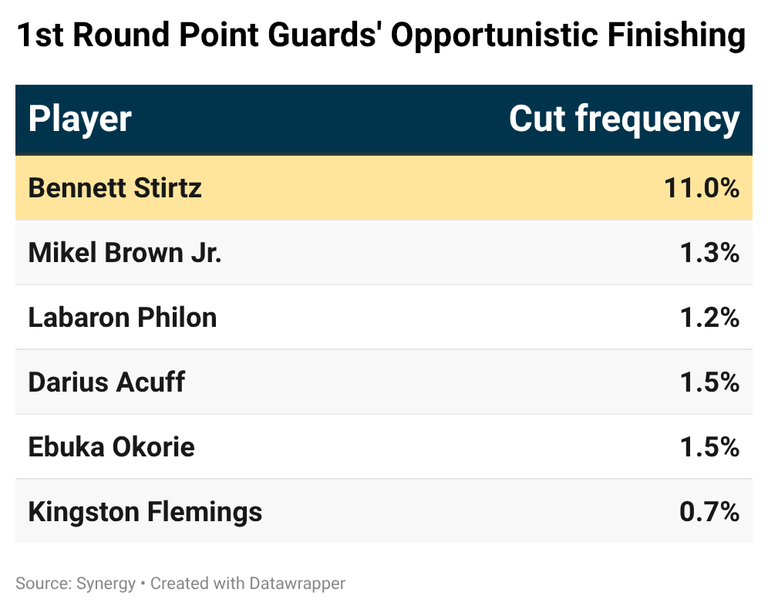
Stirtz had nearly eight times the cut frequency of the other projected first round guards! This discovery was jarring, and opened my eyes to the possibility that whatever boost in efficiency Stirtz stood to gain based on an increased transition frequency in the NBA may be nullified by the absence of opportunistic finishing chances.
Ultimately, what diminished these concerns for me is the incredible balance of his profile for the position. Over the course of his career Stirtz's two-way contributions place him in rare air amongst guard prospects.
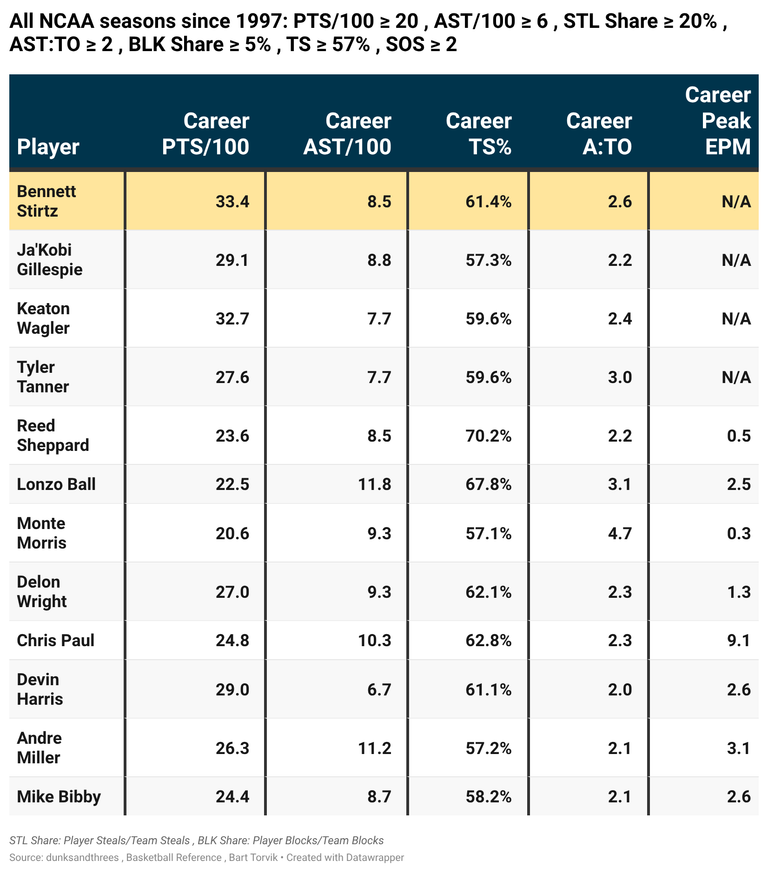
Although Stirtz may not experience the heights of the NBA players who populate this query, based off this grouping there is reason to believe his median outcome is much higher than his consensus ranking of #18, per the Rookie Scale.
Stirtz's age and lack of pre-NCAA pedigree are definitely contributing factors to his underranking, but another reason Stirtz isn't being properly valued by consensus is the heuristic commonly used to gauge guard talent. Conventional reasoning will often times apply a false equivalence to evaluating guards, where the aspects of their profile we most commonly associate with a 'lead guard', such as advantage creation, are mistaken for the entirety of their profile. The underlying assumption here is that no ancillary skillset can justify the opportunity cost of playing a guard sized player who cannot carry a heavy offensive burden over a larger player. This flawed reasoning undergirds one of the greater market inefficiencies in the NBA currently, and I'd point to Cason Wallace's fall in the 2023 draft along with Jose Alvarado and Deuce McBride's contributions to the newly crowned champion Knicks as evidence of this phenomenon.
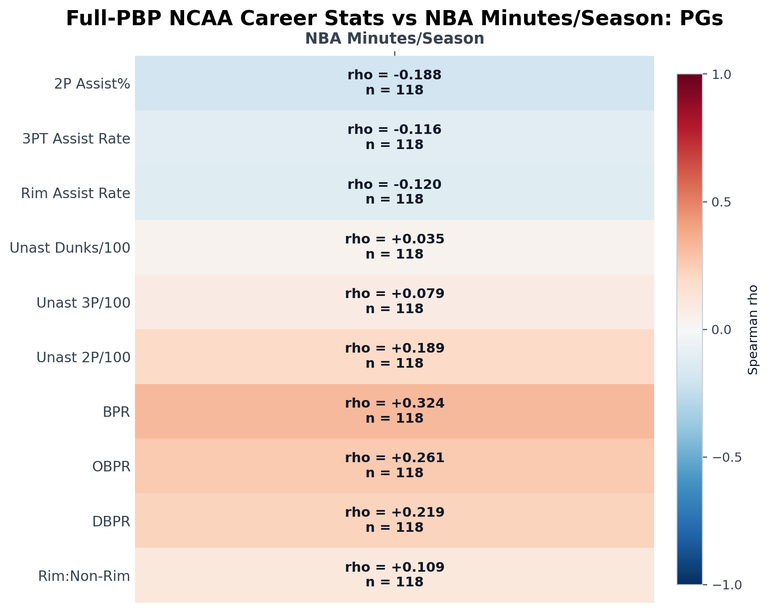
Of course I'd be remiss not to mention the fact that I'd utilized this reasoning just a few paragraphs ago when discussing Stirtz's assisted rates at the rim. Further research on the predictive value of these play-by-play statistics proved that to a certain extent, I was missing the forest for the trees here. Although it's a small sample size the correlation matrix below shows that Rim Assist% on its own cannot reliably predict NBA viability (with minutes played per season as a proxy for NBA viability).
However the question still remains of what Stirtz's ancillary skillset actually is? His stock (steal + block) rates and anthropometric profile are fairly pedestrian for the position. And thats especially if we consider the fact Ben McCollum almost exclusively tasked Stirtz with guarding their opponents lowest usage player in order to preserve Stirtz's energy. With Drake more so than Iowa, these assignments typically took the shape of a movement shooter, who would expose Stirtz's average (by NBA standards) strength and recovery tools.
IF there's a player that belies this it would be bennett Stirtz, due to his..." the unbelievable minutes load he carried in college. During his two seasons at the Division 1 level, Stirtz played over 93% of his teams' minutes, with his lowest minutes share being 85% during his second year at Northwest Missouri State. Fellow Hardwood Collective contributor Avinash Chauhan noted the effect Stirtz's iron man status had on his defensive production, with his stocks and rebounding waning over the course of games.
the clearest sign that stirtz would get 'gassed' is the decline in his second half defensive activity
— avi (@100guaranteed) May 9, 2026
at drake:
1H: 3.9% steal, 16.7% dreb
2H: 2.5% steal, 10.5% dreb
at iowa:
1H: 3.5% steal, 10.6% dreb
2H: 1.1% steal, 7.9% dreb https://t.co/pZXYFdk7d3
Of the 13 players to have played 50 career games in Bart Torvik's database, Stirtz has the highest Mins%!
And while there is reason for optimism when judging Stirtz's defense, there may not be a guard in the class with a more enticing offensive ancillary skillset. During Bennett's career he never finished lower than the 93rd percentile in Pick-and-Roll Ballhandler frequency, Per Synergy Sports, and this P&R frequency was paired with 98th and 93rd percentile Isolation Frequencies across his Junior and Senior seasons. This playtype distribution left Stirtz with virtually zero opportunity to showcase his ability as a complimentary ballhandler, and more specifically his off-ball scoring acumen. Due to the paucity of transition opportunities and playmaking talent around him, over 68% percent of Stirtz's career three-point attempts were off the dribble threes. When this is translated into play-by-play data for comparison sake, Stirtz finished his Division 1 career with 41.7% assist rate on 9.8 3PA per-100 possessions. For reference, only 11 NBA players since 2002 have finished seasons with a similar three-point scoring profile.
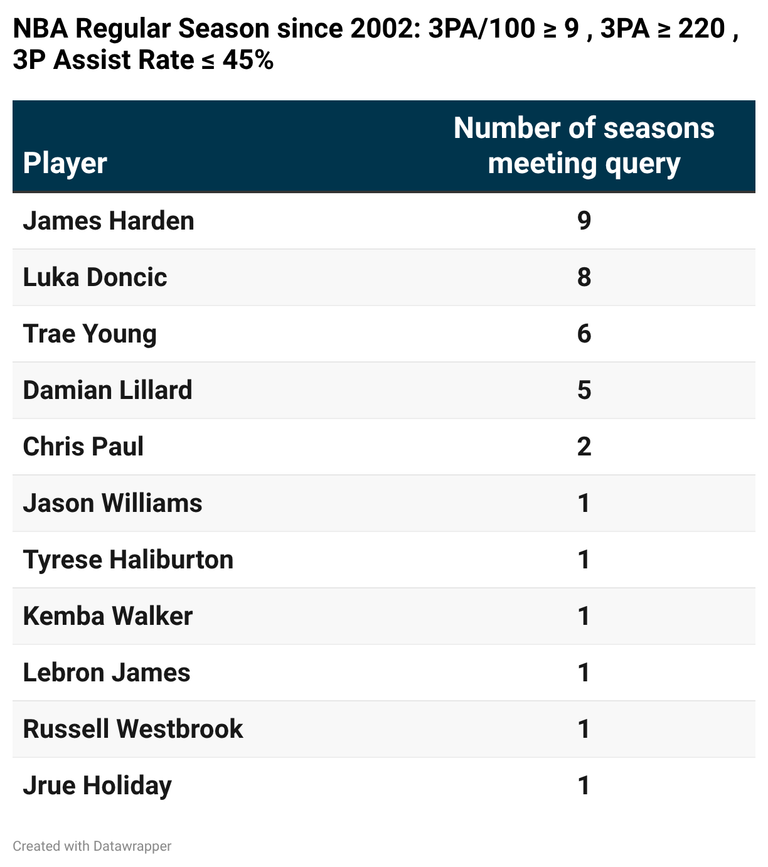
The inclusion of this query isn't to insinuate that these players represent Stirtz's range of outcomes, but that Stirtz's three-point shooting profile is due for a major shift. When Stirtz inevitably receive a steadier diet of spot-up threes in the NBA, he should be more than capable of capitalizing.
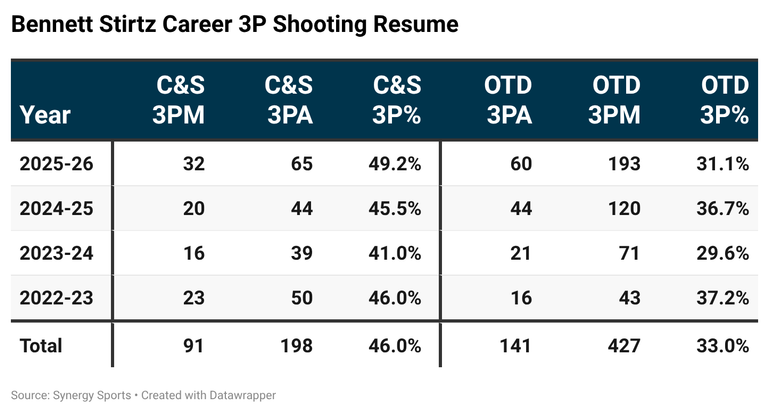
In Bennet's last four seasons of college basketball, he only attempted 17 'Off-Screen' movement threes! l I'd anticipate Stirtz's usage as an off-ball spacer and playmaker to skyrocket at the next level. And even though the opportunities to attack a tilted defense were few and far between for Stirtz, there is enough evidence to project Stirtz as a reliable closeout creator.
In the wake of the NBA Finals the resounding question from fans and pundits alike was how to find the 'next Jalen Brunson', a perimeter player who is as undervalued as they are talented. And while I am not here to draw a direct comparison, I do think the parallels between the two are unmistakeable. Two veteran college guards with extremely malleable skillsets and equally effective augmenting another handler as they are creating for themselves and others. The fact that Stirtz has seemingly secured a first round draft placement is an encouraging sign that the NBA has expanded their definition of backcourt productivity. But the added contextualization of Stirtz's developmental context puts into perspective just how singular of a prospect he is, and was enough to elevate him to 8th on my personal board.

Comments