Kingston Flemings' undeniable excellence as a freshman lead guard, thriving both on and off the ball, all while performing in a regimented environment under Kelvin Sampson, is indicative of NBA stardom.
Kingston Flemings played all 4 years of his high-school career at William J. Brennan HS in San Antonio, Texas. He finished his senior season as Gatorade Player of the Year for the state of Texas, while leading Brennan to a 33-3 record and the Class 6A state semifinals for a second straight season. Flemings was the highest ranked player in his state, the 4th highest at his position and ranked 15th overall by RSCI...yet somehow, there was very little national buzz regarding his NBA prospecthood at the beginning of the NCAA season.
Maybe Flemings flew under the radar due to competing in Puma’s Pro16 AAU Circuit instead of the more heavily scouted EYBL/Adidas/UAA circuits. Perhaps it had something to do with him electing to play for a program that very rarely entrusts freshmen to see the floor, much less run the offense.
"This is by far the youngest team we’ve ever had...Jamal Shead didn't even get to play as a freshman. Marcus (Sasser) didn't get to start until later in the year. Most freshmen don't play here. Jarace (Walker) was up and down." - University of Houston coach Kelvin Sampson to @PaperCityMag
Whatever the reason, Kingston wasted very little time garnering the national attention he rightfully deserved. He put up 19/5/9 with 3 stocks and 0 turnovers in his 3rd game (27 minutes played), grading out as a whopping 98th%ile single-game per 40 performance among future NBA guys at his position. This performance heralded one of the most impressive one and done seasons by a freshmen guard in the last decade, with Kingston going on to shatter the Coogs' single-game scoring record with an electric 42 points at Texas Tech, become the first Houston freshman to garner All-America honors and perform admirably as the most important linchpin to his teams' success.
Because Kingston was able to remain impactful in a variety of facets within Houston's system, he boasts an extremely malleable NBA projection that is exceedingly rare for his archetype.
Playstyle Trajectory
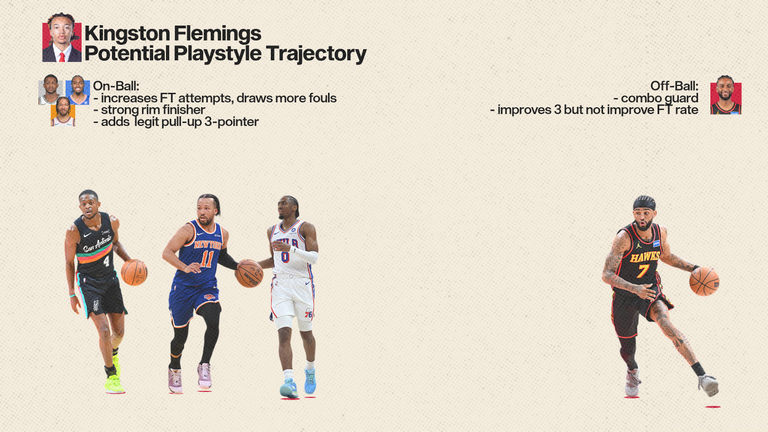
There are 2 distinct potential playstyle trajectories in Flemings’ NBA projection, with both paths tied nearly unilaterally to how much MORE weight he can add to his frame, plus how he scales his 3P and FTA volume.
Kingston Flemings measured at 6’3 with a +1 wingspan (7th%ile WS-H at his position)[1], which is far from immediately disqualifying considering Flemings’ overall profile, though his lack of length places a ton of emphasis on his weight (183.4, 41st%ile). Kingston was phenomenal in every other combine testing aspect, ranking in the 91st%ile in both verticality and agility at his position, in addition to posting the 2nd fastest ¾ sprint among projected 1st rounders. His burst measuring so well indicates there’s some room to add weight without sacrificing too much speed, which in conjuction with his athleticism, should assuage some of the traditional concerns attached to guys at his position.
His ability to punch above his measured height is evidenced by the "Statistical Height" [2] measure created by Jason. His statistical height is 1.88 inches bigger than his listed height in shoes, ranking 3rd in the biggest differential among projected 1st round freshmen guards.
Newest project: Statistical Height
Projects how tall a player is based solely on their statistical profile.
Aimed to see how “big” a player actually plays based on performance in stats positively correlated with height, independent of their listed height. pic.twitter.com/UqNmyiT7Ti
As we'll detail below, Flemings' developmental path as a NBA guard is uniquely multi-faceted, with the ability to blossom into a dynamic on-ball guard by tweaking his offense process while showcasing the requisite off-ball efficacy to remain effective in a lower-usage role.
Team Impact
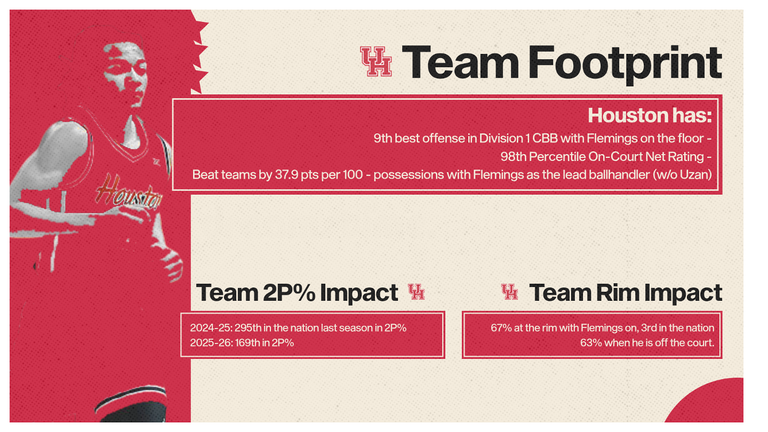
Flemings served as the fulcrum of the 7th best offense in D1 CBB (according to Luck-Adjusted Offensive Rating) when he was on the court. A large portion of this has to do with Houston’s utter dominance on the offensive glass, as Houston finished 30th in the nation in ORB%, though much of this should also be attributed to their 2-point scoring improvements this season, which Flemings is a massive part of.
Houston was 295th in the nation last season pre-Flemings in 2p%. Typically, adding a freshman with an affinity for pull-up midrange jumpers would tank a teams' ability to score efficiently within the arc, yet that was far from the case. Houston finished 169th in 2-point efficiency this season, a substantial improvement upon last season and shot 67% at the rim with Flemings on, with that number falling by over 4% when he is off the court.
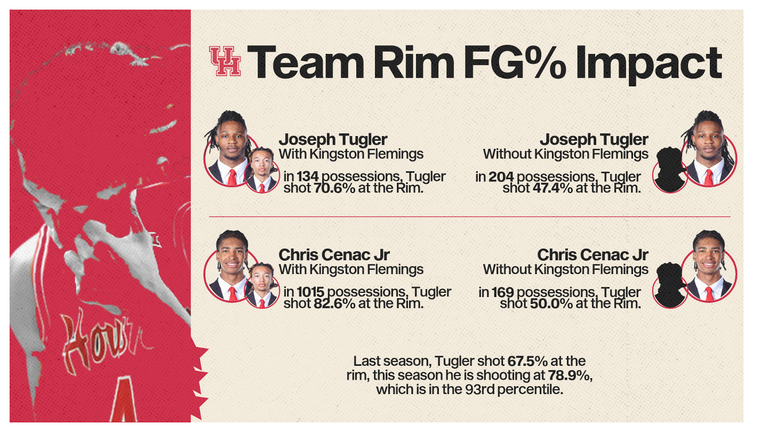
Flemings' importance to Houston's offensive infrastructure may be best represented by his impact on his frontcourt's ability to convert at the rim, which is boosted by the volume he created opportunities at the rim (2 rim assists per 40, 87th%ile in D!). Both Chris Cenac and Joseph Tugler saw massive increases in their rim FG% with Flemings on the floor. Cenac in particular was one of the best play-finishers in the NCAA when he shared mins with Kingston, shooting 82.6% at the rim with Flemings and 50% without him. Tugler was a 60th%ile rim finisher in 2025, Flemings' influence boosted him all the way to 93rd%ile this season!
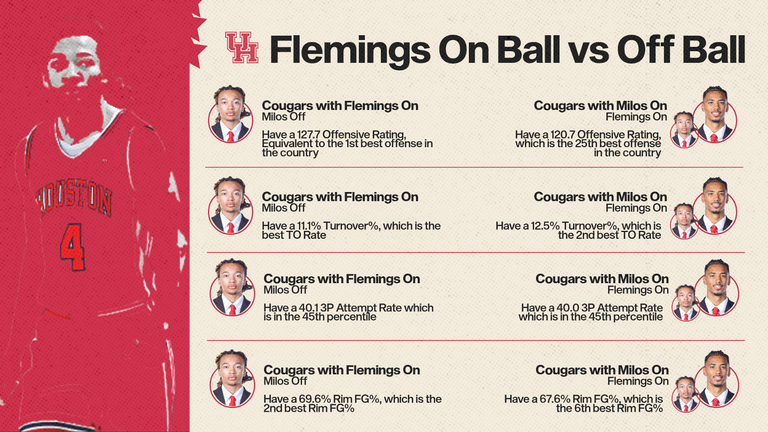
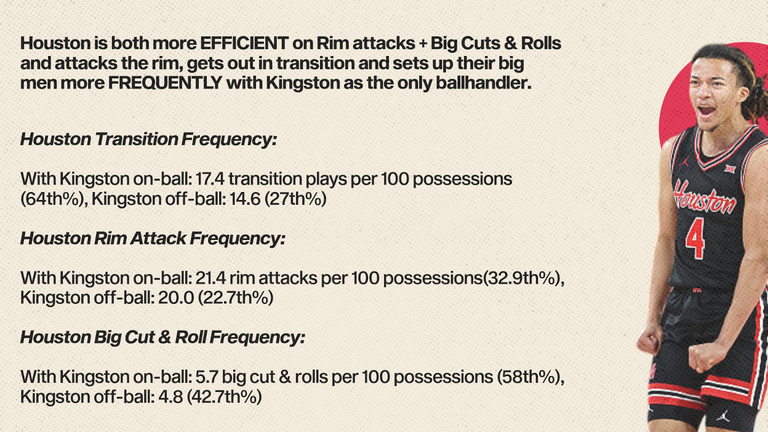
The most fascinating part of Flemings' impact is how persistent his presence was felt, whether he was on the ball or off the ball. Houston saw their best offensive results with Flemings as the only handler, but his decision making and paint pressure still guided HOU to a T30 offense that rarely turned the ball over when he shared touches with Milos Uzan.
Houston was more efficient on actions that commonly led to the highest-value shot attempts in basketball[3], got out in transition and set up their big men more frequently in the possessions Kingston functioned as the only ballhandler.
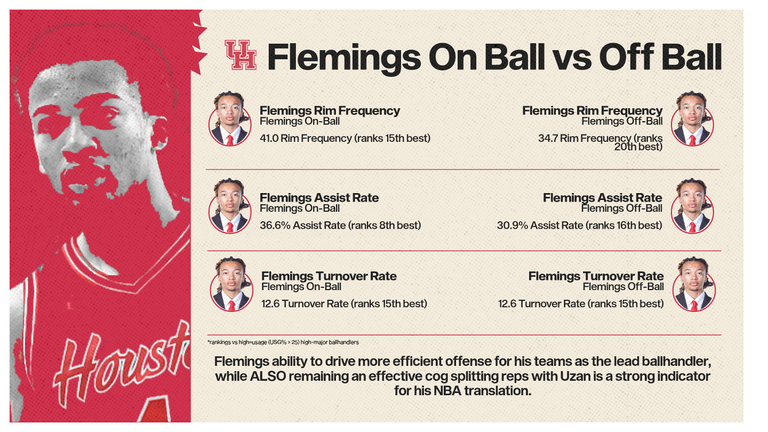
The 3 strongest pillars of Flemings' offensive profile also remained consistent whether he was solely running the offense or not. Among high-usage high-major ballhandlers[4], Flemings ranked among the best in terms of individual rim frequency, assist rate and turnover rate in both scenarios, concrete evidence of his unique skill intersection to drive more efficient offense for HOU as a lead ballhandler, while also contributing as an effective cog splitting reps with Uzan.
A Deep Dive Into Flemings' Scoring Process
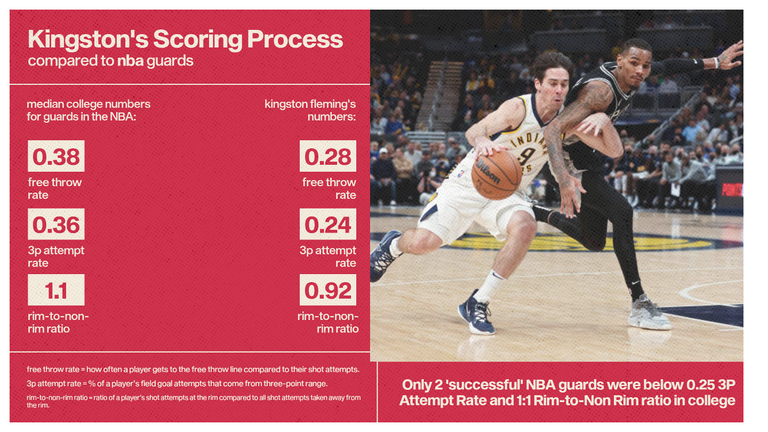
It's no secret Kingston Flemings' scoring process is suboptimal. The list of successful NBA guards who fell short of the median thresholds for Free Throw Rate and Rim:Non-Rim Ratio [5]is extremely small.
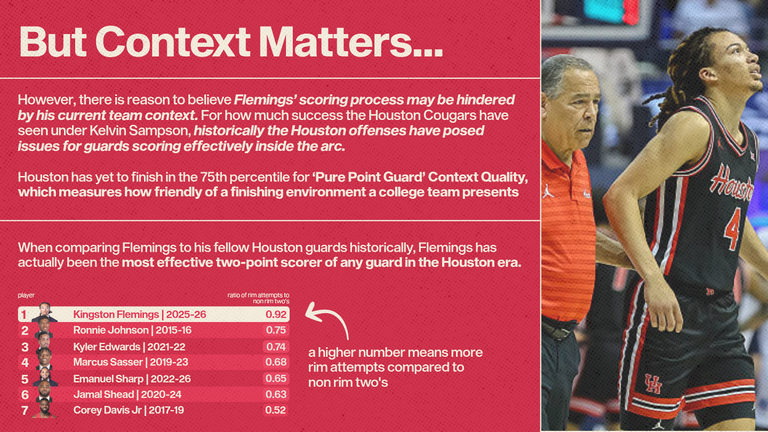
However, there is reason to believe Flemings’ scoring process may be hindered by his current team context. For how much success the Houston Cougars have seen under Kelvin Sampson, historically the Houston offenses have posed issues for guards scoring effectively inside the arc. Houston has yet to finish in the 75th percentile for ‘Pure Point Guard’ Context Quality[6]. When comparing Flemings to his fellow Houston guards historically, Flemings has actually been the most effective two-point scorer of any guard in the Sampson era.
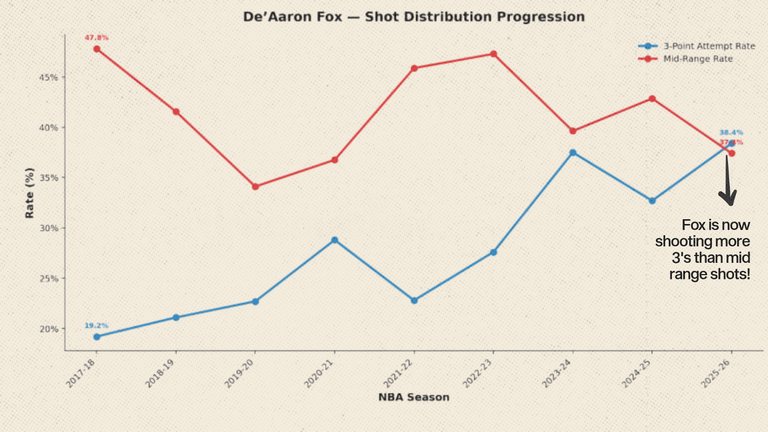
When examining freshman guards who played in a similarly restrictive environment to Flemings AND were forced to carry as large an offensive burden as Kingston, there prove to be many success cases of guards rapidly improving their three-point volume. Take De’Aaron Fox for example, who carried an Offensive Load of 42 (84th percentile)[7]compared to Kingston’s Offensive Load of 47 (93rd Percentile). Fox finished college with a 0.15 3PAr and managed to improve this consistently over the course of his career, exchanging mid-range jumpers with more threes in almost every subsequent year of his career.
Another guard who possesses similarities to Kingston’s deployment in college and the system he plays within is Tyrese Maxey. Maxey’s Kentucky team was below the 50th percentile in Context Quality, The two Texas natives also had a comparably large volume of low shot quality FGA in their pre-NBA year, with Flemings ranking in the 98th%ile in low shot quality FGA and Maxey ranking in the 87th%ile. However, Kingston boasted a much higher self-creation load, with Flemings attempting 83% of his jumpers off the dribble (99th%ile), a stark difference to Maxey's 34.2%. Flemings also shot a higher proportion of contested catch & shoot 3PA (58.6% vs 41%). These shot difficulty indicators are a strong reason why Maxey has drastically over-performed the 29% from 3 he shot as a freshman, which makes Flemings' superior efficiency on an even tougher shot diet an encouraging signal for his eventual shooting progression.
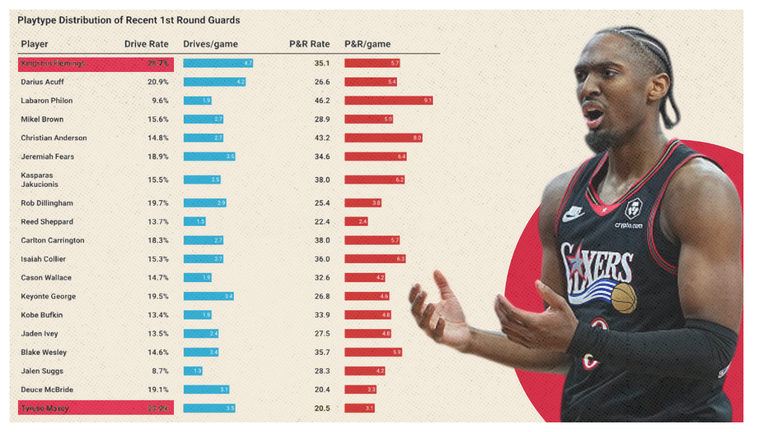
During their freshmen seasons, Maxey and Flemings received a strikingly similar split between on and off-ball usage. This usage distribution is reflected in the proximity between Maxey’s drive frequency and P&R Ballhandling frequency. Kingston and Tyrese are the only two players of recent first round guards to find success despite a high percentage of their looks coming ‘without a screen’, i.e. out of driving situations, typically attacking a closeout. When you compare this NCAA playtype distribution to how Maxey fared in the league, it's no surprise he was able to quickly adapt his scoring process to become more aligned with the demands of a NBA guard. Not only did Maxey rapidly increase his three-point attempt rate DESPITE seeing more on-ball usage, he also became more adept at drawing fouls. We believe the parallels between Maxey and Kingston shed some light on just how realistic it is Kingston will become a much more optimized perimeter player in the league.
While Kingston’s athletic indicators and in-between game draws comparisons to Fox and Maxey, his defensive acumen and otherworldly jumpshooting prowess for his archetype could potentially unlock a level of impact far beyond the aforementioned speedy tandem.
The Historical Precedence (or Lack Thereof) of Kingston's Offensive Profile
That Kingston’s non-scoring goodness must be contextualized by his ridiculous scoring goodness is circular, but a critical part of his appeal.
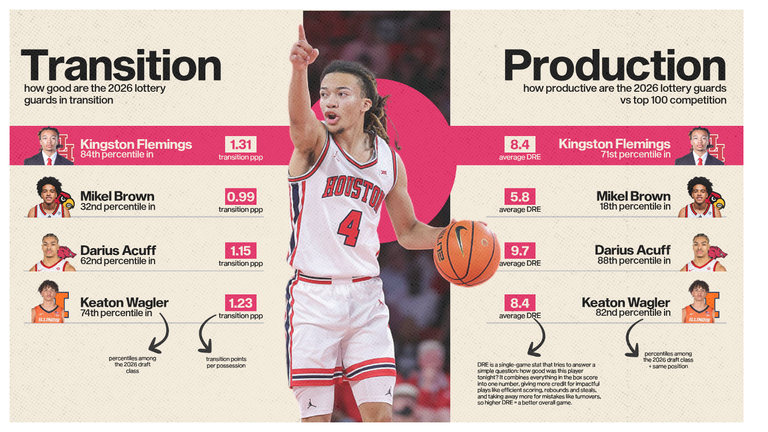
A high work rate requires high energy expenditure, and its maintenance should be physiologically impossible. Maintaining a high work rate on offense nearly always necessitates a drop in defensive output. And Kingston’s work rate on offense is absurd. He finished the season with a 50% creation rate[8], which ranks in the 95th percentile since 2011, pairing that ridiculous volume with impressive efficiency. But amongst that group of 95th%ile creationists across the last 15 seasons of high major basketball, Kingston stands alone with his transition efficiency.
A player with Kingston’s touch and processing should be a high octane creationist. A player with Kingston’s burst and handle should be highly efficient in transition. There’s just no real analog for frequently getting out in transition at high efficiency while maintaining this level of creationism. Kingston is carrying a significant scoring load...while having perhaps the best one and done playmaking season ever. Few freshmen have ever reached 32% assist rate and 2.9 A:TO, but at this scoring usage, there’s no drafted players that meet the bill. And Kingston achieved this at a high rate in America’s best conference, while only seeing his minute increase.
He played a whopping 87.6% of minutes against top 30 teams and produced a box-plus minus of 13.1 (4th in the nation). Shouldering a creation, transition, and passing burden is theoretically the most difficult integration to maintain. Kingston has done it exceptionally well, all against the best teams as Houston’s resident iron man. His offensive work rate is ridiculously outlier.
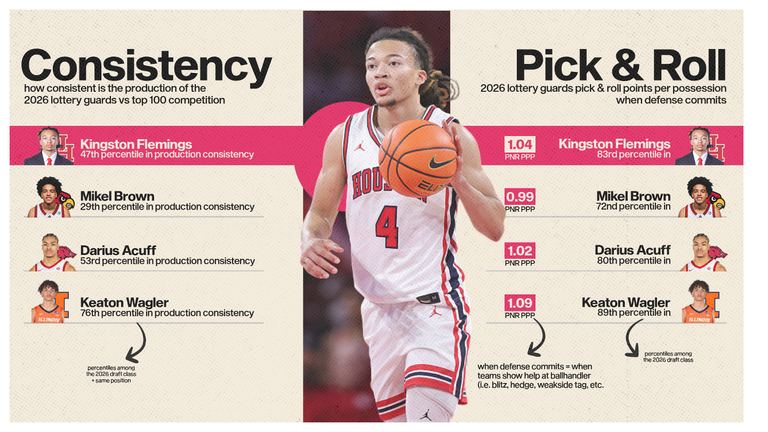
Flemings' production and consistency stands strong among every prominent freshmen in this class.
Kingston distinguishes himself among his position group in this draft class with his transition efficacy and excellence as a PNR creator vs aggressive coverages.
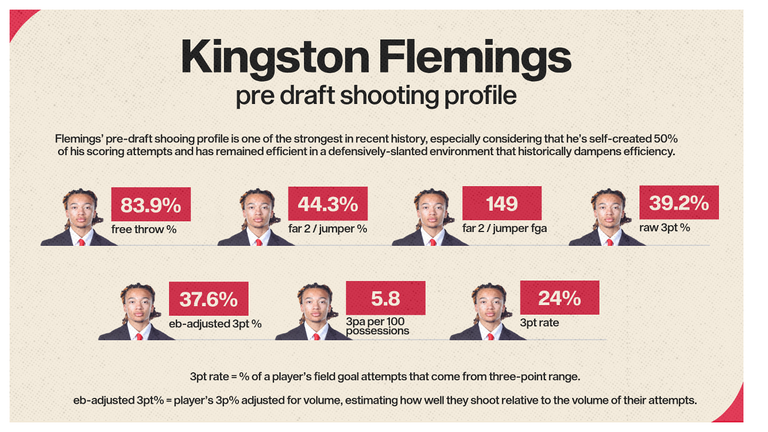
Considering the context we just discussed, Kingston Flemings' pre-draft shooting profile is one of the strongest in recent history. Flemings boasts multiple exceedingly positive indicators to be a high-level shooter in the NBA. He's been an elite FT shooter for years and exhibits excellent energy transfer on his jump shot both off the catch and off the dribble. There's just 1 area of growth that hinders his NBA 3-point projection, 3-point volume.
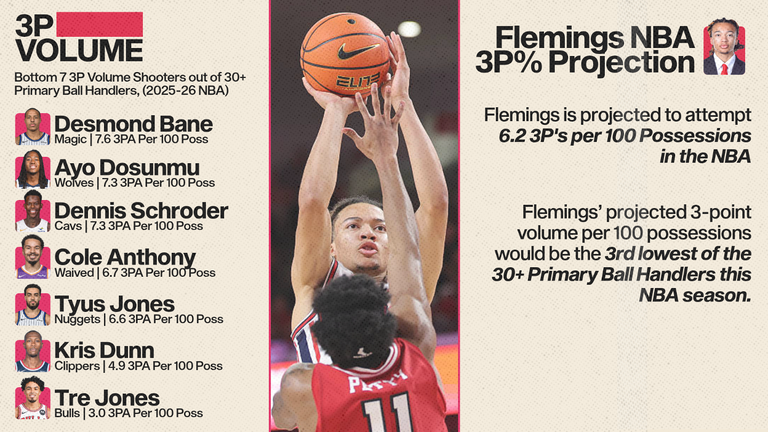
Our proprietary 3p% model predicts Flemings' NBA 3P% several points below the 38.7% he shot at Houston, as it adjusts for volume. Kingstons' projected 6.2 3s attempted per 100 possessions would rank the 3rd lowest among 30+ primary ballhandlers from this season. This threatens to cap his potency as an on-ball creator, as a reluctance to shoot 3s off the dribble invites teams to deploy heavy drop coverage on pick & rolls, which suffocates rim opportunities and relegates paint touches to lower-EV inside the arc pull-ups. Flemings' excellence as a pull-up 2PT scorer leads us to lean more optimistic than the model, particularly with the context we discussed above within Houston's hierarchy.
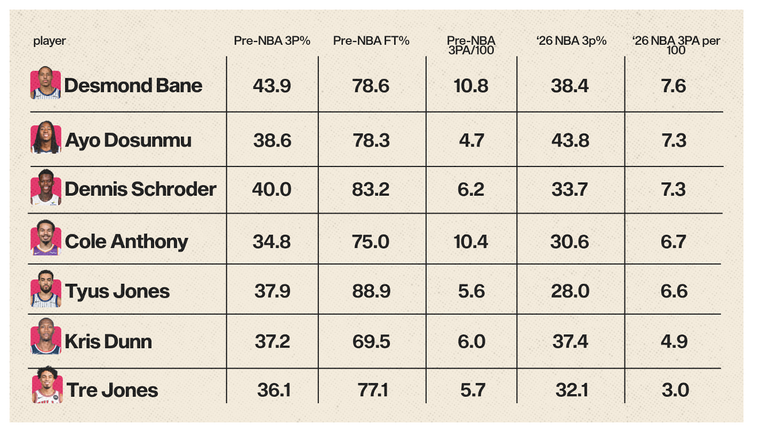
Flemings pre-draft profile surpasses this collection of low-volume 3P shooters by several magnitudes. He shouldered far more usage than anyone in the table below as a freshman and profiles as the most gifted playmaker, though it's meaningful to consider how each player below was able to still find success in the NBA despite not getting up a ton of threes. Ayo & Tre have positive transition influence and are strong catch & shoot 3-point shooters, Kris Dunn specialized as a defender, Dennis Schroeder has been a walking paint touch for a decade & Desmond Bane is a reliable secondary/tertiary creator who can scale up as a creator when necessary. Thus, Flemings' lower-end shooting outcome still presents multiple paths to being a valuable NBA player and his creation, passing & defensive indicators heavily support his ability to transcend this grouping.
We haven’t seen a player with Flemings’ talent as a shooter, passer, and defender since a certain Davidson guard skyrocketed up boards prior to the 2009 NBA draft. Kingston checks every single box BESIDES 3P volume to become an otherworldly offensive engine who doesn’t bleed value on defense. The difference between him approximating a Curry-level of offensive influence is realistically attainable by simply shifting his shot diet to be more perimeter oriented.
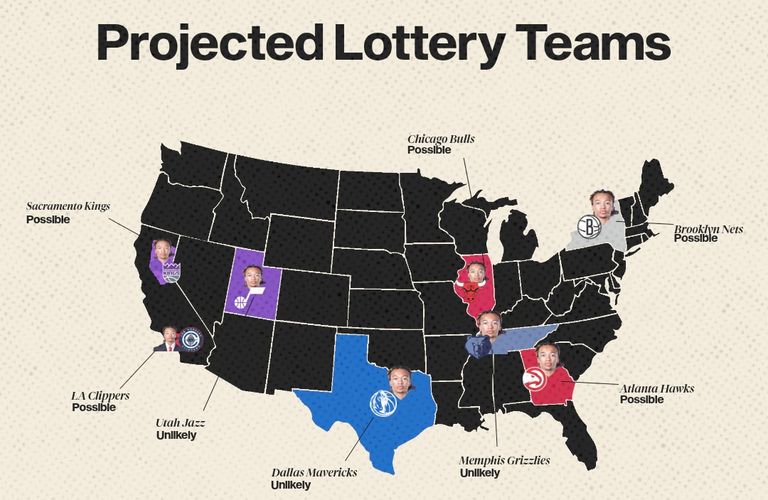
We prepared a thorough breakdown of Kingston's potential compatibility with the vast majority of the teams selecting in the lottery, weighing factors such as:
Likelihood for Flemings to get playing time and on-ball opportunity based on coach’s historical rotations
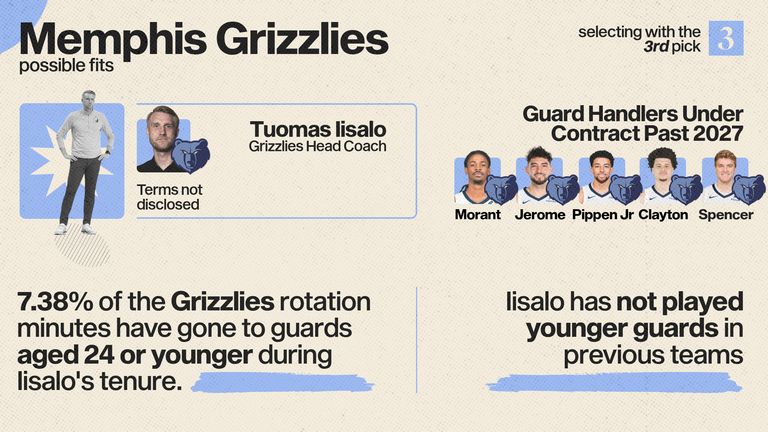
Percentage of total minutes played by a rookie or sophomore guard, age 24 or under, for the coach in his current position.
Team Contract Tables
A stable staff context and open slots on the depth chart will allow for a more seamless pro translation.
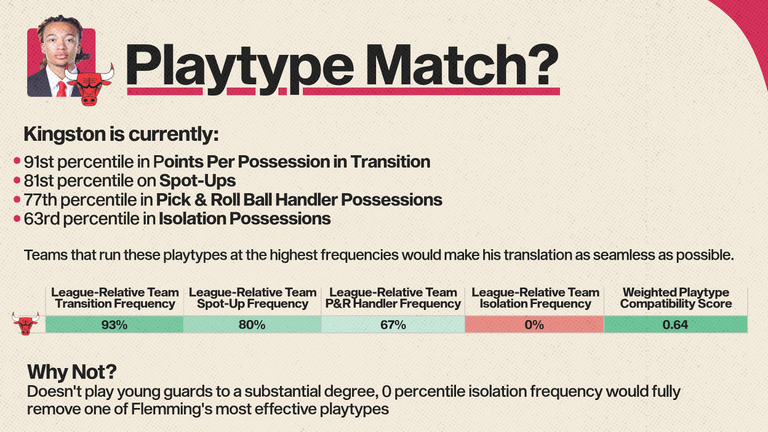
Playtype Compatibility
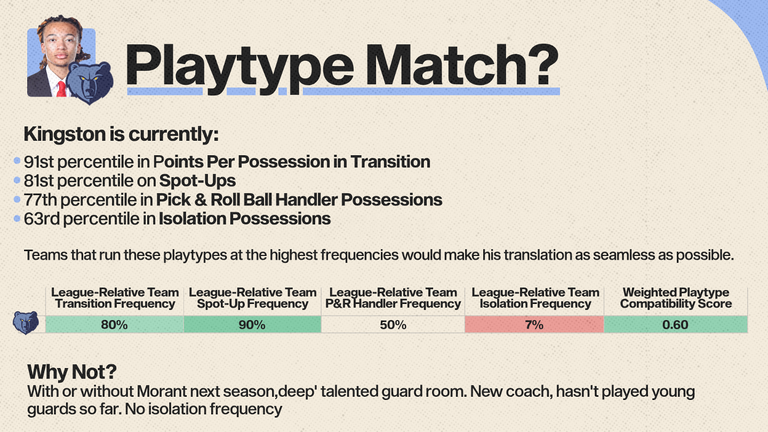
Identifying teams that most frequently run the actions Flemings succeed in or identifying teams whose offensive profile best aligns with Flemings' strengths.
Coach RAPM
Metric from xRAPM.com that estimates a coach’s impact on team performance as if they were a sixth player on the floor. Identifying teams with better coaches would likely make Flemings’ NBA translation easier.
Average Team Height/Weight
Flemings’ burgeoning frame is as important a talking point as his skillset. Understanding a coach’s preference for building rotations based on their heights and weights makes it easier to understand how much early playing time he’d receive, and how the team ethos may sway his physical development.
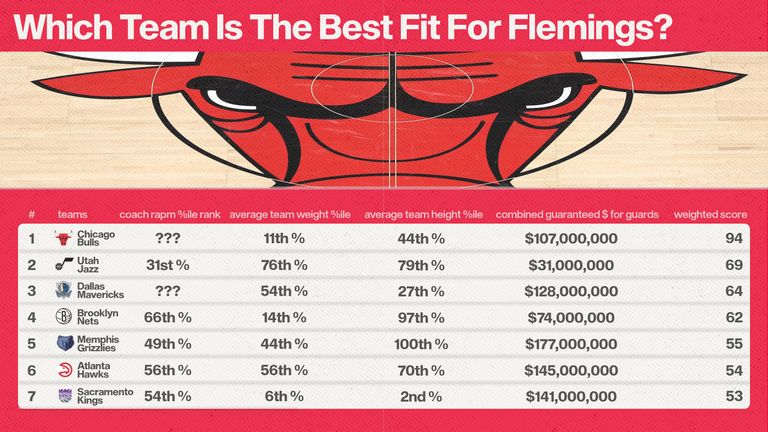
Note that these teams are loosely ordered by their weighted compatibility score, and are not reflective of recommendations on potential landing spots.
Possible Fits
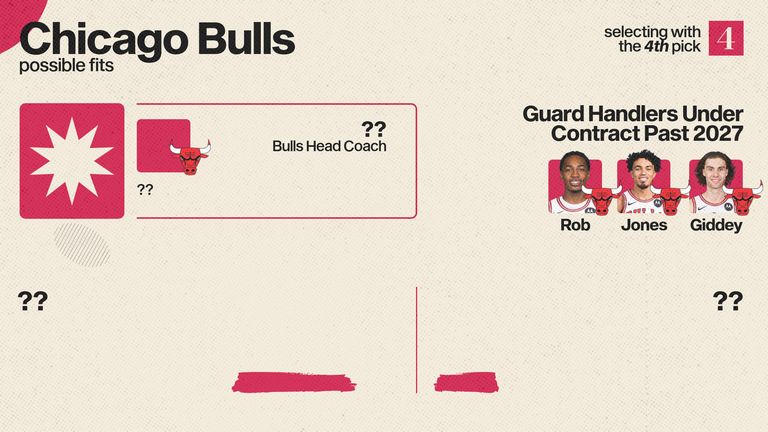
(1) Chicago Bulls: 94 (out of 100) Compatibility Rating
*Editors note: Billy Donovan stepped down as head coach of the Bulls on April 21st, 2026. The jury is out as to whether his offensive principles will remain in his absence.
Why Chicago?
KF's shot diet is currently the biggest datapoint against him; over the last two seasons, the Bulls have the best Rim+3s (Moreyball) frequency in the league, and the second-best rim rate. Billy Donovan's offense would've presented an immediate remedy. His weighted playtype compatibility is the best of the eleven surveyed teams, with his best two playtypes aligning best with the Bulls' most frequent, Transition and Spot-Up. All of their current guards are expiring or expendable outside of Giddey and Tre Jones, neither of whom is used heavily on-ball currently. Bulls are a mediocre 20th in offensive TOV% this season, Houston is #2 in the nation in oTOV%, he would solve a major team issue as well as compounding their best skills. Donovan had extensive experience with some of the most dynamic guards in recent memory, he was Westbrook's coach when he won MVP and coached Shai/Chris Paul in the bubble season.
The Bulls have had the shortest average time of possession on offense the past 2 years, Donovan frequently deployed multi-guard lineups that heavily emphasize pace.
The Case Against Chicago: Doesn't play young guards to a substantial degree, 0th percentile isolation frequency would fully remove one of KF's most effective playtypes, front office in flux
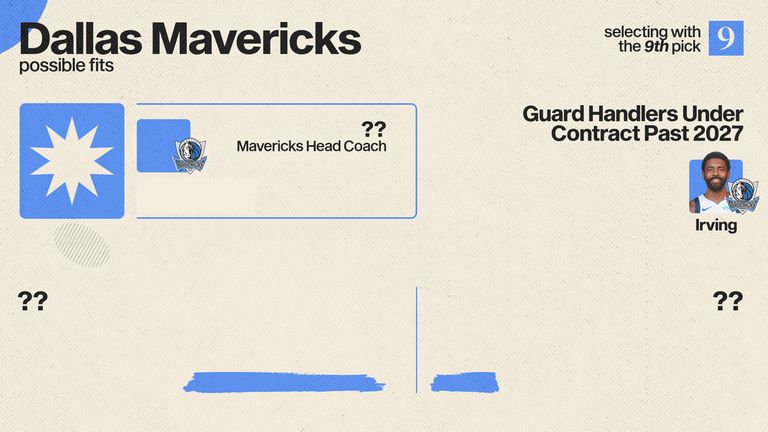
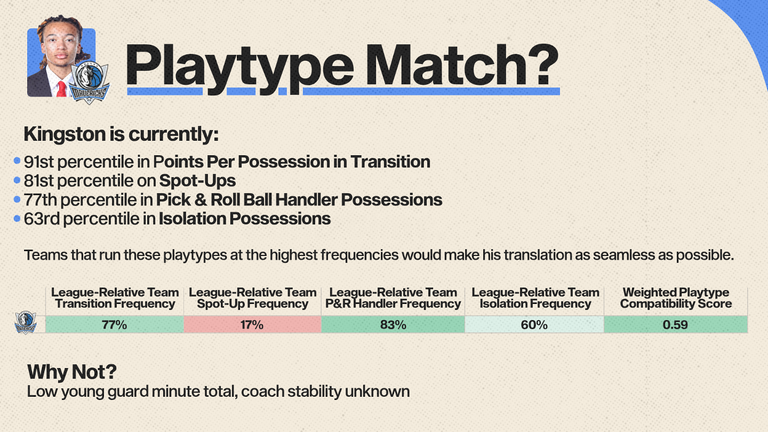
(2) Dallas Mavericks: 64 Compatibility Rating
*Editors note: Jason Kidd and the Mavericks "mutually agreed" to part ways on the 19th of May, as a part of a larger restructuring following Masai Ujiri's hiring.
Why Dallas?
The idea of Flemings completing the Texas Triangle to start his NBA career is enticing, especially with an aging Kyrie being the only true handler with enough talent to keep him off the court, but the personnel fit is much sketchier than the previous three teams. Where the Bulls are first in Moreyball frequency over the last two seasons, Dallas is 26th. Cooper Flagg's refusal to shoot three-pointers causes serious limitations to NBA offensive construction, and Flemings' diet is even more three-point averse than Flagg's was at Duke. If Dallas were to become a potential landing spot, it would make an immediate uptick in three-point volume that much more mandatory for NBA success.
The Mavericks ran the 4th most P&R per game, but ranked just 22nd in efficiency, in large part due to their high turnover rate.
The Case Against Dallas: Low young guard minute total, coach stability unknown.
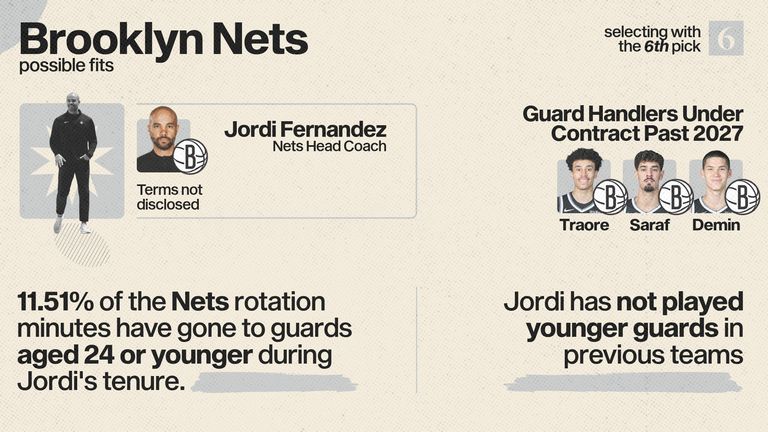
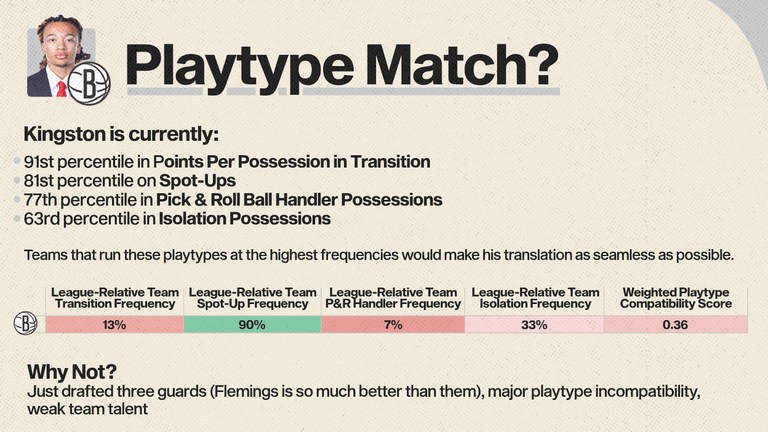
(3) Brooklyn Nets: 62 Compatibility Rating
Similar to Utah, Brooklyn is a very low frequency on-ball playtype environment.
The Nets ranked in the 97th%ile in Handoff frequency, the Nets frequently use handoffs to create opportunities for their guards to get downhill. Brooklyn often has their guards run 'Chase' action out of a variety of alignments.
The Case Against Brooklyn: Just drafted three guards (Flemings is a much stronger prospect), major playtype incompatibility, weak team talent
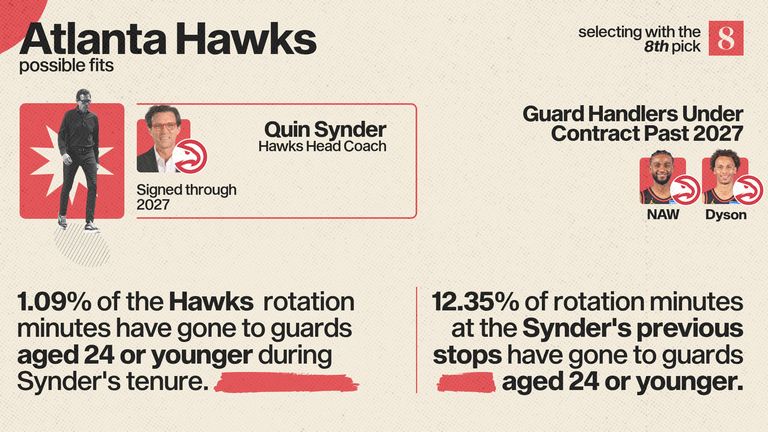
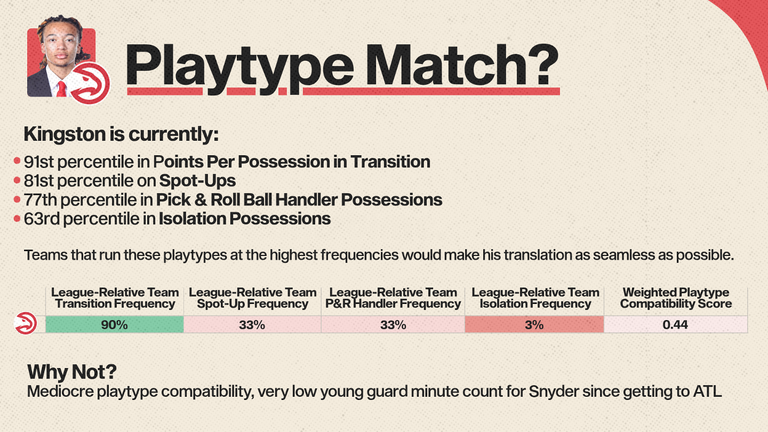
(4) Atlanta Hawks: 54 Compatibility Rating
Atlanta's half-court offense fell off a cliff in the postseason after punching above their weight in the regular season, highlighting an Achilles heel that Kingston Flemings could help support with his playmaking and downhill pressure.
The Hawks are the 2nd most assisted environment in the NBA and regularly play through their bigs, which results in Snyder asking their guards to double both as handlers out of movement and willing screeners. Atlanta runs Inverted PNR, typically with Jalen Johnson, nearly as often as they run traditional Spread PNR with a big. The Hawks' go-to set in the clutch, Inverted Spain PNR/Leak meshes well with Kingston's skillset.
The Case Against Atlanta: Mediocre playtype compatibility, very low young guard minute count for Snyder since getting to ATL. Offense has moved away from PNR in Trae's absence BUT Snyder has captained league-leading PNR frequency offenses at multiple stops.
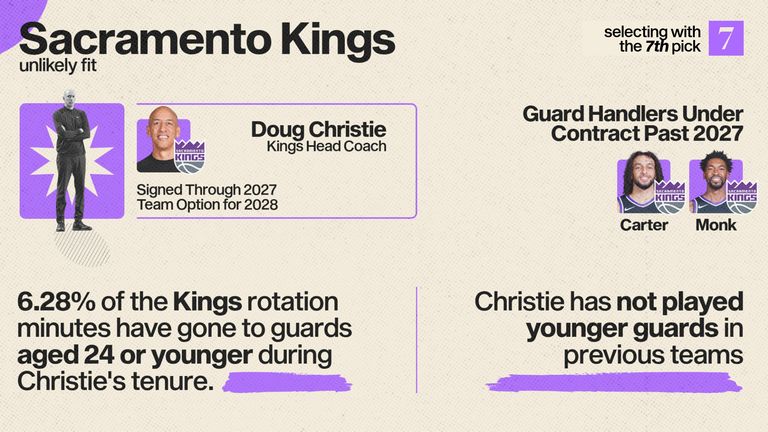
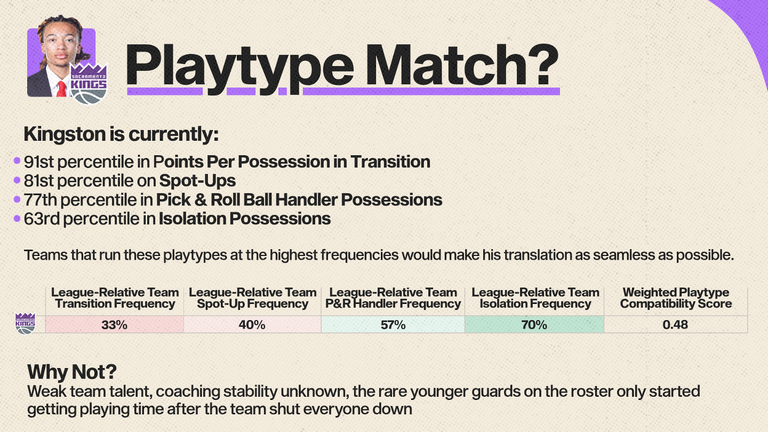
(5) Sacramento Kings: 53 Compatibility Rating
The Case Against Sacramento: Weak team talent, coaching stability unknown, the rare younger guards on the roster only started getting playing time after the team shut everyone down.
Unlikely Fits
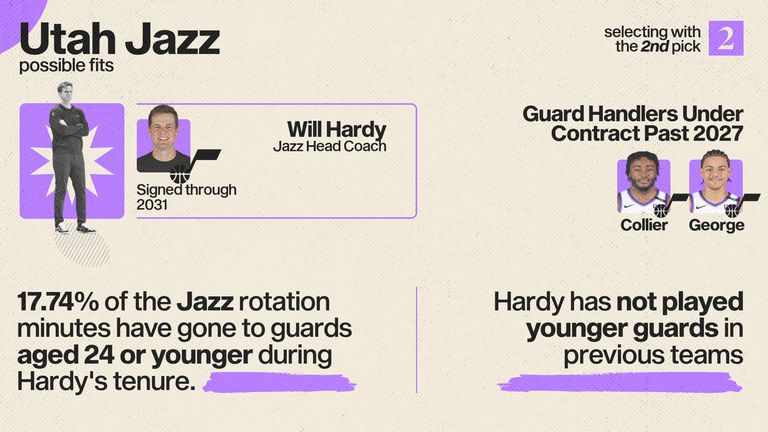
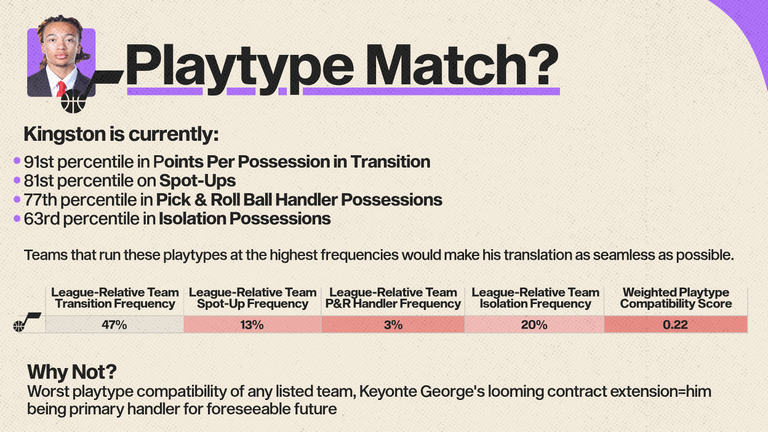
(1) Utah Jazz: 69 Compatibility Rating
Why Utah?
The transition from carrying a frontcourt as limited offensively as Chris Cenac Jr. and Joseph Tugler to that of Lauri Markkanen, Jaren Jackson Jr., and Walker Kessler would be as comfortable for Flemings as any other high-end playmaking prospect in recent history. Isaiah Collier's advanced metrics, namely, destructive lineup data, have been extremely weak up to this point in his career, and his audition as Will Hardy's primary handler of the future could come to an end as soon as Flemings arrives. My biggest fear is that a substantial Keyonte George contract extension would lead to him being forced into primary playmaking and handling duties, nullifying Flemings' fit a bit. Utah's playtype match is very weak AND Utah ranks 23rd in the league in Moreyball frequency (he would join George and JJJ as the highest frequency short midrange attempt trio in league history), but the most important developmental feature can be presented to a young player is minutes, and Hardy has proven very comfortable to play young handlers more than any other coach in the NBA.
Utah runs the least PNR in the league, typically asking their guards to create off the catch. This style of play has led to Utah leading the league in TO% for subsequent seasons while posting the worst turnover differential in NBA history.
The Case Against Utah: Worst playtype compatibility of any listed team, George's looming contract extension=him being primary handler for foreseeable future
(2) Memphis Grizzlies: 55 Compatibility Rating
The Case Against Memphis: With or without Morant next season, deep and talented guard room. New coach, hasn't played young guards so far. No isolation frequency.
The Final Matrix
Concluding Thoughts
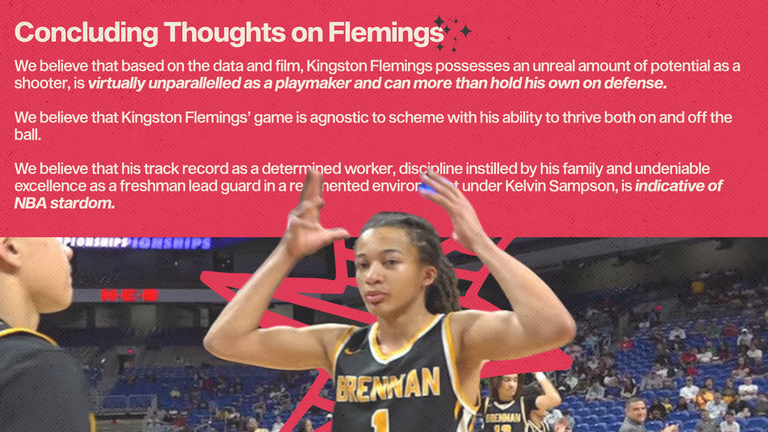
We believe that based on the data and film, Kingston Flemings possesses an unreal amount of potential as a shooter, is virtually unparalleled as a playmaker and can more than hold his own on defense.
We believe that Kingston Flemings’ game is agnostic to scheme with his ability to thrive both on and off the ball.
We believe that his track record as a determined worker, discipline instilled by his family and undeniable excellence as a freshman lead guard in a regimented environment under Kelvin Sampson, is indicative of extremely high level NBA impact.
↩among high-major D1 ballhandlers with at least a 25% usage
↩A low FTR accompanied by a heavy non-rim 2P shot diet can suggest an inability to get to the rim and/or a tendency to shy away from contact, 2 problematic indicators for on-ball hopefuls.
↩our custom metric to gauge how friendly of a finishing environment a college team presents
↩Offensive Load measures an individual player's contribution to a single possession, by expanding Usage Rating (USG%) to consider playmaking in a deeper sense. Here's what the formula looks like: Offensive Load: (Assists-(0.38*Box Creation))*0.75)+FGA+FTA*0.44+Box Creation+Turnovers Passer Rating
I’m a lifelong basketball enthusiast who blends film study and advanced analytics in my independent coverage of basketball and the NBA Draft across Tiktok, Twitter, Youtube, Substack and Instagram. I’ve also covered the Hawks for ~2 years as an accredited digital journalist for Afro News, and I am a member of the Atlanta Hawks’ Creators Collective.



Comments