Welcome to the 4th edition of my annual 30 teams in 30 days series, the most comprehensive and informative previews for every team in the NBA. Inside these posts, you’ll get up to speed with every team’s offseason additions and their roster hierarchies, learn whether they’ve addressed their biggest areas of need, ponder over 5 questions that will define their season and then decide whether you agree with my offseason grades and record predictions. For the first time, these articles will be exclusively posted on the Hardwood Collective AND paired with video deep-dives over on my Youtube!
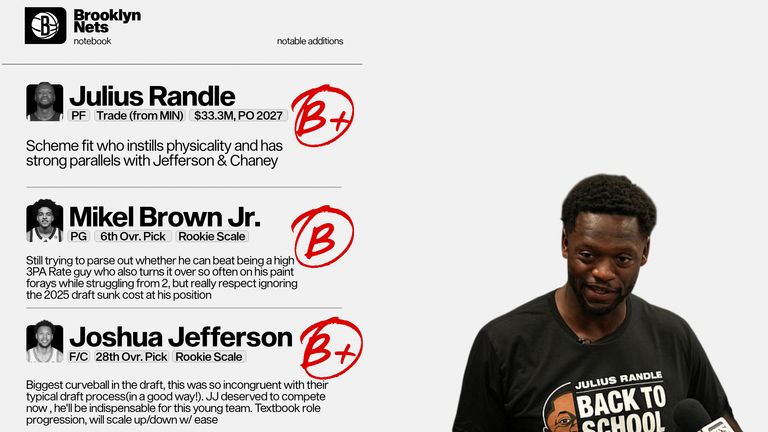
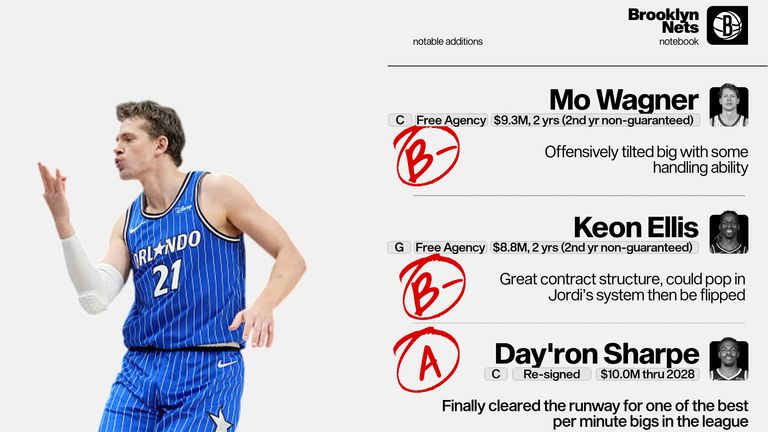
Notable Additions: Julius Randle, Mikel Brown Jr., Joshua Jefferson, Moe Wagner, Keon Ellis, Day'Ron Sharpe (re-signed), Josh Minott (re-signed), Tyler Bilodeau
Draft Pick Comps & Strengths + Weaknesses
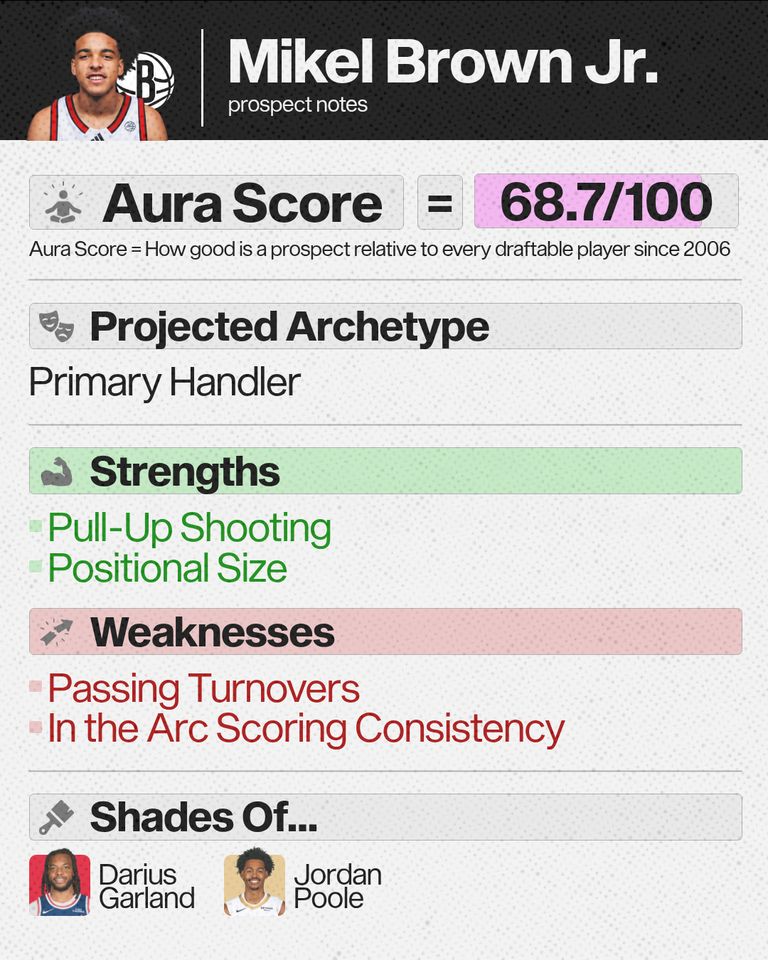
#6. Mikel Brown:
It’s relatively likely Brown is such a nuclear shooter that it doesn’t really matter that he's struggled so much as a 2P scorer, as a ~85% FT shooter on plenty of attempts in the last 2 years. My model isn't a fan of the inconsistency he displayed in the select few games he did play, as his playstyle is innately variable, prone to drastic swings in efficacy based on how his 3P shooting holds up and whether his teammates are able to salvage the 2-3 meatball subs he can tend to throw around haphazardly. Amidst all the chaos is the outline of a future offensive engine, pairing plus positional size with dynamic shooting and creative playmaking.
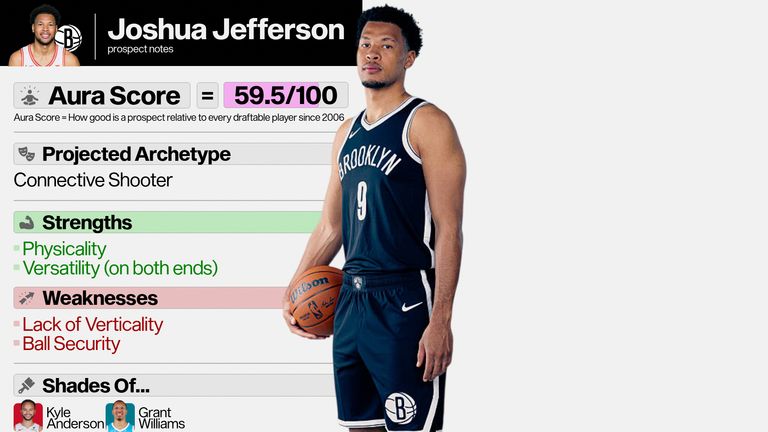
#28: Joshua Jefferson:
A peek into Jefferson’s year over year progression reveals a consistent trend of scalability, constantly adding & improving on different facets of his game. He grew as a 3P shooter every season, maintained his defensive impact even as he got tasked with more offensive responsibility and continued to feast on the glass. Prior to conference play, he had also made massive strides in his creation efficiency, only to fall victim once again to his vertical limitations. I am choosing to bet on his production, exponential improvement & excellent feel to transcend his biggest flaw in the league, where his offensive viability is highly dependent on whether the team that drafts him recognizes the gifted, yet conditional offensive player he is. Landing in BKN, with Jordi, might just be the perfect situation.
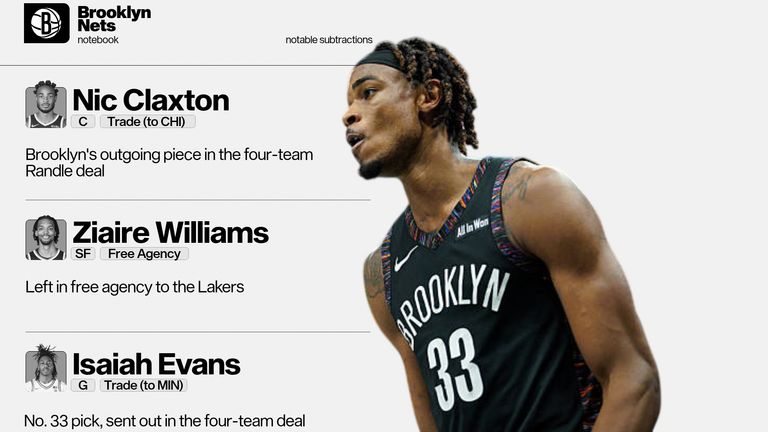
Notable Subtractions: Nic Claxton, Ziaire Williams, Malachi Smith
Depth Chart + Roster Hierarchy
Franchise — Mikel Brown Jr.; Egor Dëmin
Core — Michael Porter Jr., Julius Randle
Key Rotation — Day'Ron Sharpe, Moritz Wagner; Keon Ellis; Danny Wolf
Rotation — Terance Mann; Noah Clowney; Josh Minott, Chaney Johnson
Development — Joshua Jefferson; Tyler Bilodeau, Nolan Traoré; Drake Powell, Ben Saraf; Grant Nelson
Cap Sheet:
Offseason Overview:
The Nets have finished below .500 in each of the last 3 years and have progressively won less games over that span, so it may sound ridiculous for me to say this team has actually improved significantly over this same timeframe. There have been real signals of Brooklyn fostering a strong environment, ranking 6th in Inpredictable's Tension Index[1] in 2025 despite winning just 32% of their games, outperforming expected wins relative to their net rating by +4.2 (2nd) and +2.7 (7th) in 2025 and 2026 and establishing a record of juicing complimentary role players numbers, in a ploy to ultimately cash in on their improved value by acquiring draft equity. This is a strategy they ran to perfection with Mikal Bridges, Cam Johnson with MPJ well-positioned to be the next example.
With Jordi Fernandez leading the way, BKN has been building positive momentum in every fashion BESIDES their record, but all this progress was seriously jeopardized with how Sean Marks and the front office approached the 2025 draft. Marks opted to use all 5 of his 1st round draft picks, which prompted the following excerpt in my 2026 Nets preview:
In economics, the law of diminishing returns states that if you keep increasing one factor in the production of goods while keeping all other factors the same, you’ll reach a point beyond which additional increases will result in a progressive decline in output. In other words, adding a ton of talent in a single draft class can bottleneck the progression of prospects because their developmental pathways are exceedingly similar AND there are only so many minutes/touches available! This concept is why Brooklyn is the first team to ever use 5 picks in a single round, breaking the 2009 Timberwolves record of 4 first round picks (Rubio, Flynn, Lawson -> traded to DEN, and Ellington). The Timberwolves and Nets’ hauls share a couple of similarities beyond the size, as Brooklyn also selected multiple on-ball guards within the same class.
There was certainly a guiding principle behind their approach, as Marks wanted to add players who play 0.5 second basketball and they drafted 4 of the top 6 in the class in terms of assists per 36 minutes, but I had real concerns about each prospects' NBA viability. The lone bright spot from that haul was Egor Dёmin, who Jordi shifted off-ball to weaponize his movement shooting and playmaking ability on the wing, transforming him into one of the most lethal big shooters in the league. I have faith Fernandez would've identified Egor's optimal deployment even if he wasn't flanked by 3 other ball-dominant rookies, but perhaps this was the one benefit from over-indexing on players with the same strengths & weaknesses. My fears that Brooklyn would remain committed to the investments they made in the 2025 draft class was immediately massaged once the Mikel Brown & Joshua Jefferson selections were made.
Pre-Draft Areas of Need:
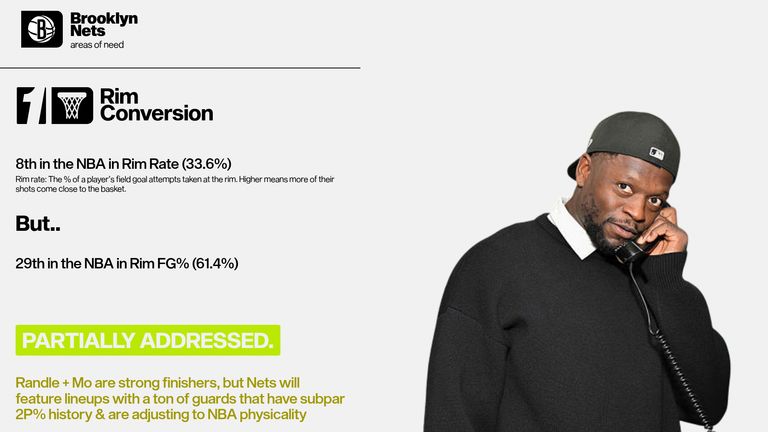
🥇 Rim Conversion:
8th in Rim Rate (33.6%), 29th in Rim FG% (61.4%)
Partially Addressed: Randle + Mo are strong finishers, but Nets will feature lineups with a ton of guards that have subpar 2P% history & are adjusting to NBA physicality
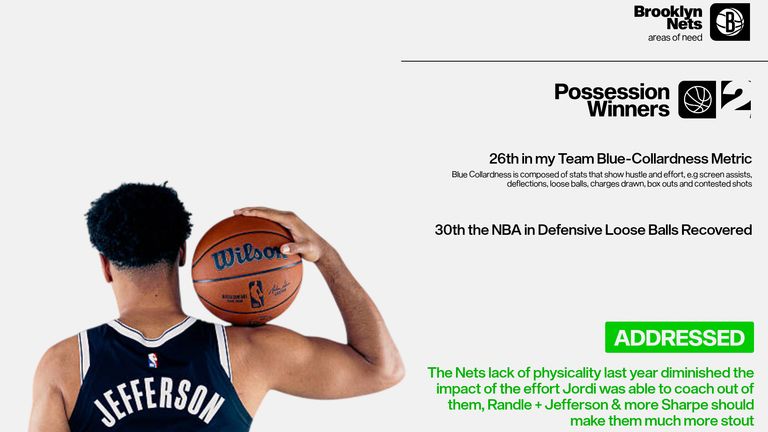
🥈 Possession Winners:
26th in my Team Blue-Collardness metric, 30th in defensive loose balls recovered
Addressed: The Nets lack of physicality last year diminished the impact of the effort Jordi was able to coach out of them, Randle + Jefferson & more Sharpe should make them much more stout
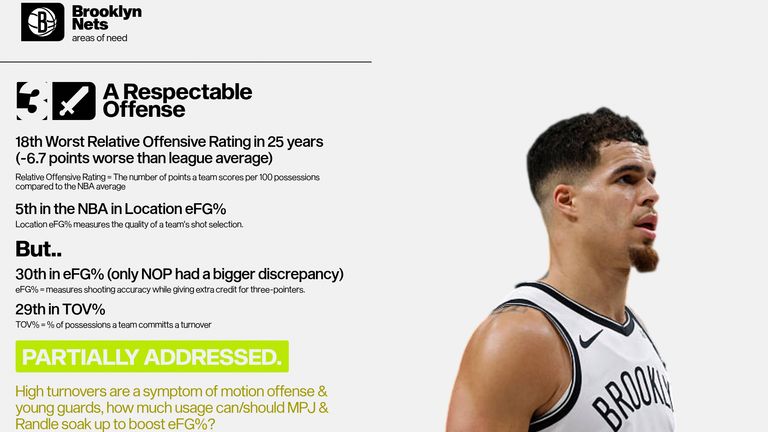
🥉 A Respectable Offense:
18th worst rORTG in 25 years (-6.7) points worse than league average, 5th in Loc eFG% but 30th in eFG% (only NOP had a bigger discrepancy), 29th in TOV%
Partially Addressed: high turnovers are a symptom of motion offense & young guards, how much usage can/should MPJ & Randle soak up to boost eFG%?
Season Outlook:
1) How aligned is the Nets’ draft/acquisition of players with Jordi’s system?
As I outlined in the Offseason Overview, there are a select few coaches in the league who can rival Jordi Fernandez's maximization of the pieces he's been given to work with. His extensive study on the observation of human behavior in pursuit of his Sports Psychology PhD, could be one explanation as to how Jordi has seemingly mastered the art of unlocking latent talent within his players. Additionally, a key feature of the system he's instilled in Brooklyn is how often they use their bigs in handoff & off-screen situations, leading the league in handoff frequency last year. This offensive style naturally simplifies the game for every player, which is how the Nets have remained an average shot quality team without a single above-average traditional shot creator.
If you squint, there's a hint of a coherent vision shaping the Nets' roster. They employ multiple large frame, stocky bigs & forwards who are strong screeners & willing passers and surround them with speedy, sleight framed high 3PA rate guards & wings. Using this collection of traits as a heuristic, we can see how well the Randle acquisition + the Nets' 2026 draft class align. Mikel is a seamless fit, projecting as easily matching Egor's 3P volume that he could potentially pair with a bit more OTD juice both as a driver and shooter. The move that really leads me to believe Jordi has the ear of the front office was their 2nd 1st round pick, Joshua Jefferson.
On the offensive end, I view Randle, Sharpe, Chaney & Jefferson as derivates of the same archetype. Each and every one is a bruising forward/big that wins with physicality but retained some semblance of passing feel, especially relative to their position. Julius has multiple years as one of the most prolific drive & kick players in the league, with the bulk to be a crushing screener & effective DHO hub, elements that Jefferson also demonstrated at Iowa State. Chaney & Sharpe lean on their motor, positioning and activity to win defensively, flashing the requisite feel to also serve as a fulcrum for the Nets' Horns/Slot offense.
2) Does the Mikel Brown pick indicate the Nets are “waving the white flag” on their PG roulette in the 2025 NBA draft?
Sunk cost fallacy is a plague among NBA draft decision makers, as GMs want to validate the decision making that guided their pick. There's an innate human element to this phenomenon, a desire to see a fruition of the massive efforts that go into researching a prospect and creating an environment for them to succeed within. Considering this team doesn't have much pressure to win besides the relegation zone and took so many bites at the apple in 2025, I had a slight worry that Brooklyn would continue to waste developmental assets in a flailing attempt to turn Saraf, Traore, Powell and Wolf into rotation players.
A typical draft class only produces 10ish rotation level players, thus Egor already trending positively in that direction is already a decent return on investment. Turning one more of the Flatbush Five into a viable player would be nice, but not at the cost of siphoning touches from Mikel Brown Jr. and Joshua Jefferson. Jordi's clear intention of utilizing the bigs to playmake also makes it a bit nonsensical to continue to platform Saraf and Traore on-ball to the extent they did last year, ranking in the 81st%ile and 86th%ile in percentage of minutes on-ball. BKN and UTA were the only teams to feature 2 players accounting for so much time on the ball, with BKN's pairing presenting a similar conclusion: How can a team justify centralizing that much decision-making into players with 2P scoring & turnover issues?
The overwhelmingly negative returns from this experiment are further compounded by a complete inability to play the 2 together, they overlapped for just 5% of their non low-leverage minutes and neither present the off-ball skillset to effectively operate off of one another. There are still points of intrigue with both, Saraf was surprisingly disruptive on defense and got to the line a decent amount, while Nolan's straight line speed could prove to be useful, but there isn't nearly enough to see a positive case for bottom 10th%ile efficiency and bottom 5th%ile ball security.
3) Is the world ready for Day’Ron Sharpe?
I was in media row for the Hawks' matchup vs the Nets , which gave me the utmost privilege of witnessing 17 glorious minutes and 24 seconds of Day'Ron Sharpe's play. Directly after an excellent defensive play to close the 1st, where he blitzed CJ after Powell let his matchup broke containment, pushed McCollum further up the floor and then executed a perfectly timed swipe down to steal the ball away from one of the NBA's best ballhandlers, I turned to a NBA scout (who wasn't affiliated with either team) and asked him for his thoughts on Day'Ron. I gushed over how special his combination of motor, feel & rebounding was for his size, but was surprised to find out that the scout wasn't nearly as moved as I was.
Sharpe has been one of the best per-minute bigs in the league for quite some time, popping up as a T100 player by RAPM in virtually any window you select. His skillset positions him well as a player who can dominate in stints, smashing the offensive glass and causing havoc on defense. He's consistently outperformed the Nets' other center options in terms of lineup data, though last season was the 1st where he cracked 1000 minutes played. His conditioning issues from his 1st couple years in the league seem to have been addressed and the 2-year commitment from Brooklyn, plus the uptick in his Potential Assist volume and the Claxton trade makes me confident the Nets are looking to evaluate his potential as a long-term piece.
The "per-minute" caveat in my sentence above is the biggest point the scout made in terms of tempering my evaluation of Sharpe. An uptick in minutes is a huge adjustment, especially for the most engaged defensive role on the floor. However, I'd argue that the instances we have historically of players popping in rate stats, lineup data and RAPM estimates in low minute seasons, then translating at least some of that impact over a bigger role is quite substantiative. Some recent examples include Ty Jerome, Robert Williams, Goga Bitadze, Luke Kornet, all players who played extremely sparingly their 1st couple years, dominated in stints and then scaled that impact to a larger role. There are of course players who saw the opposite result, such as Jordan McLaughlin, but I believe Sharpe's impact is far more sticky, since he wins on the glass more than anything.
If Brooklyn does ask him to guard at the level & switch at a high rate, which could increase how quickly he fatigues, I'd imagine a Randle + MPJ frontline can help relieve him of some of the defensive rebounding burden.
4) Which vet(s) are most likely to be flipped for “positive” value at the deadline? (Relative to each player/cost of acquisition)
The one challenge that may prevent the Nets from extracting as much value from MPJ that they did from Cam Johnson & Mikal Bridges is his contract situation. MPJ's contract expires this offseason and considering the Nets were unable to agree to terms with him before August 11th, it's highly likely they will be unable to extend him while retaining the right to trade him at the deadline. The projected length of the agreement + total dollars that MPJ is asking for would trigger a number of factors that would make him ineligible to be traded for 6 months.[2]
While we do see teams often trade for expiring contracts at the deadline, the issue is MPJ will be looking for a large payday that following season. If Brooklyn had been able to get him on a more palatable contract, then they could've demanded a stronger return from teams, but now the acquisition cost for MPJ is the salary matching, pick equity AND an extension. While I do think MPJ will still get moved, maybe BKN could get more relative to the cost of acquiring a player like Keon Ellis, who fits most rosters seamlessly and has a non-guaranteed year in the last year of his 2-year contract.
5) How likely is a Clowney extension? At what % of the cap?
Noah Clowney is the last remnant of the Nets' previous draft classes and is extension-eligible this season. There's been zero buzz about him potentially getting extended and the Nets have historically allowed guys in a similar situation to Clowney to make it to restricted free agency before offering a new contract. Clowney made real strides last year, particularly drawing free throws while maintaining a sky-high 62% 3-point attempt rate.
Outside of Garrison Mathews, the GOAT at drawing fouls on 3PA, Clowney is the most vetted example of this rare intersection of 90th%ile 3P and FT volume. The other seasons that crossed a .60 3PAr and .30 FTR were either #WashedKings such as Maxi Kleber and Kevin Love or diminutive point guards. Noah is unique in total minutes played, height and the fashion in which he generated these FT attempts, as one of just 8 players last season to account for 15% or more of their team's PF drawn on drives.
This an exceptionally fascinating niche set of skills that I'd absolutely want to see more of if I was the Nets, but there are a few problems. Noah is one of the worst 2P scorers in the league, a low passing volume, high TO rate kind of player and has yet to really knock down threes on volume at a league-average level. He also has some overlapping shortcomings with Wolf & Jefferson, especially as a vertical athlete, which manifests itself in a litany of ways. He and Wolf got blocked at the rim on 15% of their field goal attempts, a rate similar to what Jefferson experienced throughout his career. The lack of pop is also why all 3 guys are underwhelming scorers on roll-man possessions.
Considering just 1 of the 3 can potentially play the 5 (Jefferson), is it feasible for the Nets to invest in yet another frontcourt player who's not quite a big, has some wing-like qualities but finishes plays like they're 6'3? With this in mind, I'd recommend the Nets aim to offer a contract somewhere between what Jae'Sean Tate signed in 2024 (3Y/$20M w/ a Team Option, ~5.5% of the cap) or the deals Isaac Okoro/Josh Green signed after they were pushed to RFA (~7% to 9% of the cap). The team option would be a huge sticking point for me in negotiations.
Record Prediction
Combined Odds: 24.9 via multiple sportbooks
My Model Projection: 28.9 (26th out of 30), -4.4 Net Rating
Floor: 30-52 (+10 wins)
The Nets have consistently been one of the most competitive “rebuilding” teams in the NBA & their vet forward tandem projects favorably in terms of estimated wins added. They will be victims of the inconsistency & clutch mishaps that typify young teams with so many precocious guards, but I see MPJ, Randle & Sharpe holding it down enough to comfortably avoid being bottom 3.
Ceiling: 39-43 (+19 wins)
This ceiling is reflective of my belief in Jordy, particularly in his offensive system & ability to maximize effort. I think this team has enough to scare some other Eastern conference teams with playoff aspirations into thinking they could miss the play-in.
Overall Grade: B
Let me know if you agree with my predictions! What are your expectations for the Nets this season?
Up Next: Oklahoma City Thunder
Footnotes
↩Tension Index measures what % of game time stayed at a 50% win probability
↩any deal that's more than 3 years long and has a raise of more than 5% per season are typical triggers, MPJ is unlikely to sign anything less than 3 years
I’m a lifelong basketball enthusiast who blends film study and advanced analytics in my independent coverage of basketball and the NBA Draft across Tiktok, Twitter, Youtube, Substack and Instagram. I’ve also covered the Hawks for ~2 years as an accredited digital journalist for Afro News, and I am a member of the Atlanta Hawks’ Creators Collective.
-768x960.jpg)
-768x960.jpg)




Comments