30 teams, 30 days: Houston Rockets | 2027 Season Preview
Houston has unwavering faith in Fred properly placing KD in a role that minimizes his Achilles heel, while banking on their generational offensive rebounding advantage and cornucopia of athletic, young defenders to punch through the first round of the playoffs and hopefully, beyond.
Welcome to the 4th edition of my annual 30 teams in 30 days series, the most comprehensive and informative previews for every team in the NBA. Inside these posts, you’ll get up to speed with every team’s offseason additions and their roster hierarchies, learn whether they’ve addressed their biggest areas of need, ponder over 5 questions that will define their season and then decide whether you agree with my offseason grades and record predictions. For the first time, these articles will be exclusively posted on the Hardwood Collective and are paired with video deep-dives over on my Youtube and full-length podcast episodes over on The Fifth Factor!
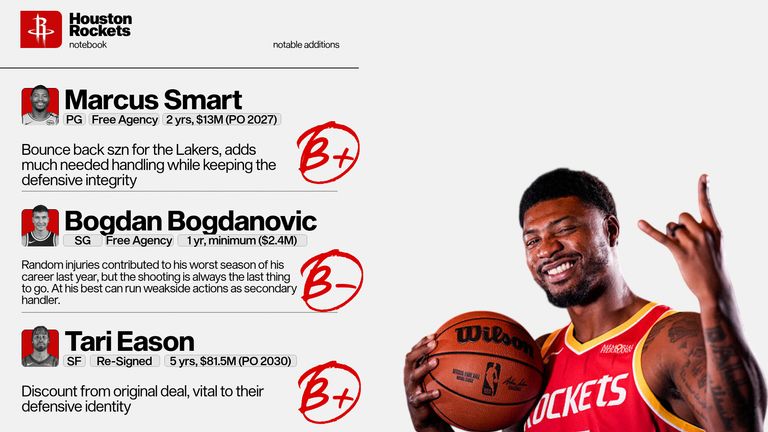
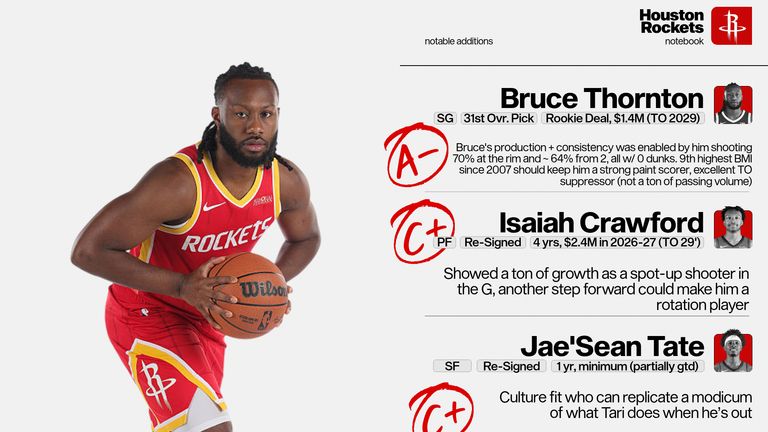
Notable Additions: Marcus Smart, Bogdan Bogdanovic, Tari Eason (re-signed), Bruce Thornton, Isaiah Crawford (re-signed), Jae'sean Tate (re-signed), Julian Phillips, Oscar Tshiebwe, Sean Pedulla, Quadir Copeland
Draft Pick Comps & Strengths + Weaknesses
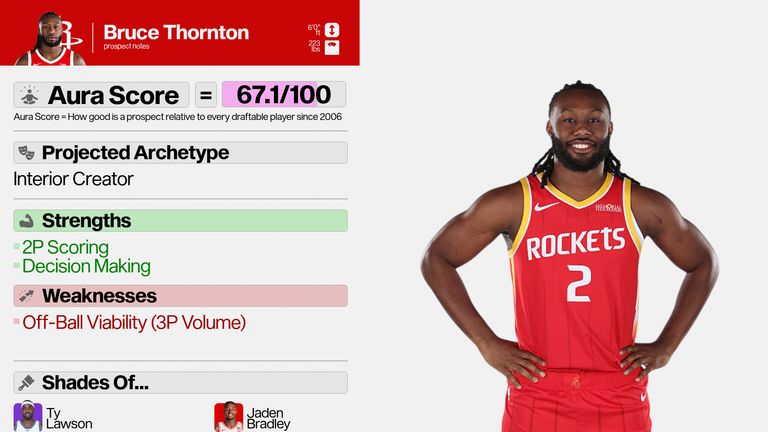
31) Bruce Thornton:
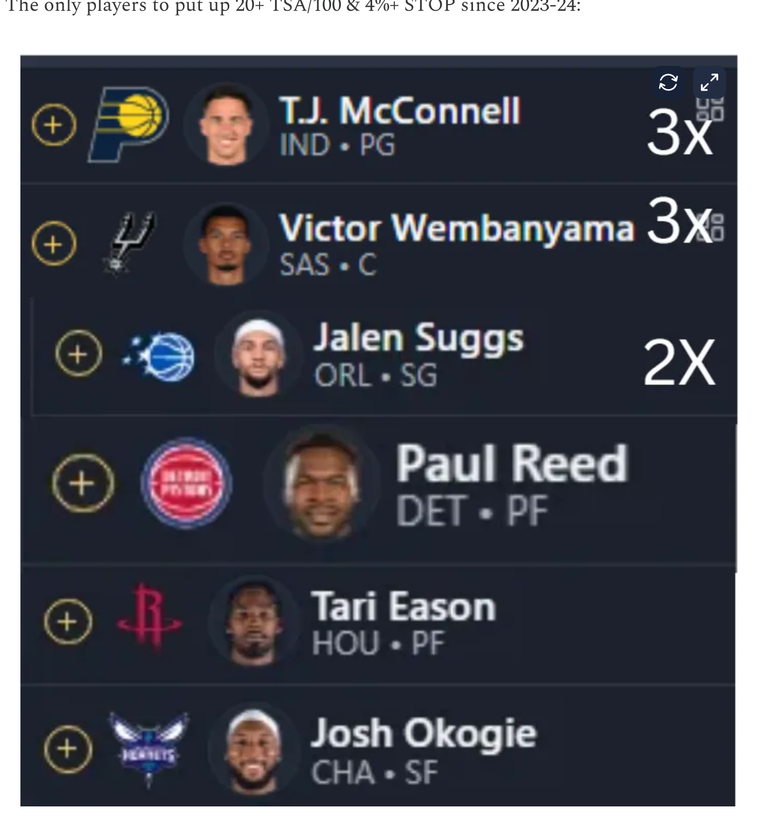
Despite measuring in at a mean 6 feet flat, Bruce Thornton shot a similar rim FG% in college as Trevon Brazile and Aday Mara. Crossing that 70 FG% threshold with 0 dunks is unprecedented for a prospect in this modern era and most examples of players being hyper-efficient with a similar lack of vertical pop were speedster variants (McConnell, Alvarado, Clark, etc.). Thornton's scoring dominance is attributed to his extreme weight advantage, ranking in the 97th%ile historically at his position and boasting a 30.24 BMI, the 2nd highest in recorded combine history for a player sub 6'2. His mass just completely negated defenders at times, driving them back several feet and shedding them when they attached themselves to his hips on a drive.
This is the same reason why he was a 90th%ile scorer in virtually every playtype possible, as Bruce has always demonstrated excellent touch (career 83% FT shooter on 500+ attempts, 55% on 2s, 38% from 3) and strong decision making, posting a career 10.7 turnover rate on one of the larger PNR shares in NCAA D1. This past season was the least time he spent running pick & rolls and he had a career year, translating that same efficacy as a handler into driving and operating out of handoffs more often. In many ways, Thornton has shades of what HOU has valued in Vanvleet for so long, the requisite frame and weight to function effectively as a defender within a team scheme, TO aversion while assuming a bulk of the handling responsibility, comfortability as a pull-up shooter and an ability to toggle on and off ball, plus he profiles as a potential option to flank Reed without creating a completely deficient defensive backcourt.
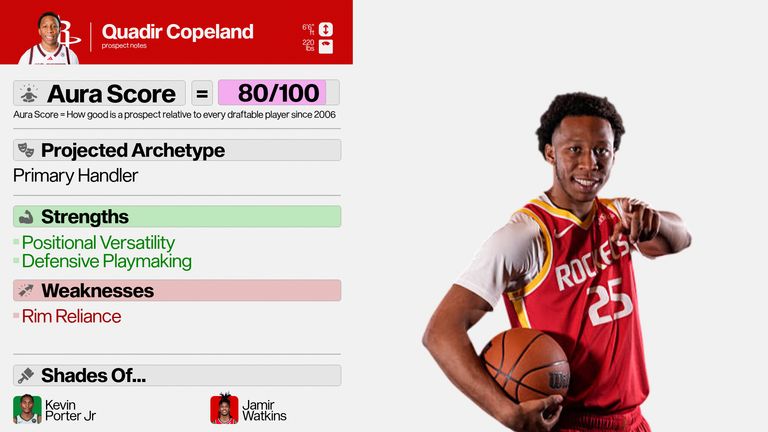
Undrafted: Quadir Copeland
The NBA Summer League is often many fans' first introduction to the league's newest faces and brightest hopes. It's a time of great optimism (or pessimism!) but mostly...uncertainty, overreactions & sweeping conclusions of a player's NBA viability based on a handful of games played in one of the most chaotic professional environments possible. Despite the variability and general clamor of SL, teams will use these games to experiment with gimmicks they wouldn't be able to get off in regular season play. Houston was one such team this summer, playing 73.4% of their minutes with 3 or more guards on the floor. If you happened to catch some of the Rockets' games, you may not have caught the fact that they were regularly trotting out 3-headed guard lineups because of how effectively Quadir Copeland masqueraded as a wing alongside Daishen Nix, Bruce Thornton and Tristen Newton.
I'm a big fan of "sleeper agent prospects", players who play a particular role that is so far from what their skillset/frame will allow them to play in the NBA all while building secondary skills that will allow them to translate successfully into an entirely different role in the league. Copeland ran a PNR on 33% of his offensive possessions this past year at NC State, despite attempting a 3 on just 13% of his PNR FGA. His form isn't quite conducive to pull-up FGA, so teams often relegated him to the "Ben Simmons treatment", sagging off 5-10 feet even while he brought the ball up. This is how he scored just 0.73 PPP on his PNR poss (39th%ile) with the 2nd highest PNR TO rate in the country (29.4%).
His PNR reps including passes however was an entirely different story, generating 1.03 PPP with 44% of his teammates' FGA coming from 3. Considering how he was covered, the only explanation is Quadir is one of the better slashers we've seen, finding solutions to create advantages for his teammates even while he was constantly getting gapped and seeing under coverages. His secondary skills were strong as well, putting up a .53 drive FTR, ranking as one of the best transition players in the league and converting efficiently on his opportunities as a cutter and out of spot-ups. A career 3.6 STL% should keep him viable Measuring in at 6'5 with a 6'11 wingspan confirmed that he could function as a wing with all the guard skills he's refined over the years, which I think will make him invaluable as a "third guard" for decades to come.
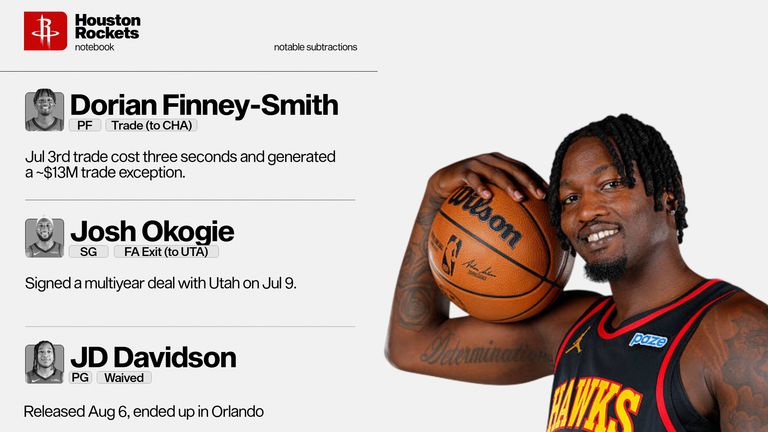
Notable Subtractions: Dorian Finney-Smith, Josh Okogie, J.D. Davison, Jeff Green, Aaron Holiday, Tristen Newton, Sean Pedulla
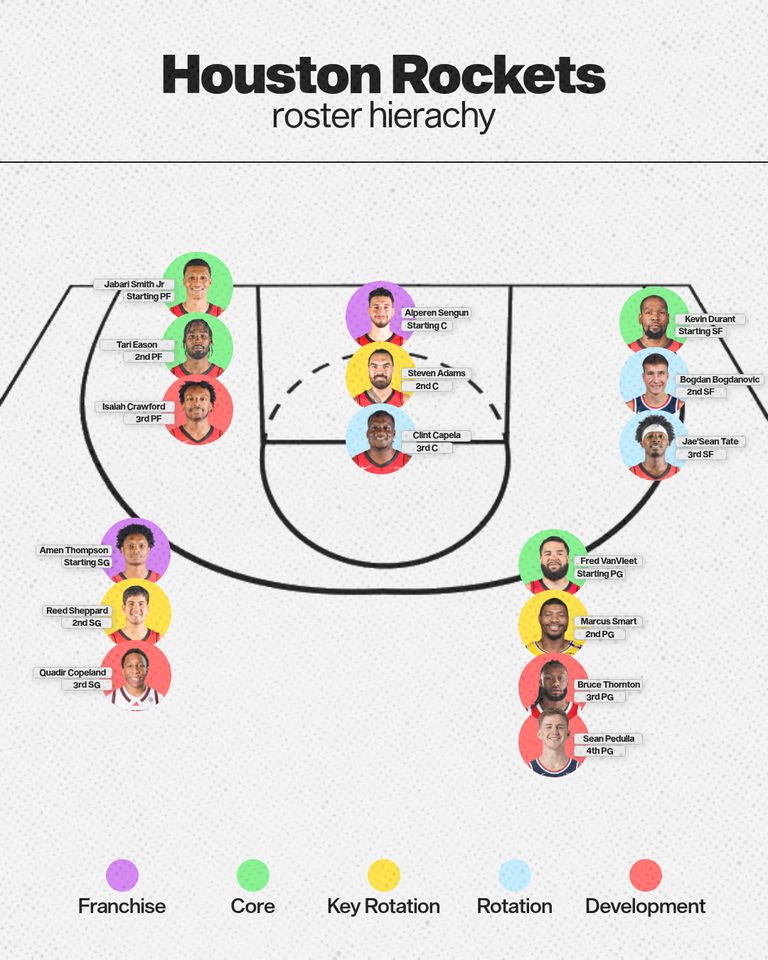
Depth Chart + Roster Hierarchy
Franchise — Alperen Sengun, Amen Thompson
Core — Fred VanVleet, Jabari Smith Jr., Tari Eason
Key Rotation — Steven Adams, Reed Sheppard, Marcus Smart
Development — Bruce Thornton, Isaiah Crawford, Quadir Copeland, Sean Pedulla
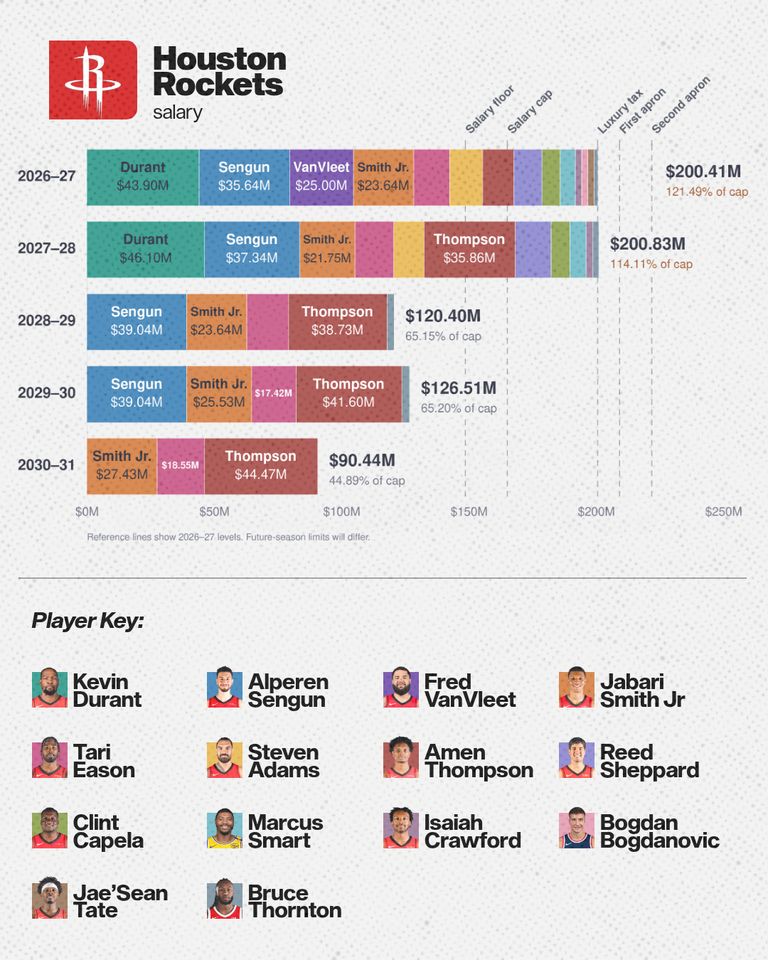
Cap Sheet
Offseason Overview:
Basketball teams tend to take on the personality of their superstar player. The Warriors have been T10 in 3-point attempt rate nearly every season that Steph Curry was healthy. The Denver Nuggets have led the league in post-up touches for 5 straight years. Luka Doncic-led teams are typically, at minimum, top-3 in Isolation volume per game. It's been a decade since a team with Giannis at the helm was NOT a top-10 rim FG% team. Last season, with Kevin Durant as their offensive fulcrum, the Houston Rockets turned the ball over on 15.7% of their possessions, the 28th highest rate in the league and a stark contrast to the 13.8% (8th) and 12.7% (6th) they finished the prior 2 seasons with.
That's not to say that the Rockets' inability to take care of the ball was solely attributable to their addition of KD, as this team went a whole season without having Fred Vanvleet, the biggest driving force of that stellar TO rate in the previous 2 years. Additionally, Durant inherited a roster that was worst in the league in TO rate before Vanvleet arrived that had just 5 players post an above average TO rate relative to their position this season. These 5 players combined to account for ~ 35% of HOU's total minutes played with an average 10.03 AST%, which means that not only did they play a small portion of the minutes, they also didn't carry a meaningful passing load. This was a less than ideal situation for Durant to operate in, which lead to his fatal flaw being exacerbated to potentially the starkest degree of his career, cursing the Rockets to struggle through blunders and self-sabotage in high-leverage moments.
Kevin Durant is an exceedingly unique talent among NBA players in general, though he also has peculiarities that distinguish him from his midrange maestro counterparts. As a 7-foot wing with a devotion to efficiency, KD is an outlier among high-volume midrange FGA guys since he doesn't like to empty the clip + his handle/playstyle/TO issues limits his ability to get high 3PA volume, which ultimately inhibits his ability to limit turnovers for his team, a footprint we usually see from players with his shot profile. This led to Houston ranking as 1 of 6 teams above .500 to have a LOSING clutch record who turned the ball over at the HIGHEST rate in the clutch (13.7 TO%), plus KD tying his career-low in true shooting attempts, posting a 15th% 3-point attempt rate and suffering his worst lost-ball TOV% in a decade.
The Houston Rockets’ recent struggles are reflective of their inheritance of Kevin Durant’s fatal flaw
1 of 3 teams above .500 with a losing clutch record 2nd most TO prone team in the clutch KD is at a career-low 26.3 TSA/100, worst non-pass TOV% since ‘14 and is 15th% in 3PAr https://t.co/8dDMbAqzWUpic.twitter.com/EnlmXXyDBm
These struggles made it evident that to the TO issues would handicap them in the playoffs, even against a middling defensive playmaking opponent in the Lakers. KD was only appeal to appear in 1 game, turning the ball over 9 times, in a Game 2 loss that ended up being Houston's highest turnover rate in the series. At this point in his career, Durant is best deployed as an off-ball scorer first, not the near-primary handler Houston needed him to function as. The organization has unwavering faith in Vanvleet resetting that offensive hierarchy, properly placing KD in a role that minimizes his Achilles heel, while leaning on their generational offensive rebounding advantage and treasure trove of athletic, young defenders to punch through the first round of the playoffs and hopefully, beyond.
Pre-Draft Areas of Need:
🥇 Halfcourt Juice: 0.96 PPP (26th), 2nd most “Short Clock” possessions per game (15.6)
Partially Addressed: Vanvleet will help HOU be more decisive in the HC, but they need internal dev & a more creative scheme to be more effective
🥈 Rim Pressure: 27th in Layups Per Game, 26th in Cut PPP (1.26)
Partially Addressed: As one of the few pull-up shooters on the ream, Fred will likely decrease rim volume while on the floor especially coming off a torn ACL, though his passing should generate higher quality looks overall. The improved spacing could open up more lanes for Amen/Tari/Sengun, etc.
🥉 Pace: 29th in Transition Frequency, 5th in PPP
Addressed: Vanvleet & Smart both have positive transition influence footprints, need to get their athletes out on the run more frequently
Season Outlook:
1) How vital is Reed Sheppard to this team’s ceiling?
In the moments following the Hawks selection of Zaccharie Risacher #1 overall, there was a report released stating that the Hawks viewed Reed Sheppard as a "Patrick Mahomes level prospect" and legitimately considered selecting him due to a belief in his potential to be one of the best shooters in the NBA.
Listen to this… The Atlanta Hawks viewed Reed Sheppard as a “Patrick Mahomes” type of prospect but had him 2nd on their board.
We can think of NBA success as a function, with skill & athleticism as the X & Y axis. Players CAN be so dominant athletically that they can succeed without being overwhelmingly skillful (and vice versa), but the most viable path to sustainable impact is the marrying of skill & athleticism, a concept we can refer to as applied athleticism. However, athleticism in a basketball sense encompasses so many different interactions on a basketball court, that excellence in one aspect rarely supersedes deficiencies elsewhere. For instance, Reed Sheppard’s 96th%ile 42-inch vert was one of the biggest headlines in the 2024 draft combine, though he dunked just 0.4% of his halfcourt FGA this past season (11th%ile) and shot 48.3% at the rim (3rd%ile).
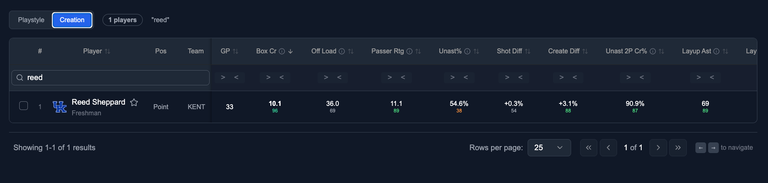
Houston’s spacing (or lack thereof) is certainly a factor, but Sheppard’s 36th%ile weight (182 lbs), 22nd%ile wingspan (6’3.5”) & 10th%ile wingspan - height differential (+1.5) are just as relevant, as well as his collegiate priors: 14th%ile in offensive rebounds per 40, 32nd%ile in FTA/40 and a pretty middling TO rate relative to how low-usage (36 Offensive load, 69th%ile) and assisted he was (only 54.6% of his buckets were unassisted, 38th%ile). This is evident when comparing Reed’s rim struggles with another short guard, whose pre-draft max vert was just 5 inches shorter than Sheppard, Jalen Brunson. JB’s wingspan isn’t meaningfully longer than Reed, he didn’t test faster & Reed is an inch taller, yet Brunson is one of the most dominant paint scorers in the league, ranking in the 99th%ile in volume, 95th%ile in self-created paint buckets & 73rd% in scoring efficiency. The biggest difference is Brunson’s weight, a full 10lbs over what Reed measured pre-draft, in conjunction with JB’s superior scoring craft, handle, footwork and foul-drawing capability, plus his shamelessness getting shots up, skills that are unlocked & accentuated by his outlier mass relative to his position.
In addition to his slight frame, Reed's struggles with physicality have been exacerbated by his relatively weak handle and inability to create separation without a screen. He defaults to trying to put as much space as possible between him and a mismatch before attacking, which has led to mixed results as a self-creator. HOU desperately needed him to function as a release valve for their collection of non-shooting creators, often asking him to be the only real shooting threat in lineups, a tough task for a player who only attempted 25% of his 3PA in college off the dribble. His struggles need to be contextualized with the Rockets asking Reed to perform in an environment that is so distinctly different than what he thrived in at Kentucky, with the 2024 Wildcats ranking 13th in Pace, 75th in Assist Rate and finished the season as the best 3P shooting team in the country. Over the last 2 years of Sheppard's NBA career, HOU has ranked 28th in Assist Rate, 29th in Moreyball% and got out in transition just 13.6% of the time in 2026, the 2nd lowest fast break frequency in the league.
Zaccharie Risacher is joining one of the roughest developmental environments for his play-finisher skillset in the NBA
Dallas is one of just 2 teams with a bottom 10 rank in AST% (60.6), Moreyball% (65.2), Spot-Up Frequency (21.9%) & Spot-Up PPP (1.01) in the last 2 years! https://t.co/ScQ9uhoL0Ypic.twitter.com/U1xxe4wq40
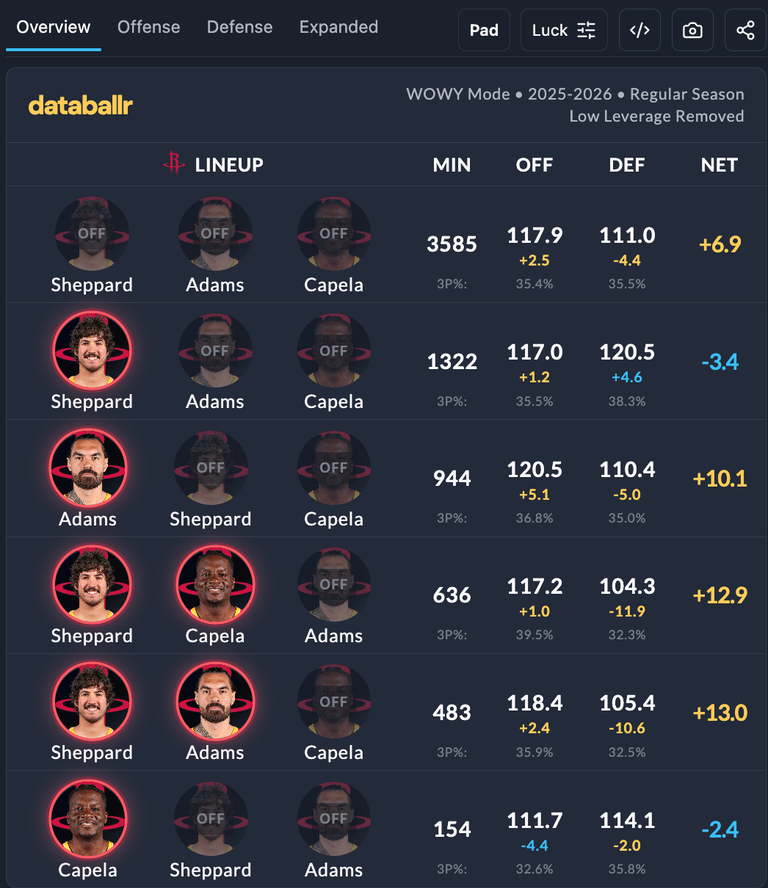
The scheme incongruence is nearly as debilitating as the overlapping anti-synergies that Reed and Sengun bring out of one another when they're on the floor together. I view both of them as neutral to positive team defenders, due to Reed's disruptiveness and Sengun's mobility and use of verticality to wall off the rim, but it gets spooky when they're asked to guard pick & rolls as a tandem. Sheppard has a tendency to get screened off and defend as a trailer, which works when he can use his excellent hands to poke at the ball and funnel guys into a drop coverage big, but Alperen isn't at his best as a retreating PNR defender due to an inability to defend vertical space and recover if he gets drawn to the handler. This is a big reason why the defense falls apart when they share the floor, with the Rockets allowing 1.013 PPP in the Halfcourt with them both on the floor, but they can defend just fine with Reed WITHOUT Sengun, allowing just 0.9 PPP in those situations, improving their PNR defense from 53 eFG% to just 42.7 eFG%.
Offensively, Sengun's preference to catch and face up out of PNR doesn't mesh cleanly with Reed's rim aversion, with their lineups attempting middies 5% more frequently than league average. Aside from that quirk, Reed's presence seems to really allow Alpi to finish more efficiently at the rim, with the added spacing enabling Sengun to convert on his post-ups at a 1.05 PPP clip, improving sharply on the .912 PPP he posted without Reed. At a glance, Reed appears to benefit Alperen to a degree that Sengun doesn't quite return, considering how much more productive and efficient Reed is without him, but the boost in assist rate with Alperen and increased rim FG% are positive influences that get diminished by Reed shooting 11% worse on pull-up 3s with Alpi on. This could be reflective of Capela and Adams' superior screening talent and roll gravity creating larger windows for Reed to operate, so it's worth monitoring whether Sheppard remains more effective with a traditional big to operate alongside.
This dilemma Houston manufactured may be alleviated this year with Fred's return, as Reed played the majority of his minutes last year with Amen as the only other guard-adjacent handler. Marcus Smart & Bogdan Bogdanovic are pluses in this aspect as well and their younger guards in the developmental pipeline could further bolster the handling infrastructure in the future. The high-end, on-ball dynamo dynamic shooter outcome the Hawks envisioned in the draft process was audacious considering the realities of Reed's profile, but he's still one of the premier prospects in recent memory who should thrive as Houston better approximates the infrastructure that made him a player worthy of a top-3 pick.
Are the Rockets the best negotiating FO in the league? Are they consistently drafting players who are just sub-max contract level?
2) Can HOU find an alternative for their double big lineups when Steve-O is resting?
The Rockets bench posted a +1.0 net rating with their bench on the floor in 2026, the 8th best margin in the league. When Adams was healthy, their bench snagged a ludicrous 40% of their misses and 70% of opponent's misses, controlling the glass better than any team in the league by leaps and bounds. The Rockets are still at their best with Steve-O's generational ability to vacuum up their misses, with him appearing in 3 of their top 5 2-man duos over the last few years. This is slightly problematic, as Adams has played just 90 games over the last 2 years for a TOTAL of 1500 or so minutes. While verticality already wasn't a massive part of his game, he'll be 33 this season and his minutes will be managed once again.
Amen, Tari and Jabari is the foundation of the lineup I'd turn to when double big isn't a feasible option, as those 3 have yielded pretty strong results over the years, provided one of Sengun and/or KD was on the court to solidify the offensive floor. Their minutes without Sengun WITH KD were extremely turnover prone, but Durant was able to shoot just well enough to push an average ORTG. Once KD and Alpi came OFF the floor though, this was a 1st %ile offense that took on all the worst characteristics of Thompson, Eason and Smith II: being careless with the ball, not getting to the FT line and missing everything they shot. The one thing they could do, even without Sengun and Adams, was get on the offensive glass. I think this warrants tasking Reed and Bogdanovic to just get up as many 3s as possible and/or embracing the chaos by running Marcus Smart alongside the triplets with Jabari at the 5.
The reality is that there isn't really an ideal solution currently on the roster that can replace what Steven Adams does to legitimize their offense, so I think their best bet is to try and force as many turnovers as possible in a ploy to play almost exclusively in transition, while leaning on their crashing ability to clean up what will almost surely be low quality FGA. I do feel the need to draw attention to the talent that is Oscar Tshiebwe, one of the NCAA's greatest offensive rebounders whose superpower has translated its' way to the NBA in limited minutes. This team getting him on a 2-way was exhilarating, as he's finally on a team that truly values offensive rebounding and I think there's more than a good chance that he earns a rest of season contract and supersedes Capela as the backup center. His ascension would solve a decent amount of the bench minutes in Adams' inevitable absences.
Oscar Tshiebwe is the only player since 2007 to have 2 NCAA seasons adding 100+ points on offensive rebounds + graded out as one of the highest feel prospects ever at his position
3) Which of their wings is best poised to make an offensive leap relative to their current baseline? (Tari/Bari/Amen)
Amen Thompson is head and shoulders above the Rockets' other wings as an offensive player, though I'd argue the improvement that he needs to make in order to meaningfully graduate from fringe 90th%ile offensive player to a near 95th%ile offensive player is one of the hardest leaps to make. It's incredible that a player with a .02 pull-up 3P rate out of PNR was able to sustain 80th%ile creation volume at plus efficiency, though that lack of dynamic shooting is exactly why Amen was much better operating in isolation than he was as a handler. Continuing to find ways to get to a floater (he shot 54.4% on 90 attempts)and improving his layup timing would benefit him a ton, as teams will concede the middle of the floor to him via drop coverage. He's too gifted to be shooting sub 50% on layups (has regressed every year), this his inefficiency is likely a product of being on-ball too much without Fred. His freakish athleticism allowed him to dunk 33% of his rim attempts, enabling him to convert 64% of his rim FGA even while struggling so much on layups, which does open up a path to, somewhat counterintuitively, making an offensive leap by finishing plays more often. The experience on-ball should have refined his decision-making, allowing him to be even more dangerous on the short roll.
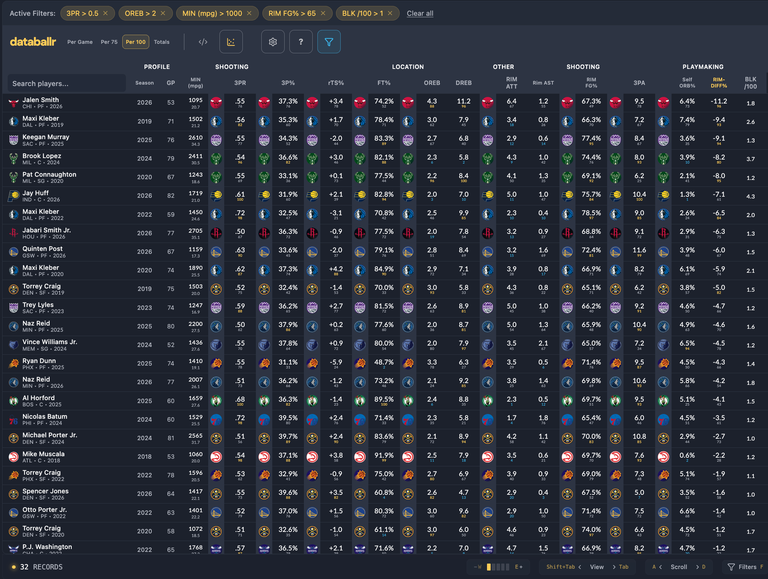
Jabari has downscaled from his NCAA career more than any other drafted HOU prospect still on the roster, going from a 27.5 creation frequency at Auburn to spacing and finishing plays accounting for ~85% of his true shot attempts at Houston. There are still the occasional moments where the off the bounce game he utilized at AUB rears its' head as he attacks closeouts, but even moreso than Amen, Smith II's path to being a much more impactful offensive player comes with embracing his role. He's already done that to be fair, upping his 3-point rate year after year and improving as a finisher even with his roll man possessions dwindling. If he can convert at a near 70% at the rim, he would reach the legendary complementary wing with the junior abbreviation that plays a consequential role on a champion, with a profile resembling Michael Porter Jr. and Otto Porter Jr.
Tari's case is much more specific. Through February 1st of last season, he was shooting 49.1% on 4.2 catch & shoot 3s per game. He then got hit with one of the meanest regressions I can remember, shooting just 26.1% off the catch for the rest of the season, including a near 3-week stretch in March where he made just one of his twenty-eight 3-point attempts. Eason was never going to sustain 49% from 3, though that dramatic of a crash leading to him hovering around 35% for the 4th consecutive year really dampened what felt like a true improvement. He's their best non-big offensive rebounder and so overwhelmingly disruptive that he does push above-average offensive impact in the non-traditional sense, but he's got to build confidence in his shot so he doesn't get himself in trouble off the dribble, where his turnover rate becomes so much more problematic. He already has the audaciousness to get shots up, as one of the few players to be this disruptive while emptying the clip, which is a step many defensive-first players never surpass, a distinction that could separate him from being a specialist and turn him into the quintessential wing he's destined to be, We already saw the hot 3P shooting streak bear fruit in reducing his turnovers in spot-up situations (halved it from 2025, 8% to 4%), but his overall TO rate didn't improve because of some boneheaded turnovers in transition. Cleaning those up would be massive in improving his offensive game.
4) Could they extend KD and/or Fred?
Of the two, I envision Houston prioritizing extending Fred than they do Durant, even if they don't have the immediate successor(s) in place for KD's skillset. Houston does have players whose potential growth into Vanvleet's role would be massive, but he's still so important to what they do on both ends and Reed's on-ball viability is still an open question. They demonstrated commitment to him last season when they didn't add a guard at the deadline, which is reflective of how rare they think his skillset is and by extension, indicative of how much they believe in him being the right guard to shepherd their young core for a few more seasons.
I'd imagine their decision regarding Durant will be reserved until they have a sample with him playing in the role they visualized when trading for him. Even at 37, Durant finished T10 in Points added on Isos, Spot-Ups and Handoffs (and T30 in P&R and Transition), all while finishing out of the T50 in avg sec and dribbles per touch, emphasizing how effective he can be functioning as a decisive play finisher as he ages. The twilight years of Durant's career should feature a steady diet of pindowns and zipper screens to generate a modicum of separation for him to shoot over desperate contests, releasing the pressure to create that advantage with his increasingly shaky handle. Houston has the infrastructure to enable that, the defensive personnel to cover up some of his missteps and a PG who can deliver those passes into his shooting pocket, so it'll come down to how much Durant believes in what they're building and how gracefully he ages. They do say shooting is always the last thing to go, and there isn't a team who needs that more than the Rockets.
5) Is this offense maximized when Sengun leads the team in creation volume? (As he did last year) If not, where should he be in the offensive hierarchy for his best success?
As we discussed in the overview, the Reed question and the Amen/Tari/Bari question, this team has a lot of question marks regarding on-ball creation ability. Kevin Durant is in love with turning the ball over. Amen, Bari and Tari are either non-existent or streaky shooters. Reed Sheppard has immense trouble dealing with physicality and needs to 2k cheese his way past centers in iso. Marcus Smart is 32. Bogdan Bogdanovic is 34. Fred Vanvleet tore multiple ligaments in his knee at 31 years old.
By default almost, Alperen Sengun is this teams' lead creator for the foreseeable future. In 2025, the average Sengun Iso/Post-Up yielded better results than his reps as a roller, cutter or on tip-ins, which I think spoke to his comfortability dictating when he would be in position to attempt a shot. As a ground-bound big with a ton of creative flair, Alpi has been at his best as a finisher when he can carve out space on the move or with pumpfakes before releasing the ball. His push shot also returned in 2026 and he found ways to not get blocked on it as constantly as he had in years prior. Sengun's career-high rim FG% coming the year he was 99th%ile in creation TSA is directly correlated, just like how his rim FG% improving with Reed on the floor is inextricably linked.
In an ideal world, the optimal playtype distribution for Alpi is likely closer to 2024, with about 30% of his TSA coming out of Isos/Post-Ups/Inverted & 5/4 PNR, but until this team is better constructed to enable him to be a more efficient finisher, he's going to need to carry a higher creation burden.
Record Prediction
Combined Odds: 46.8 via multiple sportbooks
My Model Projection: 53.9 (4th of 30), +5.60 Net Rating, 89% playoff odds
Floor: 51-31 (-1 win)
Orlando, 2024 Miami & the 2023 Bulls are the only T5 defenses in the last 5 years to NOT win 50+ games (CHI would’ve if Lonzo was healthy) and this Rockets team has far more offensive talent, will still be generationally dominant on the glass and should be one of the five best defenses in the league once more with Smart in the fold.
Ceiling: 59-23 (+7 wins)
My model is expecting even more defensive output from Amen Thompson with Fred returning to run the show and sees Marcus Smart bringing a ton of defensive impact as well. I’m in agreement, as I believe this team will be just as strong defensively with a much more reasonable offensive hierarchy. Offensive growth from Reed, a healthy Steve-O year and/or a bounce back year from Bogdan could even push them past 60 wins.
Overall Grade: B+, I had gripes about them not adding another guard last year at the deadline, but maybe that was due to how much faith they have in both Fred and Reed. I’m extremely excited about their pickups in the draft and Vanvleet’s return.
Let me know if you agree with my predictions! What are your expectations for the Rockets this season?
I’m a lifelong basketball enthusiast who blends film study and advanced analytics in my independent coverage of basketball and the NBA Draft across Tiktok, Twitter, Youtube, Substack and Instagram. I’ve also covered the Hawks for ~2 years as an accredited digital journalist for Afro News, and I am a member of the Atlanta Hawks’ Creators Collective.









Comments